
Nursing is not a static profession. It never has been.
Every generation of nurses has inherited a profession shaped by the forces of its era — the social movements that expanded nursing’s scope, the technological advances that transformed clinical practice, the policy battles that defined nursing’s legal authority, and the workforce crises that tested nursing’s resilience. Every generation of nurses has also been called to shape what nursing becomes next — through advocacy, leadership, education, and the courageous willingness to engage with the issues that determine the profession’s future.
Understanding those issues — where they come from, what they mean for clinical practice, and where nursing is headed — is not an academic exercise removed from bedside care. It is the professional literacy that distinguishes nurses who participate in their profession from nurses who merely work within it.
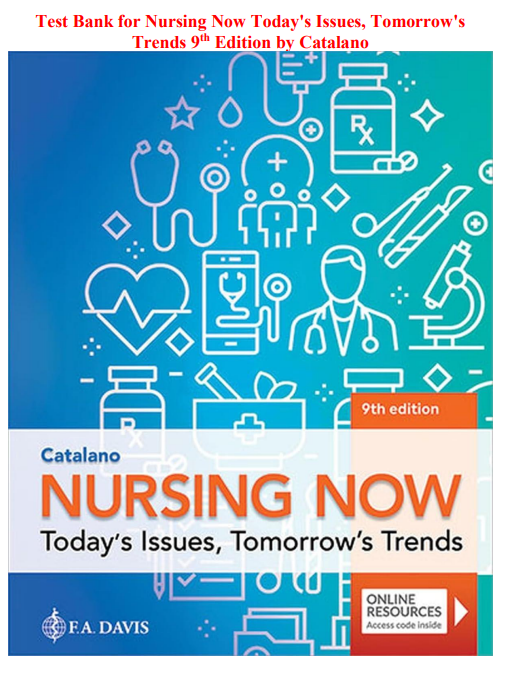
This comprehensive test bank is built for the 9th Edition of Nursing Now: Today’s Issues, Tomorrow’s Trends by Catalano. It is one of the most widely used and most intellectually engaging professional nursing issues textbooks in undergraduate and graduate nursing education — covering the contemporary challenges, emerging trends, and future directions of nursing practice with the depth and rigor that professional nursing education demands.
This test bank helps you master every chapter with the focused, issues-based, professionally grounded practice that Catalano’s framework demands — and that the NCLEX management of care questions test throughout the examination.
Whether you are preparing for a nursing issues or professional trends course exam, an RN-to-BSN professional nursing assessment, or building the professional identity that sustains a nursing career through change and complexity, this resource delivers the professional reasoning, ethical clarity, and leadership perspective that Nursing Now has always provided.
What’s Inside?
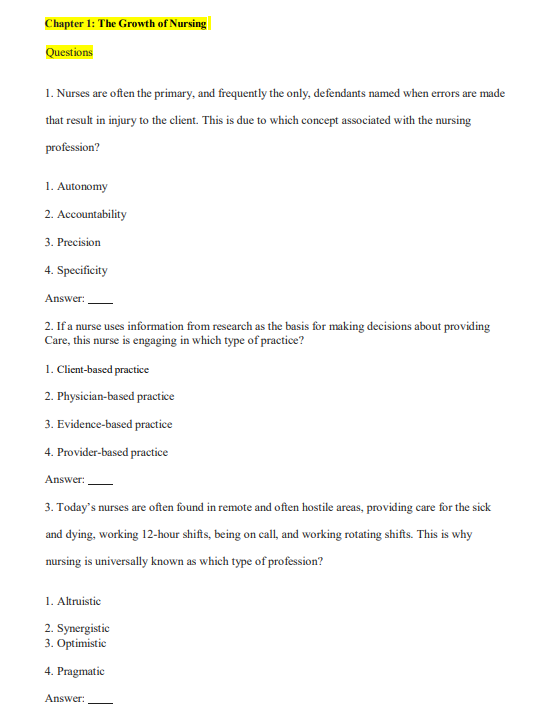
- Hundreds of practice questions covering every chapter
- Multiple-choice, select-all-that-apply, and professional scenario questions
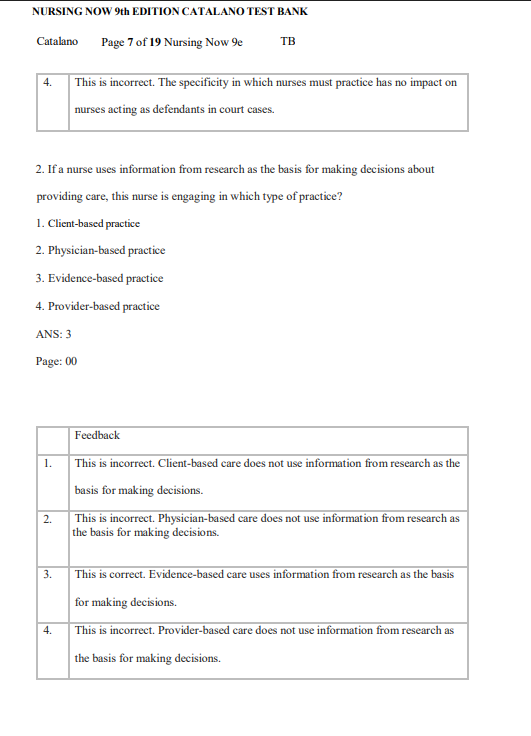
- Complete answer keys with thorough, professionally grounded rationales
- Questions aligned with current NCLEX-RN examination standards and professional nursing competency frameworks
- Coverage of the full scope of contemporary nursing issues — from professional identity and ethics through healthcare policy, technology, workforce trends, and the future of nursing
Who Is This Test Bank For?
This resource is ideal for:
- Undergraduate BSN nursing students in nursing issues, trends, and professional practice courses
- RN-to-BSN students completing professional nursing issues and trends coursework
- Senior nursing students preparing for NCLEX management of care content
- Graduate nursing students reviewing professional nursing foundations and contemporary issues
- NCLEX-RN candidates reviewing professional practice, ethical, and legal content
- Nursing faculty developing professional nursing issues course exams and assessments
- Nursing students in accelerated BSN or second-degree programs covering nursing professional issues
- New graduate nurses building the professional identity and advocacy skills that sustain long-term careers
Topics Covered Include:
- The history and evolution of nursing as a profession
- Nursing education — pathways, academic progression, and the education-practice gap
- Nursing licensure, credentialing, and regulation
- Standards of nursing practice and professional accountability
- Critical thinking and clinical judgment in professional nursing
- Evidence-based practice and nursing research utilization
- Leadership and management in nursing — theories, styles, and practical application
- Delegation, supervision, and management of nursing personnel
- Communication and interprofessional collaboration in healthcare teams
- Legal dimensions of nursing — licensure, liability, malpractice, and scope of practice
- Ethical principles and moral distress in nursing practice
- Patient rights — informed consent, confidentiality, and advance directives
- Healthcare policy, legislation, and political action in nursing
- Health insurance and the economics of healthcare delivery
- Healthcare reform and its implications for nursing practice
- Quality improvement and patient safety in contemporary nursing
- Healthcare informatics and the digital transformation of nursing
- Telehealth and technology trends in nursing practice
- Cultural competence, health equity, and social justice in nursing
- Workplace issues — lateral violence, burnout, and nursing workforce challenges
- Collective bargaining and labor relations in nursing
- Career development and professional portfolio building
- Complementary and alternative medicine in nursing practice
- The future of nursing — trends, challenges, and opportunities
- Global health nursing and international nursing practice
Why This Test Bank Stands Out
Catalano’s Nursing Now has remained one of the most trusted and most widely assigned professional nursing issues textbooks in nursing education because it does something genuinely important — it takes contemporary nursing issues seriously.
Not as abstract theoretical debates. Not as historical background that students must learn to move on from. But as the living, present-tense challenges that will define the professional environment every nursing student is about to enter — the staffing ratios they will work under, the scope of practice regulations that govern what they can and cannot do, the technology that will transform how they deliver care, the workforce burnout crisis that threatens to drive them from the profession, and the policy advocacy that determines whether nursing’s voice is heard in the decisions that shape their patients’ health.
The 9th Edition reflects the most current professional nursing landscape — including the nursing workforce crisis and burnout epidemic intensified by the COVID-19 pandemic and its aftermath, updated healthcare policy content reflecting the most current legislative and regulatory developments, expanded telehealth and technology content, enhanced health equity and social justice frameworks, and the latest nursing leadership and interprofessional collaboration evidence.
This test bank is built to develop the professional reasoning that these issues demand.
Every question reflects the issues-based thinking, ethical analysis, legal awareness, and leadership competency that Catalano embeds throughout the 9th Edition. You will not simply recall the history of nursing licensure — you will analyze how regulatory frameworks currently protect and constrain nursing practice and what advocacy strategies could change them. You will not just define informed consent — you will apply informed consent principles to a complex clinical scenario in which a patient’s decision-making capacity is questioned. You will not merely identify delegation principles — you will apply them to a realistic multi-patient staffing scenario and justify every assignment decision based on scope of practice and patient acuity.
Detailed rationales explain the professional nursing principles, legal standards, ethical frameworks, healthcare policy context, and leadership reasoning behind every correct answer. Questions are organized chapter by chapter for structured, systematic study. Build the professional nursing literacy, advocacy capacity, and career resilience that Catalano’s framework demands — and that the nursing profession needs from every nurse it produces.
Sample Questions
Question 1
A nurse is working on a busy medical-surgical unit when the charge nurse informs the staff that due to three call-outs, the unit will be operating at a 1:8 nurse-to-patient ratio for the night shift. The staff nurses express serious concern that this ratio creates an unacceptable patient safety risk. Which action most effectively reflects professional nursing advocacy and institutional accountability?
- A) Accept the assignment without comment since refusing a charge nurse’s decision could jeopardize employment
- B) Complete assignment despite objection forms, document the unsafe staffing concern through the chain of command to the house supervisor and nursing administration, and request that the staffing situation be resolved before the shift begins
- C) Walk off the unit immediately in protest since the staffing ratio violates patient safety standards
- D) Ask a nursing assistant to take on additional patient monitoring responsibilities to compensate for the unsafe nurse-to-patient ratio
Correct Answer: B
Rationale: This scenario addresses one of the most important and frequently encountered professional nursing issues — unsafe staffing and the nurse’s professional obligation to advocate for patient safety while maintaining professional conduct. Professional nursing advocacy requires nurses to communicate safety concerns through formal institutional channels rather than accepting unsafe conditions silently or abandoning patients. The assignment despite objection form — sometimes called a protest form — is the professionally and legally recognized mechanism by which nurses formally document their safety concerns while remaining available to provide care. This documentation creates an official record that protects both the patient and the nurse legally — establishing that the nurse identified and reported the safety risk through appropriate channels. Reporting through the chain of command — charge nurse, house supervisor, nursing administration, and beyond if necessary — reflects professional accountability and gives the institution the opportunity to resolve the staffing crisis. Walking off the unit abandons patients and constitutes a serious professional and legal violation regardless of the motivation. Delegating clinical monitoring tasks beyond a nursing assistant’s scope of practice to compensate for unsafe staffing creates additional patient safety risks rather than resolving them. The ANA’s Nursing Scope and Standards of Practice, the Code of Ethics for Nurses, and professional advocacy frameworks all support the nurse’s obligation to formally report unsafe staffing rather than silently absorb the risk.
Question 2
A nursing student is reviewing the history of nursing and the development of nursing education. Which historical development most directly led to the establishment of nursing as a recognized academic discipline with standardized educational requirements rather than a purely apprenticeship-based trade?
- A) The invention of the stethoscope by René Laënnec, which gave nurses a diagnostic tool independent of physician observation
- B) Florence Nightingale’s establishment of the first formal nursing school at St. Thomas’ Hospital in 1860, which created a model for structured nursing education based on scientific principles rather than hospital service alone
- C) The passage of Medicare and Medicaid legislation in 1965, which required hospitals to employ credentialed nurses for reimbursement eligibility
- D) The formation of the American Medical Association in 1847, which established physician credentialing standards that were subsequently adopted by nursing
Correct Answer: B
Rationale: Florence Nightingale’s establishment of the Nightingale Training School for Nurses at St. Thomas’ Hospital in London in 1860 is the foundational historical event most directly responsible for transforming nursing from an apprenticeship-based service into a recognized discipline with structured, theory-based educational standards. Before Nightingale’s reform, nursing was largely performed by untrained individuals — often of low social standing — without systematic education, clinical standards, or professional identity. Nightingale introduced several revolutionary principles that became the foundation of modern nursing education — the concept that nursing required formal training rather than mere practical experience, that nursing knowledge had a scientific basis distinct from medical knowledge, that nurses should be educated in educational institutions rather than simply trained in hospitals as cheap labor, and that nursing practice should be guided by data collection and evidence rather than tradition and intuition alone. Her work directly influenced the establishment of nursing schools throughout the United States and internationally — creating the educational model that eventually evolved into today’s diploma, associate degree, baccalaureate, and graduate nursing programs. The stethoscope was a medical diagnostic instrument and did not directly influence nursing education development. Medicare and Medicaid significantly affected nursing workforce deployment but were not the foundational event in nursing education development. The AMA’s formation preceded nursing’s professional development but did not directly shape nursing educational standards.
Question 3
A nurse is caring for a 72-year-old patient with advanced Parkinson’s disease who has been admitted for aspiration pneumonia. The patient has a healthcare proxy document naming their adult daughter as the decision-maker when the patient lacks decisional capacity. The attending physician has assessed the patient as lacking decisional capacity. The daughter requests that the medical team initiate palliative care and not attempt resuscitation if the patient’s condition deteriorates. The patient’s adult son — who is not the named proxy — objects strongly and demands aggressive treatment including CPR. Which response most accurately reflects the legal and ethical framework governing this situation?
- A) The son’s request takes equal precedence with the daughter’s since both are adult children of the patient
- B) A court order must be obtained before any end-of-life care decisions can be implemented regardless of the proxy document
- C) The daughter’s healthcare proxy authority is legally operative since the patient lacks decisional capacity — her decisions as the legally designated surrogate take precedence over the son’s objections, and the medical team should follow the proxy’s direction in implementing palliative care and DNR orders
- D) The physician has the final authority to determine the care plan regardless of the proxy’s decisions or the son’s objections
Correct Answer: C
Rationale: This scenario requires applying the legal and ethical framework governing surrogate decision-making — one of the most important professional nursing issues in contemporary practice. A healthcare proxy document — also called a durable power of attorney for healthcare — is a legally binding instrument by which a competent individual designates a specific person to make healthcare decisions on their behalf when they lose decisional capacity. When the designated conditions are met — the patient lacks decisional capacity, as assessed by the attending physician in this scenario — the named proxy’s authority becomes operative and legally supersedes the preferences of other family members who were not designated as proxy. The daughter, as the legally designated healthcare proxy, has the authority to make decisions consistent with what she believes the patient would want — her decisions represent the patient’s autonomous wishes expressed through the proxy mechanism. The son’s objections, while understandable from an emotional perspective, do not carry legal authority in this framework — he was not designated as the decision-maker. The medical team’s obligation is to follow the proxy’s legally operative directives for palliative care and DNR status. Court intervention is not required when a valid healthcare proxy document exists and the designated proxy is available and willing to exercise their authority. Physician authority does not override valid proxy decisions except in very specific legal circumstances such as requests for futile treatment — palliative care and DNR orders in advanced Parkinson’s disease with recurrent aspiration do not represent requests that fall outside the bounds of appropriate medical practice.
Question 4
A nurse manager is reviewing data showing that the unit’s 30-day patient readmission rate for heart failure has increased by 12% over the past two quarters. The manager implements a quality improvement initiative — including standardized discharge education, a 48-hour post-discharge phone call protocol, and a scheduled follow-up clinic appointment for all heart failure patients. After two quarters, the readmission rate decreases by 9%. This process most directly represents which professional nursing framework?
- A) Evidence-based practice — generating new primary nursing research through a rigorous experimental design
- B) Nursing informatics — using electronic health record technology to automatically identify and flag at-risk heart failure patients for readmission
- C) Quality improvement — using systematic data collection, analysis, and targeted evidence-based interventions to identify a performance gap and measure the impact of practice changes on patient outcomes
- D) Collective bargaining — negotiating with hospital administration for resources to fund the discharge education program
Correct Answer: C
Rationale: This scenario represents a classic quality improvement cycle — one of the core professional nursing competencies identified by the IOM, QSEN, and The Joint Commission as essential for contemporary nursing leadership and practice. Quality improvement involves the systematic identification of performance gaps through outcome data analysis, the implementation of targeted, evidence-based practice changes to address those gaps, and the measurement of whether those changes produced the intended improvement in patient outcomes. The nurse manager in this scenario executed the QI cycle correctly — identifying the performance gap (increased readmission rate), analyzing the factors contributing to it (inadequate discharge preparation, lack of post-discharge follow-up, delayed clinic access), implementing targeted multifaceted interventions addressing those factors, and measuring the outcome of those interventions (9% reduction in readmission rate). This is QI methodology — not primary research, which would require a formal research design, IRB approval, randomization, and control groups. Nursing informatics involves health information technology management and application — while EHR data extraction may support QI activities, the core activity described is QI rather than informatics. Collective bargaining involves labor-management negotiation — completely unrelated to this clinical outcome improvement initiative. Understanding the distinction between QI, EBP, and primary research is an important professional nursing competency increasingly assessed on the NCLEX and in professional nursing courses.
Question 5
A nurse is working in a state that has enacted mandatory minimum nurse-to-patient staffing ratios legislatively. The hospital administration announces plans to use a float pool of agency nurses — who are unfamiliar with the unit — to meet the mandated staffing numbers on paper while reducing permanently employed staff. Nursing staff believe this approach meets the letter but not the spirit of the staffing ratio legislation and compromises care quality. Which professional action most effectively reflects nursing’s advocacy role in healthcare policy?
- A) Accept the staffing model since the hospital is technically complying with the legislative requirement for nurse-to-patient ratios
- B) Engage with the state nurses association, nursing unions, and legislative contacts to advocate for regulatory language that specifies competency and continuity requirements in addition to numerical ratios — and document patient safety outcomes during agency staffing for evidence-based advocacy
- C) Refuse to work alongside agency nurses since they are not permanently employed unit staff members
- D) File an immediate complaint with the state board of nursing since using agency nurses violates staffing ratio legislation
Correct Answer: B
Rationale: This scenario illustrates the difference between technical regulatory compliance and the substantive patient safety intent that drives healthcare policy — and it tests the professional nursing competency of policy advocacy through appropriate channels. The nurses’ concern is valid — staffing ratio legislation is intended to protect patient safety by ensuring adequate, competent nursing care, not simply to achieve numerical compliance that may not reflect actual care quality. Agency nurses unfamiliar with the unit’s patient population, equipment, protocols, and communication systems represent a different patient safety consideration than experienced unit nurses — a concern that existing ratio legislation may not adequately address. The most professionally effective response is to engage through appropriate advocacy channels — state nurses associations, professional nursing organizations, nursing unions, and legislative contacts — to build an evidence-based case for regulatory improvement. Documenting patient safety outcomes during periods of heavy agency staffing creates the outcome data necessary to support advocacy for stronger, more specific regulatory language. This reflects the professional nursing role in health policy — not passive acceptance of inadequate regulations, not individual refusal to work with colleagues, and not mischaracterizing legal agency nurse use as a board of nursing violation. Healthcare policy advocacy is an ongoing professional nursing responsibility — regulations rarely capture every dimension of their intended purpose on the first attempt, and nursing’s experiential expertise is essential to improving them through legitimate advocacy processes.
Frequently Asked Questions (FAQs)
What edition does this test bank cover?
This test bank is written specifically for the 9th Edition of Nursing Now: Today’s Issues, Tomorrow’s Trends by Catalano. All questions are fully aligned with the current edition’s chapter organization, updated professional nursing content, contemporary healthcare workforce issues, current healthcare policy developments, and current NCLEX-RN examination standards.
How are the questions organized?
Questions are arranged chapter by chapter, allowing you to study systematically through the full scope of professional nursing issues and trends content — from nursing history and education through legal and ethical practice, healthcare policy, workforce trends, and the future of nursing — or focus on specific content areas based on your upcoming exam schedule or professional development priorities.
Is this test bank useful for NCLEX preparation?
Yes. The NCLEX management of care client needs category — including delegation, supervision, legal and ethical practice, patient rights, advocacy, and quality improvement — is one of the most heavily weighted content areas on the NCLEX-RN. This test bank directly reinforces the professional reasoning and ethical decision-making that NCLEX management of care questions require.
How does this test bank differ from the Zerwekh Nursing Today test bank?
This test bank is written specifically for the 9th Edition of Catalano’s Nursing Now: Today’s Issues, Tomorrow’s Trends. While both textbooks cover professional nursing issues, they differ in chapter organization, content emphasis, theoretical framework, and pedagogical approach. Students using Catalano’s textbook will find this test bank most accurately aligned with their specific chapter assignments and course content.
Is this test bank appropriate for RN-to-BSN students?
Absolutely. Contemporary nursing issues, healthcare policy, professional advocacy, and leadership are core content areas in every RN-to-BSN program. This test bank is an invaluable resource for RN-to-BSN students building the professional nursing competencies and issues-based reasoning that baccalaureate nursing education demands.
How quickly can I access the test bank after purchase?
Immediately. As soon as your purchase is complete, you receive instant digital access with no waiting period. Study on your own schedule, at your own pace, from any device.
Are the rationales grounded in current professional nursing standards and evidence?
Yes. Every rationale reflects current professional nursing standards — including the ANA Code of Ethics for Nurses, ANA Nursing Scope and Standards of Practice, QSEN competency frameworks, Joint Commission standards, and current healthcare policy and workforce evidence — consistent with the professional nursing framework Catalano establishes throughout the 9th Edition.
Can nursing faculty use this test bank for course assessments?
Absolutely. The chapter-by-chapter organization, issues-based scenario emphasis, policy analysis questions, and professional competency framework make this an outstanding resource for faculty building unit exams, case-based assessments, and comprehensive examinations for professional nursing issues and trends courses at both the undergraduate and graduate level.

Kamara Reid –
Clear, well-organized test bank with excellent practice questions for reinforcing key nursing concepts
Lucille Maria –
Great resource for exam preparation, covering current nursing issues with realistic and challenging questions
Lisa Horton –
Comprehensive and easy to use, helping build confidence before quizzes and major nursing exams.
Peterson S. –
Perfectly structured for quick exam preps
Dorcas M. –
Excellent!
Winnie M. –
Well-written questions with strong topic coverage, making study sessions more effective and focused
Lucas Gabriel –
Perfect
Janny Cummings –
A solid test bank
Melania Angel –
Perfect for daily study sessions
fred m –
Very very good
Maryanne –
Helped me recognize knowledge gaps before exam day
Kevin May –
Clear questions with useful explanations
Carol Kay –
Definitely useful for final exam preparation.
Liam Mbogo –
Questions are relevant and excellent for exam preparation.