Every medication you give carries your name behind it.
That is the reality of nursing pharmacology. When you administer a drug, you are not simply carrying out a physician’s order — you are exercising independent clinical judgment. You are assessing for contraindications. You are recognizing adverse effects. You are educating your patient. You are evaluating whether the therapy is working. And you are the last line of defense between your patient and a medication error.
That is an enormous responsibility. And it demands an equally serious commitment to pharmacological mastery.
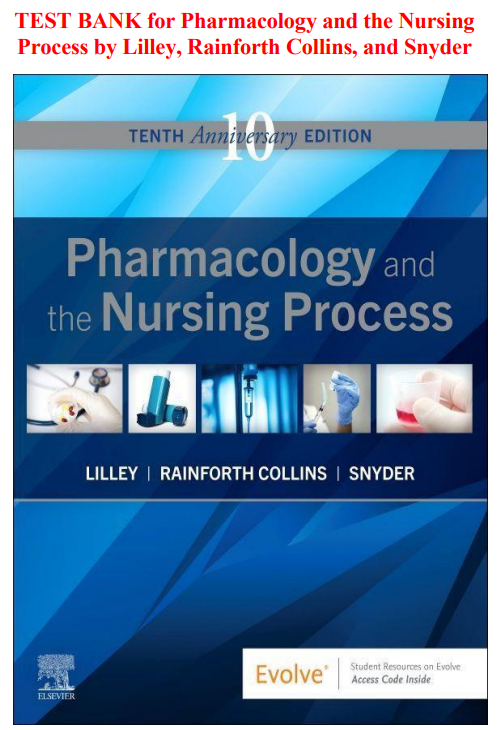
This comprehensive test bank is built for the 10th Edition of Pharmacology and the Nursing Process by Lilley, Rainforth Collins, and Snyder. It is one of the most widely used and clinically respected pharmacology textbooks in undergraduate nursing education — integrating drug knowledge with the nursing process in a way that prepares students not just to pass pharmacology exams but to practice medication safety with genuine clinical confidence.
This test bank helps you master every chapter with the focused, nursing-process-driven, patient-safety-centered practice that pharmacology mastery demands — and that the NCLEX tests relentlessly.
Whether you are preparing for a pharmacology unit exam, an ATI pharmacology assessment, or the NCLEX-RN, this resource delivers the drug knowledge, clinical reasoning, and patient safety focus that nursing pharmacology — and nursing practice — requires.
What’s Inside?
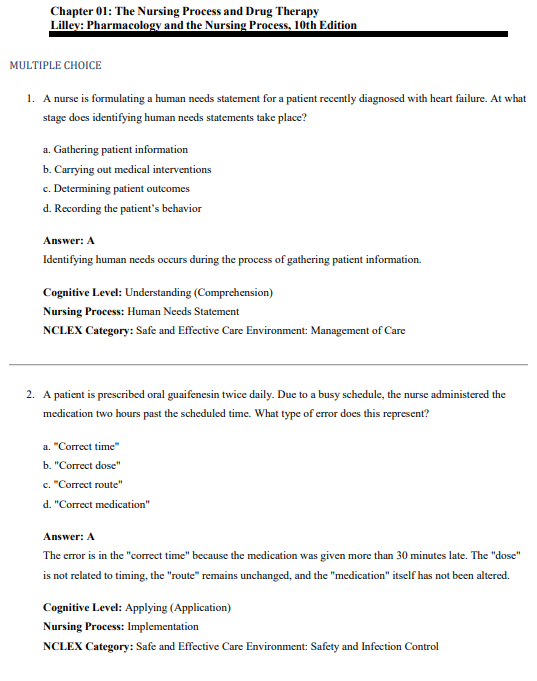
- Hundreds of practice questions covering every chapter
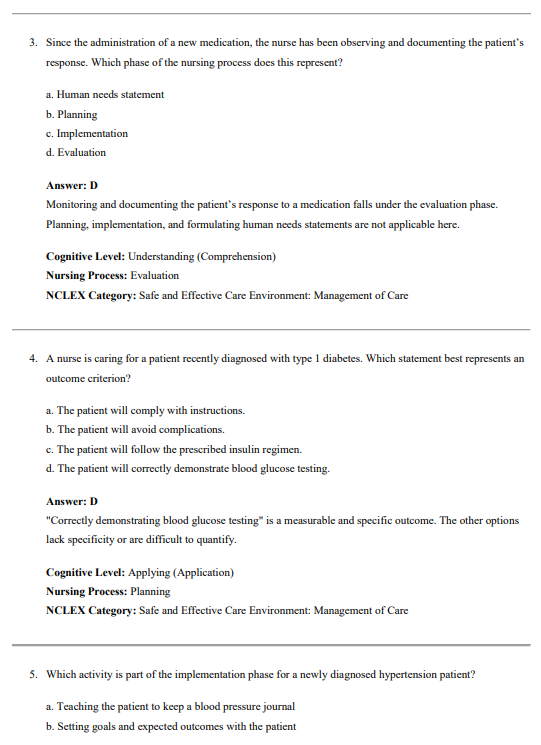
- Multiple-choice, select-all-that-apply, alternate-format, and clinical scenario questions
- Complete answer keys with thorough, clinically grounded pharmacological rationales
- Questions aligned with current NCLEX-RN and Next Generation NCLEX examination standards
- Coverage of all major drug classifications, nursing implications, patient education priorities, and pharmacological safety across every body system
Who Is This Test Bank For?
This resource is perfect for:
- Undergraduate RN and LPN nursing students in pharmacology courses using the 10th Edition
- NCLEX-RN and NCLEX-PN candidates seeking targeted pharmacology content review
- Nursing students completing ATI pharmacology assessments and proctored exams
- Nursing faculty developing pharmacology course exams and unit assessments
- LPN-to-RN bridge students updating and expanding pharmacological knowledge
- Nursing students in accelerated BSN or second-degree programs covering pharmacology
- New graduate nurses reinforcing foundational medication safety knowledge
Topics Covered Include:
- Pharmacological principles — pharmacokinetics and pharmacodynamics
- Medication safety — the rights of medication administration and error prevention
- The nursing process applied to pharmacological care
- Cultural, lifespan, and genetic considerations in pharmacotherapy
- Patient education and medication adherence principles
- Analgesics — opioid agonists, antagonists, and non-opioid pain management
- Anti-inflammatory agents — NSAIDs, corticosteroids, and antigout medications
- Antibiotics — penicillins, cephalosporins, fluoroquinolones, and macrolides
- Antivirals, antifungals, antiprotozoals, and antiparasitic agents
- Antineoplastic agents and biotherapy principles
- Immunosuppressants, immunizing agents, and biological response modifiers
- Central nervous system depressants — sedative-hypnotics and anxiolytics
- Antiepileptic drugs and CNS stimulants
- Psychotherapeutic agents — antidepressants, antipsychotics, and mood stabilizers
- Antihypertensive agents and cardiovascular drug therapy
- Antianginal, antidysrhythmic, and heart failure medications
- Coagulation modifier drugs — anticoagulants, antiplatelets, and thrombolytics
- Diuretic therapy and fluid balance medications
- Antidiabetic agents — insulin and oral hypoglycemics
- Thyroid and adrenal pharmacotherapy
- Pituitary, gonadal, and reproductive pharmacotherapy
- Respiratory pharmacotherapy — bronchodilators, antihistamines, and decongestants
- Gastrointestinal pharmacotherapy — antacids, antiemetics, and bowel agents
- Dermatological, ophthalmic, and otic pharmacotherapy
- Vitamins, minerals, and nutritional supplements
- Herbal products and dietary supplement considerations
Why This Test Bank Delivers Results
Pharmacology and the Nursing Process by Lilley, Rainforth Collins, and Snyder is built around a foundational truth — that pharmacology cannot be separated from the nursing process.
Every drug interaction, every adverse effect assessment, every patient education conversation, every medication safety check is an application of the nursing process. Assessment before administration. Nursing diagnoses that guide drug selection rationale. Planning that anticipates adverse effects. Implementation that executes safe administration. Evaluation that determines therapeutic success or failure.
That integration is what makes Lilley’s approach unique — and it is what makes this test bank uniquely effective.
Every question in this test bank is constructed around the nursing process framework that Lilley, Rainforth Collins, and Snyder establish throughout the textbook. You will not simply memorize drug names and their side effects. You will apply the nursing process to a patient receiving that drug — assessing for contraindications before the first dose, recognizing early signs of toxicity during therapy, evaluating the patient’s response after administration, and educating the patient about what to expect and what to report.
The NCLEX tests pharmacology relentlessly — and it tests it exactly this way. Not as isolated drug facts, but as applied clinical decisions embedded in patient care scenarios. This test bank prepares you for exactly that.
Detailed rationales explain the pharmacological mechanisms, nursing process applications, patient safety principles, and clinical reasoning behind every correct answer. The 10th Edition reflects the most current drug therapy guidelines, FDA safety communications, and evidence-based nursing pharmacology standards — and this test bank is fully aligned with every update.
Questions are organized chapter by chapter for structured, systematic study. Target drug classes where your knowledge is weakest. Return to high-yield pharmacological categories as your exam approaches. Build the medication safety mindset that nursing practice demands — and that the NCLEX tests from the very first question to the last.
Sample Questions
Question 1
A nurse is preparing to administer morphine sulfate 4 mg IV to a postoperative patient who reports pain rated 7 out of 10. Before administering the medication, which assessment is the nurse’s priority?
- A) Asking the patient to rate the quality and location of their pain in detail
- B) Confirming the patient’s allergy status and reviewing the last dose administration time
- C) Assessing the patient’s respiratory rate, oxygen saturation, and level of sedation
- D) Reviewing the patient’s most recent complete blood count and metabolic panel
Correct Answer: C
Rationale: Before administering any opioid analgesic, the nurse’s priority assessment is respiratory status — specifically respiratory rate, oxygen saturation, and level of sedation. Opioids cause dose-dependent respiratory depression by binding to mu receptors in the brainstem respiratory center, reducing respiratory drive. Administering morphine to a patient with already-compromised respiratory function or excessive sedation can precipitate respiratory arrest. The standard safety threshold is to hold opioid administration and notify the provider if the respiratory rate falls below 12 breaths per minute or if the patient shows signs of excessive sedation. While pain quality assessment and allergy verification are important components of pre-administration assessment, they do not represent the immediate life-safety priority that respiratory assessment does before opioid administration. Laboratory values are not routinely required before standard analgesic administration.
Question 2
A nurse is providing discharge teaching to a patient prescribed atorvastatin for hyperlipidemia. Which patient statement indicates the need for additional teaching?
- A) “I should avoid eating large amounts of grapefruit or drinking grapefruit juice while taking this medication.”
- B) “I need to report any unexplained muscle pain, weakness, or dark-colored urine to my doctor immediately.”
- C) “I should take this medication in the morning with breakfast for best results.”
- D) “I will continue taking this medication even when my cholesterol levels improve.”
Correct Answer: C
Rationale: Atorvastatin and most HMG-CoA reductase inhibitors are most effective when taken in the evening or at bedtime — not in the morning. This is because cholesterol synthesis by the liver occurs primarily during the overnight fasting period, and evening administration maximizes the drug’s inhibitory effect during peak synthesis hours. Taking the medication in the morning with breakfast reduces its pharmacological effectiveness. The remaining statements reflect correct understanding. Grapefruit and grapefruit juice inhibit CYP3A4 — the enzyme responsible for statin metabolism — and can significantly increase statin plasma levels and toxicity risk. Muscle pain, weakness, and dark urine are warning signs of myopathy and rhabdomyolysis — rare but serious statin adverse effects requiring immediate medical evaluation. Continuing statin therapy even when cholesterol levels normalize is correct — statins treat cardiovascular risk, not just lipid numbers, and discontinuation leads to rapid return of elevated lipid levels.
Question 3
A patient with a history of type 2 diabetes is admitted for a urinary tract infection and is started on trimethoprim-sulfamethoxazole. The patient takes metformin 1000 mg twice daily at home. On day two of antibiotic therapy, the patient’s serum creatinine rises from 0.9 mg/dL on admission to 1.6 mg/dL. Which nursing action is most appropriate?
- A) Continue all medications as prescribed and recheck creatinine in 48 hours
- B) Hold the trimethoprim-sulfamethoxazole and switch to a different antibiotic
- C) Hold the metformin and notify the provider of the rising creatinine immediately
- D) Increase IV fluid rate to improve renal perfusion and resolve the creatinine elevation
Correct Answer: C
Rationale: A rising serum creatinine indicates declining renal function — a critical safety concern for a patient taking metformin. Metformin is renally cleared, and in the setting of impaired renal function, it accumulates and significantly increases the risk of lactic acidosis — a rare but potentially fatal metabolic emergency. Current guidelines recommend holding metformin when acute kidney injury is suspected or renal function is declining, and not resuming until renal function has been reassessed and confirmed stable. The nurse must hold the metformin immediately and notify the provider. The creatinine rise may be related to the infection itself, dehydration, or antibiotic nephrotoxicity — but regardless of the cause, metformin safety requires immediate action. Simply increasing IV fluids without holding the metformin is an incomplete and insufficient response to a patient safety concern of this magnitude.
Question 4
A nurse is administering IV vancomycin to a patient with a confirmed MRSA bacteremia. The prescribed infusion rate is 1,500 mg over 90 minutes. Thirty minutes into the infusion, the patient develops flushing and erythema of the face, neck, and chest, along with pruritus and mild hypotension. The patient denies dyspnea and throat tightness. Which nursing action is the priority?
- A) Stop the infusion permanently and document a vancomycin allergy in the medical record
- B) Slow the infusion rate significantly, administer diphenhydramine as prescribed, and notify the provider
- C) Stop the infusion, administer epinephrine 0.3 mg IM, and prepare for emergency airway management
- D) Increase the infusion rate to complete the dose before symptoms worsen
Correct Answer: B
Rationale: This clinical presentation describes red man syndrome — a rate-dependent infusion reaction to vancomycin caused by direct mast cell degranulation and non-IgE-mediated histamine release, not a true allergic reaction. It presents with the classic flushing and erythema of the upper body — the “red man” distribution — pruritus, and sometimes mild hypotension. The absence of dyspnea and throat tightness distinguishes this from anaphylaxis, which would require epinephrine. Management involves slowing or stopping the infusion temporarily, administering an antihistamine such as diphenhydramine to block histamine effects, and notifying the provider. Once symptoms resolve, the infusion can typically be restarted at a slower rate — vancomycin should always be infused over a minimum of 60 minutes, with 90 minutes preferred for larger doses. Permanently documenting a vancomycin allergy for a rate-related reaction could prevent a patient from receiving a critically needed antibiotic in the future — a significant and potentially harmful clinical error.
Question 5
A nurse is reviewing the morning medication administration record for an 80-year-old patient with atrial fibrillation who is taking warfarin, amiodarone, and aspirin 81 mg. The patient’s INR this morning is 4.8. The patient has no signs of active bleeding. Which nursing action is most appropriate?
- A) Administer all medications as prescribed and recheck the INR in the evening
- B) Hold the warfarin dose, notify the provider of the supratherapeutic INR, and assess the patient for bleeding risk
- C) Administer vitamin K 10 mg IV immediately to reverse anticoagulation without provider notification
- D) Administer the warfarin as prescribed since the patient has no active bleeding symptoms
Correct Answer: B
Rationale: An INR of 4.8 is significantly supratherapeutic — the therapeutic range for atrial fibrillation is typically 2.0–3.0. This elevation is particularly dangerous in an 80-year-old patient, who faces higher baseline bleeding risk from age-related physiological changes including decreased renal clearance, increased vascular fragility, and higher fall risk. The combination of warfarin, amiodarone, and aspirin dramatically amplifies bleeding risk — amiodarone inhibits CYP2C9, significantly reducing warfarin metabolism and increasing free warfarin levels, while aspirin adds antiplatelet effects. The nurse must hold the warfarin dose and notify the provider immediately for guidance on INR management — which may include simply holding warfarin and monitoring, or administering oral vitamin K depending on the clinical situation. IV vitamin K administration without a provider order is outside independent nursing scope and carries its own risks. Administering warfarin to a patient with an INR of 4.8 without provider consultation is a serious medication safety error that could result in catastrophic hemorrhage.
Frequently Asked Questions (FAQs)
What edition does this test bank cover?
This test bank is written specifically for the 10th Edition of Pharmacology and the Nursing Process by Lilley, Rainforth Collins, and Snyder. All questions are fully aligned with the current edition’s chapter organization, updated drug content, current FDA safety information, and evidence-based nursing pharmacology practice standards.
How are the questions organized?
Questions are arranged chapter by chapter, allowing you to study systematically through all pharmacological content or focus on specific drug classes — such as cardiovascular agents, antibiotics, or CNS medications — based on your course exam schedule or NCLEX preparation priorities. The nursing process framework is integrated throughout every chapter’s question set.
Is this test bank aligned with the NCLEX and Next Generation NCLEX?
Yes. Questions are written to reflect current NCLEX-RN and NCLEX-PN examination standards and incorporate the clinical judgment emphasis of the Next Generation NCLEX framework. Pharmacological and parenteral therapy is one of the most heavily weighted NCLEX content categories — this test bank directly targets that content with the nursing-process-driven clinical reasoning the exam demands.
How is this test bank different from the McCuistion pharmacology test bank?
This test bank is written specifically for the 10th Edition of Lilley, Rainforth Collins, and Snyder’s Pharmacology and the Nursing Process. While both textbooks cover nursing pharmacology, they differ in chapter organization, drug classification approach, and nursing process integration emphasis. Students using Lilley’s textbook should use this test bank for fully aligned, chapter-specific exam preparation.
How quickly can I access the test bank after purchase?
Immediately. As soon as your purchase is complete, you receive instant digital access with no waiting period. Study on your own schedule, at your own pace, from any device.
Are the rationales detailed enough to support genuine pharmacological learning?
Yes. Every rationale explains the pharmacological mechanisms, nursing process application, patient safety principles, and clinical reasoning behind the correct answer. This approach builds the deep, transferable pharmacological understanding that Lilley and colleagues emphasize throughout the nursing process framework — and that clinical practice demands.
Can nursing faculty use this test bank for course assessments?
Absolutely. The chapter-by-chapter organization, nursing process integration, varied question formats, and clinical scenario emphasis make this an outstanding resource for faculty building unit exams, ATI-style assessments, and comprehensive pharmacology course finals for undergraduate nursing programs at both the RN and PN level.


Penny –
Exactly what I needed! Thanks a ton.
Nelly –
well organized high quality content
Evans367 –
The test bank met my expectations
Norah Helen –
Perfectly organized for exam preparation
Lucille Maria –
High quality potential exams questions and detailed answers
Kevin May –
A solid study guide for nursing pharmacology
Winnie M. –
Good quality
Cayte N. –
Excellent
Lisa Horton –
The quality of the document is unbelievably good
Kamara Reid –
A very helpful resource for nursing pharmacology
Caleb Martins –
this is all I needed to build exam confidence
Yunice M –
Simple, useful, and easy to work through
Alicia Silva –
Helped me feel more prepared for exams
Rosemary R –
Questions closely match the difficulty of nursing school exams
Even Njeri –
Useful questions covering important nursing concepts.
Liam Mbogo –
Clear questions with excellent answers and rationales.
Stephaniemclister –
A useful resource for every nursing pharmacology student.