Nursing is more than a job. It is a profession — and there is a critical difference.
A job is something you show up to perform. A profession is something you grow into, advocate for, and carry with you as a defining part of who you are. It is a commitment to evidence-based practice, ethical decision-making, lifelong learning, and the kind of patient advocacy that sometimes requires courage as much as clinical skill.
Understanding nursing as a profession — its history, its theoretical foundations, its ethical obligations, its political dimensions, and its evolving scope of practice — is not a soft topic that exists alongside clinical knowledge. It is the framework within which all clinical knowledge operates. It is what transforms a technically skilled nurse into a truly professional one.
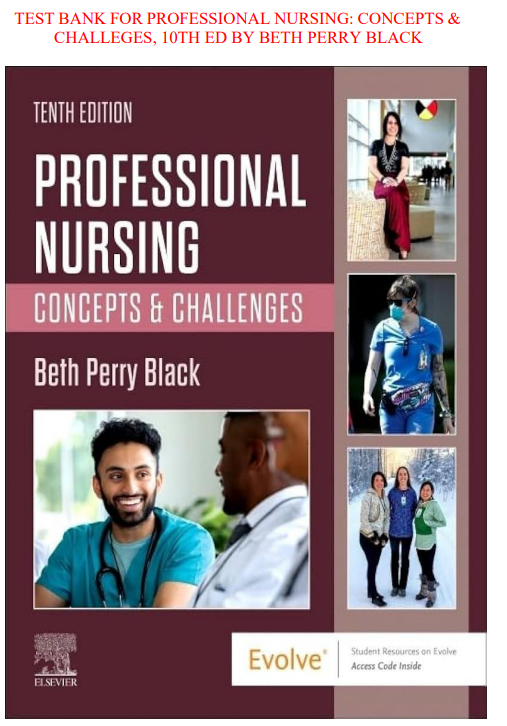
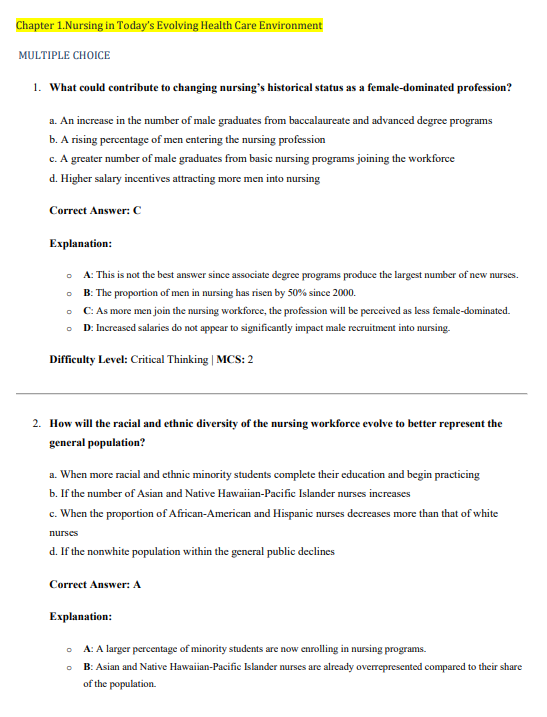
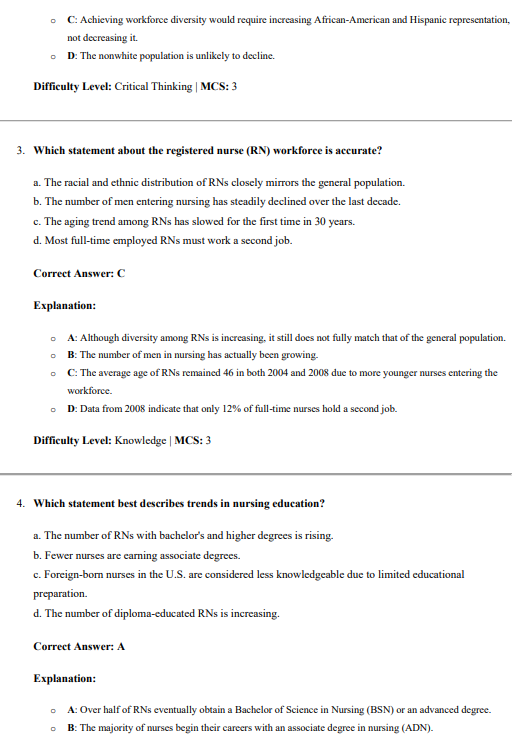
This comprehensive test bank is built for the 10th Edition of Professional Nursing: Concepts & Challenges by Beth Perry Black. It is one of the most respected and widely used professional nursing and nursing issues textbooks in undergraduate and graduate nursing education — and this test bank helps you master every chapter with the focused, concept-driven, issues-based practice that professional nursing education demands.
Whether you are preparing for a professional nursing course exam, a nursing issues and trends assessment, or building the professional identity foundation that your entire nursing career will rest upon, this resource delivers the conceptual depth, ethical reasoning, and evidence-based professional practice preparation that Beth Perry Black’s framework demands.
What’s Inside?
- Hundreds of practice questions covering every chapter
- Multiple-choice, select-all-that-apply, and complex scenario-based questions
- Complete answer keys with thorough, conceptually grounded rationales
- Questions aligned with current NCLEX-RN examination standards and professional nursing competency frameworks
- Coverage of the full scope of professional nursing — from historical foundations through contemporary practice challenges and future trends
Who Is This Test Bank For?
This resource is ideal for:
- Undergraduate RN nursing students in professional nursing, nursing issues, and nursing trends courses
- RN-to-BSN students building professional nursing identity and evidence-based practice competency
- Graduate nursing students reviewing professional nursing foundations
- NCLEX-RN candidates reinforcing professional practice, ethical, and legal nursing content
- Nursing faculty developing professional nursing course exams and issues-based assessments
- Nursing students in accelerated BSN or second-degree programs covering professional nursing concepts
- Nurses pursuing professional development and leadership competency growth
Topics Covered Include:
- The history of professional nursing — from Florence Nightingale to contemporary practice
- Nursing education — pathways, accreditation, and the evolving educational landscape
- Theories and frameworks of professional nursing practice
- Nursing as a discipline — knowledge development and nursing science
- Evidence-based nursing practice — principles, process, and application
- Critical thinking, clinical judgment, and clinical reasoning in professional nursing
- Legal dimensions of nursing practice — licensure, liability, and scope of practice
- Ethical dimensions of nursing practice — principles, frameworks, and moral distress
- Values clarification and ethical decision-making in clinical nursing
- Cultural competence, diversity, and inclusion in professional nursing practice
- Leadership and management in nursing — styles, theories, and application
- Healthcare policy, political action, and advocacy in nursing
- Healthcare financing — insurance, reimbursement, and the economics of care
- Quality improvement, patient safety, and evidence-based systems change
- Informatics and technology in professional nursing practice
- Nursing research — basics, evidence appraisal, and application to practice
- Communication — therapeutic, interprofessional, and organizational
- The nurse-patient relationship and professional boundaries
- Collective bargaining, workplace advocacy, and nursing unions
- Stress, burnout, resilience, and self-care in professional nursing
- Nursing’s future — trends, challenges, and opportunities in healthcare
- Interprofessional collaboration and team-based healthcare delivery
- Global health and nursing’s role in international healthcare
- Professional nursing organizations and their impact on the profession
Why This Test Bank Stands Out
Professional nursing courses are unlike any other course in nursing education.
They ask you to think not just about what nurses do — but about who nurses are, what nurses believe, and what nursing means as a profession in society. They challenge you to examine the historical forces that shaped nursing’s current status, the ethical frameworks that guide nursing’s toughest decisions, the political realities that determine nursing’s scope of practice, and the evidence-based standards that define nursing’s quality of care.
These are not abstract academic exercises. They are the foundations of professional identity — and nurses who lack them are clinically skilled but professionally incomplete.
This test bank is built to develop that professional completeness.
Every question is grounded in the conceptual framework, issues-based thinking, and professional nursing scholarship that Beth Perry Black establishes throughout the 10th Edition. You will not simply recall historical dates and famous nursing figures. You will analyze how nursing’s historical trajectory has shaped its current professional challenges. You will not just define ethical principles — you will apply them to morally complex clinical scenarios where multiple principles conflict and a reasoned decision must be made. You will not merely identify leadership styles — you will analyze which style is most appropriate for a specific nursing management scenario and justify your reasoning.
The 10th Edition reflects the most current trends in professional nursing practice — including the latest IOM and National Academy of Medicine recommendations, updated diversity, equity, and inclusion frameworks, contemporary healthcare policy developments, and the evolving scope of advanced practice nursing. This test bank is fully aligned with every update.
Detailed rationales explain the professional nursing principles, ethical reasoning frameworks, legal standards, and evidence-based practice foundations behind every correct answer. That depth of conceptual explanation is what transforms a professional nursing course from memorization of nursing facts into genuine development of professional nursing identity — and genuine professional identity into the kind of nursing practice that patients and communities deserve.
Questions are organized chapter by chapter for structured, systematic study. Target the content areas where your professional nursing conceptual understanding needs the most development. Build the professional identity, ethical reasoning, and advocacy skills that nursing school is ultimately designed to produce.
Sample Questions
Question 1
A nurse working on a medical-surgical unit observes a colleague consistently documenting medication administration before actually giving the medications. When confronted by the nurse, the colleague says, “Everyone does it — it saves time and I always give the medications anyway.” Which response best reflects the professional nursing obligations in this situation?
- A) Accept the colleague’s explanation since the medications are ultimately administered and no patient harm has occurred
- B) Report the behavior to the charge nurse or nurse manager as a patient safety concern and a violation of professional nursing documentation standards
- C) Document the observation in the nurse’s own personal notes and wait to see if patient harm occurs before escalating
- D) Confront the colleague publicly at the next staff meeting to discourage other nurses from adopting the practice
Correct Answer: B
Rationale: Pre-documenting medication administration — recording medications as given before they are actually administered — is a serious violation of professional nursing practice standards, nursing documentation ethics, and patient safety principles. Documentation is a legal record and a clinical communication tool — it must be accurate, timely, and reflective of actual care provided. Pre-documentation creates multiple patient safety risks — if the nurse is interrupted or prevented from administering the medication after documenting it, the medical record will falsely indicate the patient received a dose they did not. Another clinician relying on that documentation could make clinical decisions based on false information. The professional nurse is ethically and legally obligated to report this unsafe practice through the appropriate chain of command — charge nurse, nurse manager, or risk management — as a patient safety and professional standards concern. The argument that “everyone does it” does not justify the practice and does not absolve the reporting nurse of their professional obligation. Waiting for patient harm to occur before acting violates the nurse’s duty to protect patients proactively. Public confrontation is inappropriate and professionally counterproductive.
Question 2
A nurse is caring for an 84-year-old patient with terminal cancer who has decisional capacity and repeatedly refuses further chemotherapy, stating, “I have lived a good life and I want to die peacefully at home.” The patient’s adult children are demanding that the nurse advocate for continuing aggressive treatment. Which ethical principle most directly supports the nurse’s obligation to honor the patient’s wishes?
- A) Beneficence — the nurse must act in the patient’s best interest by supporting life-prolonging treatment
- B) Justice — the nurse must ensure the patient receives the same standard of treatment as all other cancer patients
- C) Autonomy — the nurse must respect the patient’s right to make informed decisions about their own care
- D) Nonmaleficence — the nurse must prevent harm by ensuring the patient does not make a decision they will regret
Correct Answer: C
Rationale: Autonomy is the ethical principle that recognizes the right of a competent individual to make informed decisions about their own healthcare — including the right to refuse treatment, even life-prolonging treatment. A patient with confirmed decisional capacity has the absolute legal and ethical right to refuse any medical intervention, including chemotherapy. The nurse’s professional obligation is to respect and advocate for the patient’s autonomous decision — not to align with the preferences of family members, however well-intentioned. Beneficence — acting in the patient’s best interest — must be interpreted from the patient’s own perspective, not from the family’s or clinician’s perspective. A patient who has clearly articulated their wish to die peacefully at home is defining their own best interest. Nonmaleficence — do no harm — supports honoring the refusal, since forcing unwanted chemotherapy on a terminal patient constitutes harm. Justice concerns equitable distribution of resources and fair treatment — it does not override individual patient autonomy. Professional nursing advocacy means amplifying the patient’s voice — not substituting another’s.
Question 3
A nurse manager is implementing a quality improvement initiative to reduce catheter-associated urinary tract infections on a medical-surgical unit. The manager reviews the current evidence, develops a new catheter care protocol, and presents it to the nursing staff with the supporting research. This action best exemplifies which component of professional nursing practice?
- A) Nursing administration — using managerial authority to impose new practice standards on staff
- B) Evidence-based practice — integrating current best research evidence with clinical expertise and patient values to improve care outcomes
- C) Nursing theory — applying a specific nursing conceptual model to guide unit-wide clinical practice
- D) Collective bargaining — negotiating with nursing staff to reach agreement on acceptable practice changes
Correct Answer: B
Rationale: Evidence-based practice — the integration of the best available research evidence with clinical expertise and patient values to guide clinical decision-making — is the gold standard framework for professional nursing practice improvement. This scenario exemplifies all three pillars of the EBP model — the nurse manager reviews current research evidence on CAUTI prevention, applies clinical expertise in developing a contextually appropriate protocol, and presents it to staff in a way that supports informed, evidence-driven practice change. EBP is distinguished from tradition-based practice, opinion-based practice, and authority-based practice by its explicit grounding in current research evidence. The Institute of Medicine — now the National Academy of Medicine — has identified EBP as a core competency for all health professionals and a foundational requirement of safe, high-quality patient care. Nursing administration involves organizational management functions. Nursing theory refers to conceptual frameworks that guide nursing’s philosophical understanding of its metaparadigm. Collective bargaining involves labor-management negotiation — not clinical practice improvement.
Question 4
A registered nurse working in a state that has enacted mandatory minimum nurse-to-patient staffing ratios expresses concern that current staffing on the unit does not meet the legal minimum. The charge nurse responds, “We are short-staffed tonight — everyone just needs to do their best.” Which action by the nurse best reflects professional advocacy and legal accountability?
- A) Accept the charge nurse’s explanation and manage the assignment as safely as possible without further action
- B) Refuse the patient assignment entirely and leave the unit until adequate staffing is provided
- C) Complete an assignment despite objection form, notify the nursing supervisor, and document the unsafe staffing situation through the appropriate chain of command
- D) Contact the state board of nursing immediately during the shift to report the staffing violation
Correct Answer: C
Rationale: Professional nursing advocacy in the workplace requires nurses to use formal institutional mechanisms to address unsafe conditions — not to abandon patients or circumvent institutional processes. Completing an assignment despite objection — also called a protest assignment form — is the professional and legally recognized mechanism by which nurses document their objection to an unsafe assignment while continuing to provide care to avoid patient abandonment. This formal documentation creates an official record of the unsafe condition, protects the nurse legally, and notifies administration through the chain of command. The nurse must escalate through the chain of command — charge nurse, supervisor, house supervisor, and beyond if necessary — while maintaining patient care. Refusing an assignment and leaving the unit constitutes patient abandonment — a serious legal and professional violation that can result in licensure action. Accepting the situation without documentation fails the professional obligation of advocacy and self-protection. Immediately contacting the state board of nursing during the shift bypasses institutional processes that should be exhausted first, and is disproportionate as an initial response to a staffing concern.
Question 5
A nurse is caring for a patient from a cultural background in which family members traditionally make healthcare decisions on behalf of the patient. The patient’s family has asked the nurse not to disclose the patient’s cancer diagnosis to the patient directly, saying, “In our culture, telling someone they have cancer will destroy their hope and hasten their death.” The patient has not indicated they do not want information about their diagnosis. Which nursing response best balances cultural competence with professional ethical obligations?
- A) Honor the family’s request completely and withhold all diagnostic information from the patient as the family requests
- B) Ignore the family’s concerns and disclose the full diagnosis to the patient immediately since informed consent requires complete disclosure
- C) Engage in a therapeutic conversation with the patient to assess their individual preferences for receiving health information while respectfully acknowledging the family’s cultural concerns
- D) Document the family’s cultural preferences and defer entirely to the provider to manage the disclosure situation
Correct Answer: C
Rationale: This scenario represents one of the most nuanced and clinically important intersections of cultural competence and professional ethics in nursing practice. Cultural competence requires genuine respect for diverse cultural values — including cultures in which family-centered or collective decision-making is the norm. However, professional nursing ethics — and legal informed consent standards — are grounded in individual patient autonomy. The ethical resolution is not to choose between culture and autonomy — it is to ask the patient directly what their preferences are. The nurse should engage the patient in a sensitive, private conversation that assesses their individual wishes regarding information disclosure — some patients from collectivist cultures genuinely prefer family-mediated information and will explicitly delegate disclosure decisions to family members. If the patient expresses this preference, it is then autonomy — not family pressure — that guides the approach. If the patient wants direct information, the nurse has a professional obligation to ensure it is provided. Cultural competence does not mean wholesale adoption of family preferences when the individual patient has not expressed their own. It means approaching every patient as a unique individual within their cultural context — not as a cultural stereotype.
Frequently Asked Questions (FAQs)
What edition does this test bank cover?
This test bank is written specifically for the 10th Edition of Professional Nursing: Concepts & Challenges by Beth Perry Black. All questions are fully aligned with the current edition’s chapter organization, updated professional nursing content, contemporary healthcare policy developments, and current evidence-based professional nursing practice standards.
How are the questions organized?
Questions are arranged chapter by chapter, allowing you to study systematically through the full scope of professional nursing content — from historical foundations through contemporary challenges and future trends — or focus on specific content areas such as ethics, legal dimensions, evidence-based practice, or leadership based on your upcoming exam schedule.
Is this test bank useful for NCLEX preparation?
Yes. The NCLEX tests professional nursing content across multiple client needs categories — including management of care, safety and infection control, and psychosocial integrity. Questions on professional responsibilities, ethical decision-making, legal nursing practice, delegation, advocacy, and evidence-based practice are consistent NCLEX content areas. This test bank directly reinforces the professional practice foundation that NCLEX management of care questions demand.
Is this test bank appropriate for RN-to-BSN students?
Absolutely. Professional nursing concepts, evidence-based practice, healthcare policy, nursing research, and leadership are core content areas in every RN-to-BSN program. This test bank is an invaluable resource for RN-to-BSN students building the professional nursing scholarship and evidence-based practice competencies that BSN-level nursing education demands.
How quickly can I access the test bank after purchase?
Immediately. As soon as your purchase is complete, you receive instant digital access with no waiting period. Study on your own schedule, at your own pace, from any device.
Are the rationales grounded in current professional nursing standards and evidence?
Yes. Every rationale reflects current professional nursing standards — including ANA Code of Ethics for Nurses, ANA Nursing Scope and Standards of Practice, National Academy of Medicine recommendations, Joint Commission standards, and current evidence-based professional practice guidelines — consistent with the professional nursing framework Beth Perry Black establishes throughout the 10th Edition.
Can nursing faculty use this test bank for course assessments?
Absolutely. The chapter-by-chapter organization, concept-driven question construction, ethical scenario emphasis, and issues-based question formats make this an outstanding resource for faculty building unit exams, case-based assessments, and comprehensive examinations for professional nursing, nursing issues and trends, and nursing leadership courses at both the undergraduate and graduate level.

Townsend –
Awesome! it’s worth much more than its price.
Beverly –
great study guide
Bruno Molino –
I like it!
Winnie M. –
The study guide exceeded my expectations
Lisa Horton –
One of the best nursing test banks I’ve used so far.
Leo Fernandez –
Very good study questions
Rosemary R –
Accurate, relevant, and detailed
Helen Christie –
an excellent test bank
Theresa M. –
Made review sessions way more productive.
Yunice M –
Nice resource when you need extra practice
Betty N. –
Well-organized questions make study sessions more focused
Mary Lincoln –
A valuable addition to my study routine