Understanding the human body is where every healthcare career begins.
Before you can recognize disease, you must understand normal. Before you can interpret abnormal lab values, you must know what normal physiology looks like. Before you can assess a patient with confidence, you must have a clear, working knowledge of how every body system functions — and what happens when it fails.
That foundation starts here.
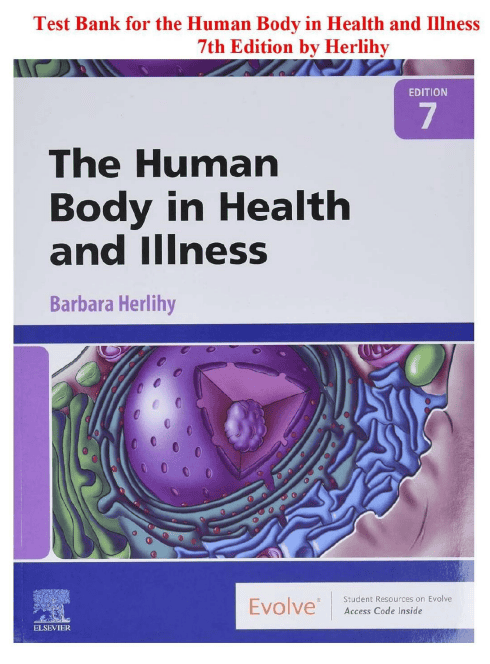
This comprehensive test bank is built for the 7th Edition of The Human Body in Health and Illness by Herlihy. It is one of the most accessible, student-friendly anatomy and physiology textbooks in healthcare education — written specifically for nursing and allied health students who need to master foundational science without losing sight of its clinical relevance.
This test bank transforms that foundational content into focused, exam-ready practice — helping you retain more, study smarter, and walk into every exam with genuine confidence.
Whether you are completing a nursing prerequisite, preparing for a course exam, or building the science foundation your nursing program demands, this resource delivers the systematic, body-system-by-body-system practice you need.
What’s Inside?
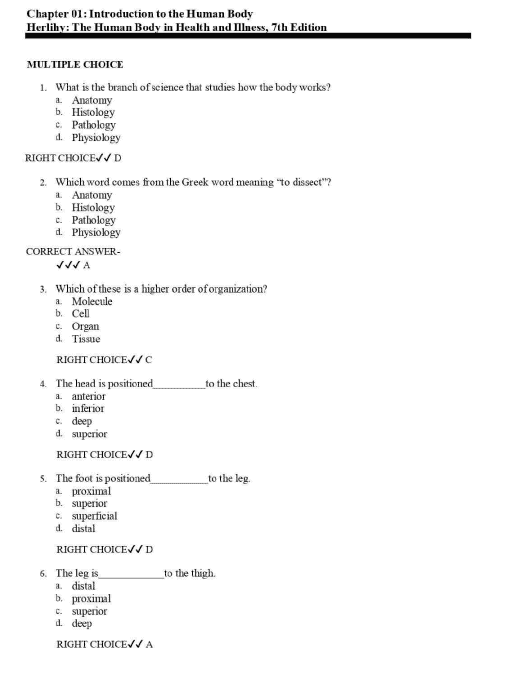
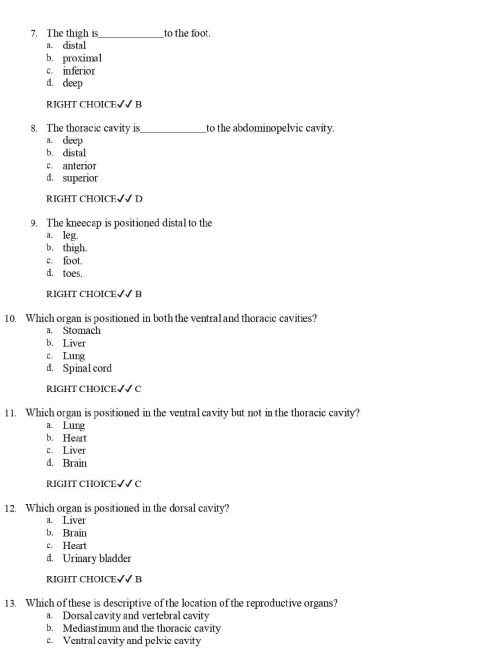
- Hundreds of practice questions covering every chapter
- Multiple-choice, true/false, matching, and clinical application questions
- Complete answer keys with clear, detailed rationales
- Questions covering anatomical structures, physiological processes, and disease conditions
- Content aligned with nursing and allied health program examination standards
Who Is This Test Bank For?
This resource is perfect for:
- Pre-nursing students completing anatomy and physiology prerequisites
- Practical nursing and LPN students building foundational science knowledge
- Allied health students in medical assisting, radiography, and respiratory therapy programs
- Nursing students reviewing core anatomy and physiology concepts
- Science instructors building course exams and unit assessments
- Healthcare professionals seeking a foundational science refresher
Topics Covered Include:
- Organization of the human body — cells, tissues, and body cavities
- Homeostasis and feedback mechanisms
- The integumentary system — skin, hair, and nails
- The skeletal system — bones, joints, and skeletal anatomy
- The muscular system — muscle types, contraction, and movement
- The nervous system — central, peripheral, and autonomic divisions
- Sensory systems — vision, hearing, taste, smell, and touch
- The endocrine system — hormones and glandular function
- The blood — composition, blood types, and clotting
- The cardiovascular system — heart anatomy, cardiac cycle, and blood vessels
- The lymphatic system and body immunity
- The respiratory system — anatomy, ventilation, and gas exchange
- The digestive system — organs, digestion, and absorption
- The urinary system — kidney function, urine formation, and fluid balance
- The reproductive system — male and female anatomy and physiology
- Acid-base balance and fluid and electrolyte regulation
- Disease conditions associated with each body system
Why This Test Bank Works
Anatomy and physiology is the science that makes nursing make sense.
When you understand how the cardiovascular system maintains cardiac output, you understand why heart failure causes the symptoms it does. When you know how the kidneys regulate fluid balance, you understand why CKD leads to edema and electrolyte imbalances. When you grasp how the nervous system controls muscle function, you understand why a stroke produces the deficits it does.
Herlihy’s textbook is uniquely designed to make those connections explicit — bridging normal anatomy and physiology to the disease states that nurses encounter every day. This test bank reinforces exactly that approach.
Every question is written to test not just anatomical recall but physiological understanding and clinical application. You will not simply label a diagram — you will explain why a structure’s anatomy determines its function. You will not just memorize a hormone — you will understand what happens when it is deficient or excessive. You will not only name a disease — you will connect it to the underlying physiological breakdown that causes it.
That level of applied understanding is what distinguishes students who merely pass their prerequisite from students who build the lasting scientific foundation that nursing school — and nursing practice — demands.
Detailed rationales explain the science behind every correct answer in clear, accessible language. Questions are organized chapter by chapter for structured, body-system-by-body-system study. Target your weakest systems first. Return to high-yield content as your exam approaches.
Sample Questions
Question 1
A student nurse is reviewing the concept of negative feedback in the endocrine system. Which of the following best illustrates a negative feedback mechanism?
- A) Rising blood glucose levels stimulate the pancreas to release more insulin, which lowers blood glucose
- B) Uterine contractions during labor stimulate the release of oxytocin, which intensifies contractions further
- C) Blood loss triggers increased heart rate, which further increases cardiac output
- D) A high fever stimulates shivering, which generates more body heat
Correct Answer: A
Rationale: Negative feedback is the body’s primary homeostatic mechanism — it works by reversing or opposing a change to restore balance. When blood glucose rises after a meal, the pancreas detects this and releases insulin, which lowers blood glucose back toward the normal range. Once blood glucose returns to normal, insulin secretion decreases — the system has corrected the deviation. This is the classic example of negative feedback. Option B describes positive feedback — oxytocin release during labor intensifies contractions rather than opposing them, continuing until birth occurs. Options C and D also describe processes that amplify rather than reverse the initial change, making them positive feedback examples. Negative feedback maintains stability; positive feedback drives a process to completion.
Question 2
A patient is diagnosed with a fracture of the surgical neck of the humerus. Which structure is most at risk for injury based on the anatomical location of this fracture?
- A) The radial nerve in the spiral groove of the humerus
- B) The axillary nerve and anterior circumflex humeral artery
- C) The ulnar nerve at the medial epicondyle
- D) The median nerve in the cubital fossa
Correct Answer: B
Rationale: The surgical neck of the humerus is the narrowed region just below the greater and lesser tubercles — a common site of humeral fractures, particularly in older adults following falls. The axillary nerve and the anterior circumflex humeral artery pass directly around the surgical neck of the humerus, making them highly vulnerable to injury at this location. Axillary nerve damage produces weakness of shoulder abduction and loss of sensation over the deltoid region. The radial nerve runs in the spiral groove of the humeral shaft — at risk in mid-shaft fractures. The ulnar nerve is vulnerable at the medial epicondyle — the “funny bone” location. The median nerve is at risk in supracondylar fractures near the elbow. Anatomical proximity to fracture sites determines neurovascular injury risk.
Question 3
A patient with chronic obstructive pulmonary disease has a chronically elevated PaCO₂. Which compensatory mechanism best explains the patient’s normal blood pH despite persistently elevated carbon dioxide levels?
- A) The respiratory system increases ventilation rate to blow off excess CO₂
- B) The kidneys retain bicarbonate to buffer the excess carbonic acid produced
- C) The liver produces additional albumin to buffer circulating hydrogen ions
- D) The spleen releases stored red blood cells to improve oxygen-carrying capacity
Correct Answer: B
Rationale: When PaCO₂ is chronically elevated — as in COPD — carbonic acid accumulates in the blood, threatening to lower pH and produce respiratory acidosis. The kidneys compensate through metabolic compensation by retaining bicarbonate ions and excreting hydrogen ions, raising the bicarbonate level to buffer the excess acid and restore pH toward normal. This is the classic renal compensation for chronic respiratory acidosis. In acute CO₂ elevation, the respiratory system would normally increase ventilation to blow off CO₂ — but in COPD patients, the respiratory system itself is the source of the problem and cannot fully compensate. The liver produces clotting factors and albumin but does not play a primary buffering role in acid-base compensation. Splenic red blood cell release improves oxygen delivery but does not correct acid-base imbalance.
Question 4
A patient with a urinary tract infection is found to have bacteria in the urine. The infection ascends and reaches the kidneys, causing pyelonephritis. Which specific region of the kidney is most directly affected by ascending infection?
- A) The renal cortex, containing the glomeruli and Bowman’s capsules
- B) The renal pelvis and calyces, the collecting structures of the kidney
- C) The loop of Henle in the renal medulla
- D) The juxtaglomerular apparatus responsible for renin secretion
Correct Answer: B
Rationale: Ascending urinary tract infections travel from the bladder through the ureters into the collecting system of the kidney — specifically the renal pelvis and calyces, which are the first renal structures encountered by ascending bacteria. Pyelonephritis — literally “inflammation of the renal pelvis and kidney” — begins in the renal pelvis and calyces and can progress into the medulla and cortex with severe infection. The renal cortex contains the filtration apparatus — glomeruli and Bowman’s capsules — which are affected in glomerulonephritis, a different pathological process typically caused by immune mechanisms rather than bacterial ascent. The loop of Henle and the juxtaglomerular apparatus are deeper renal structures involved in concentration and blood pressure regulation — not primary sites of ascending bacterial infection.
Question 5
A nursing student is studying the cardiac conduction system. In which order does a normal electrical impulse travel through the heart?
- A) SA node → AV node → Bundle of His → Bundle branches → Purkinje fibers
- B) AV node → SA node → Bundle of His → Purkinje fibers → Bundle branches
- C) SA node → Bundle of His → AV node → Bundle branches → Purkinje fibers
- D) Purkinje fibers → Bundle branches → AV node → SA node → Bundle of His
Correct Answer: A
Rationale: The normal cardiac conduction pathway begins at the sinoatrial node — the heart’s natural pacemaker — located in the right atrium. The impulse spreads through the atrial myocardium to the atrioventricular node, where it is delayed briefly to allow atrial contraction and ventricular filling to complete before ventricular activation. From the AV node, the impulse travels through the Bundle of His — the only electrical pathway between the atria and ventricles — into the right and left bundle branches, which distribute the impulse through the interventricular septum. Finally, the impulse reaches the Purkinje fibers, which rapidly distribute it throughout the ventricular myocardium, producing coordinated ventricular contraction. Disruption at any point in this pathway produces a specific cardiac dysrhythmia — making knowledge of the normal conduction sequence essential for ECG interpretation and dysrhythmia recognition.
Frequently Asked Questions (FAQs)
What edition does this test bank cover?
This test bank is written specifically for the 7th Edition of The Human Body in Health and Illness by Herlihy. All questions are fully aligned with the current edition’s chapter organization, updated physiological content, and disease condition coverage.
How are the questions organized?
Questions are arranged chapter by chapter — body system by body system — allowing you to study systematically from cellular biology through the reproductive system, or focus specifically on the systems where your exam performance needs the most improvement.
Is this test bank useful for nursing school prerequisites?
Absolutely. This test bank is designed precisely for students completing anatomy and physiology prerequisites for nursing and allied health programs. The questions mirror the level and style of course exams in pre-nursing and health science programs — making it an ideal companion for building the science foundation your nursing program will require.
Is this test bank appropriate for LPN and allied health students?
Yes. The Human Body in Health and Illness is widely used in LPN, medical assisting, radiography, respiratory therapy, and surgical technology programs. This test bank is equally valuable for students in all of these programs — wherever Herlihy’s textbook is the course text, this test bank is a directly relevant study resource.
How quickly can I access the test bank after purchase?
Immediately. As soon as your purchase is complete, you receive instant digital access with no waiting period. Study on your own schedule, at your own pace, from any device.
Are the rationales written in language that is accessible for pre-nursing students?
Yes. The rationales are written in clear, accessible language that explains the underlying science without assuming advanced clinical knowledge — appropriate for students at the prerequisite level while still building the clinical application thinking that nursing programs require.
Can instructors use this test bank for course assessments?
Absolutely. The chapter-by-chapter organization, varied question formats, and clinical application emphasis make this an excellent resource for faculty building unit exams, quizzes, and comprehensive course assessments for anatomy and physiology courses in nursing and allied health programs.
Foster867 –
This one has really been helpful in my A&P class
Helen Christie –
Perfect!
Caleb Martins –
A very good and easy to follow study guide for anatomy and physiology
Beverly –
Excellent quality
Norah Helen –
One of the best test banks I’ve ever used
Dorcas M. –
Every A&P student needs this
Vmansteain –
Exactly what I needed to build confidence
Liam Mbogo –
Helped me nail my midterm and final exams
Kamara Reid –
Very good
Mary Lincoln –
Simple, practical, and easy to study from
Lucas Gabriel –
Lots of useful practice questions in here
Terence V. –
Straightforward questions with helpful explanations.
Mary Kesh –
Convenient test bank for nursing students
Carol Kay –
Covers essential topics without feeling overwhelming.
Perpetual Gates –
Convenient material for short, focused study sessions.
Lucille Maria –
Helpful tool for strengthening recall of important topics.
Rachael M. –
Questions provide practical opportunities for self-checking
Jonny Frimpong –
Good resource for reviewing nursing fundamentals independently
Kai Marcus –
Makes challenging subjects easier to revisit regularly.
Dennys Kim –
Helpful questions for strengthening knowledge of patient safety.
Andy Sole –
Supports consistent practice across different subject areas.
Charlotte Rivera –
Practical questions for reviewing key learning points.
Doris King –
Makes independent test preparation more manageable.