

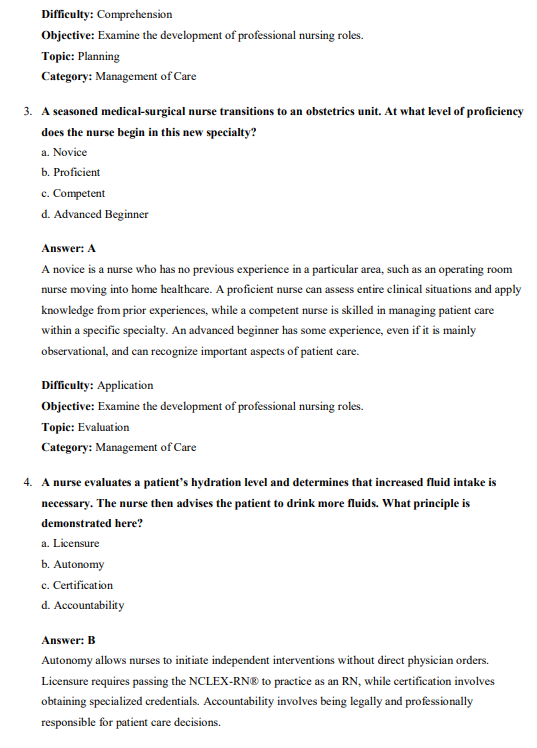
About This Test Bank
If you are just starting your nursing program, this test bank will be one of the most useful resources you own. It is built around Fundamentals of Nursing, 12th Edition by Potter, Perry, Stockert, and Hall — one of the most widely used nursing textbooks in the world.
This is not a summary guide or a shortcut. It is a full set of practice questions that test your understanding of core nursing concepts. Every question is tied to something you need to know to pass your exams and become a safe nurse.
We created this for one reason — to give nursing students a smarter way to prepare.
What’s Inside
When you get this test bank, here is what you will find:
- Hundreds of multiple-choice questions covering every chapter
- Questions written in the same style as NCLEX-RN exams
- Clear, correct answers for every single question
- Detailed rationales that explain the reasoning behind each answer
- Questions across all levels — recall, application, and analysis
- Content fully aligned with the 12th edition of the textbook
Topics Covered
Fundamentals of Nursing covers the building blocks of safe, patient-centered care. This test bank includes questions on all major topics in the book:
- The nursing process and clinical decision making
- Health assessment and physical examination
- Patient safety and infection control
- Vital signs and basic monitoring
- Medication administration and dosage calculations
- Wound care and skin integrity
- Nutrition and fluid balance
- Oxygenation and respiratory care
- Mobility, positioning, and exercise
- Pain management and comfort
- Sleep, hygiene, and elimination
- Communication and therapeutic relationships
- Documentation and informatics
- Legal and ethical foundations of nursing
- Health promotion across the lifespan
Who Should Use This
This test bank is ideal for:
- First and second-year nursing students studying fundamentals
- Students preparing for unit exams, midterms, and finals
- Anyone using Fundamentals of Nursing 12th Edition as their main text
- NCLEX-RN candidates who want to strengthen foundational knowledge
- Nursing faculty who need quality test questions for their courses
- Study groups looking for structured practice material
If fundamentals is your current course, this test bank gives you a direct line to the types of questions your instructors and licensing boards will ask.
Why Students Love It
Fundamentals of Nursing is a thick book. It covers a lot. Most students feel overwhelmed trying to study everything.
This test bank solves that problem. Instead of re-reading hundreds of pages, you can test yourself on the most important content. When you get a question wrong, you read the rationale and learn exactly why. That is one of the fastest ways to study.
Students who use this material regularly tend to:
- Walk into exams feeling more prepared
- Catch knowledge gaps before they show up on a test
- Understand the reasoning behind clinical decisions
- Build the kind of critical thinking that nursing boards expect
It is practical. It is focused. And it works.
Sample Questions with Answers & Rationales
Here are 10 sample questions from this test bank. They reflect the style and depth of what is inside.
Question 1
A nurse is preparing to perform hand hygiene before inserting an IV catheter. Which method is most appropriate?
- A. Rinsing hands with water only
- B. Using an alcohol-based hand rub
- C. Washing hands with soap and water for at least 20 seconds
- D. Wiping hands with a clean towel
Correct Answer: C Rationale: Before invasive procedures like IV insertion, soap and water handwashing for at least 20 seconds is recommended. Alcohol-based rubs are effective for routine care but soap and water is preferred when hands may come into contact with body fluids or before invasive procedures.
Question 2
Which of the following best describes the assessment phase of the nursing process?
- A. Carrying out the planned nursing interventions
- B. Collecting subjective and objective data about the patient
- C. Writing nursing diagnoses based on patient problems
- D. Evaluating whether the care plan goals were met
Correct Answer: B Rationale: Assessment is the first step of the nursing process. It involves gathering subjective data (what the patient reports) and objective data (what the nurse observes and measures). This information forms the basis for all other steps.
Question 3
A nurse enters a patient’s room and finds them on the floor. What is the nurse’s first action?
- A. Call for help immediately
- B. Check the patient for injury
- C. Assist the patient back into bed
- D. Document the incident in the chart
Correct Answer: B Rationale: The nurse must first assess the patient for injury before moving them. Moving a patient who has a spinal injury or fracture without assessment could cause serious harm. Calling for help and documentation come after the initial safety assessment.
Question 4
Which vital sign finding in an adult patient requires immediate nursing attention?
- A. Blood pressure of 118/76 mmHg
- B. Respiratory rate of 10 breaths per minute
- C. Oral temperature of 37.1°C
- D. Heart rate of 78 beats per minute
Correct Answer: B Rationale: A respiratory rate of 10 breaths per minute is below the normal range of 12 to 20 breaths per minute for adults and indicates bradypnea. This can signal respiratory depression or neurological compromise and requires prompt assessment and intervention.
Question 5
A nurse is teaching a patient about a low-sodium diet. The patient says, “I don’t understand why this matters.” What is the best response?
- A. “Your doctor ordered it, so you need to follow it.”
- B. “Too much sodium can cause your body to retain fluid, which raises blood pressure.”
- C. “It is not that complicated. Just avoid salty food.”
- D. “You can ask your doctor about it at your next appointment.”
Correct Answer: B Rationale: Effective patient education means explaining the reason behind the instruction in simple terms. This response gives the patient a clear, meaningful explanation that supports their understanding and motivation to comply with the diet.
Question 6
Which action by the nurse best prevents the spread of infection when changing a wound dressing?
- A. Wearing gloves only when touching the wound directly
- B. Using sterile technique throughout the entire procedure
- C. Washing hands after the dressing change is complete
- D. Disposing of old dressings in the regular trash bin
Correct Answer: B Rationale: Sterile technique is required during wound dressing changes to prevent introducing microorganisms into the wound. Gloves alone are not sufficient. Hand hygiene should occur both before and after the procedure, and contaminated materials must be disposed of properly.
Question 7
A patient reports pain as 8 out of 10 thirty minutes after receiving oral pain medication. What should the nurse do first?
- A. Reassure the patient that the medication needs more time to work
- B. Document the pain score and check back in an hour
- C. Reassess the patient and notify the prescriber of inadequate pain relief
- D. Ask the patient to use relaxation techniques until the pain improves
Correct Answer: C Rationale: Pain that remains high after an appropriate time for medication to take effect requires reassessment and communication with the prescriber. Effective pain management is a patient right, and the nurse is responsible for advocating for adequate relief.
Question 8
What is the primary purpose of a nursing care plan?
- A. To document the nurse’s daily schedule
- B. To provide a structured guide for individualized patient care
- C. To record the patient’s medical history
- D. To satisfy hospital accreditation requirements
Correct Answer: B Rationale: A nursing care plan organizes and communicates a patient-centered approach to care. It includes nursing diagnoses, goals, interventions, and evaluation criteria. It ensures consistency across all nurses caring for the patient.
Question 9
A nurse is preparing to administer medication and notices the patient’s name on the label does not match the wristband. What should the nurse do?
- A. Administer the medication and correct the label afterward
- B. Ask the patient to confirm their name verbally and proceed
- C. Hold the medication and clarify the discrepancy before administering
- D. Check the chart and administer if the medication seems correct
Correct Answer: C Rationale: Medication safety requires verification of at least two patient identifiers before administration. A mismatch between the label and wristband is a red flag that must be resolved before proceeding. Administering without clarification puts the patient at risk for a serious medication error.
Question 10
Which position is best for a patient who is having difficulty breathing?
- A. Supine with legs elevated
- B. Prone position
- C. Semi-Fowler’s or high Fowler’s position
- D. Left lateral position
Correct Answer: C Rationale: Semi-Fowler’s (30 to 45 degrees) or high Fowler’s (60 to 90 degrees) positions allow the diaphragm to drop and the lungs to expand more fully. These positions reduce the work of breathing and improve oxygenation in patients with respiratory difficulty.
Frequently Asked Questions (FAQs)
Is this the official test bank from the publisher? No. This is an independently developed study resource. It is not affiliated with Elsevier, the publisher of Fundamentals of Nursing, or with the textbook authors. It is intended to support your independent study.
Do I need to own the textbook to use this? It helps to have the textbook as a reference, but it is not required. The questions and rationales are written clearly enough to stand on their own as a study tool.
What file format will I receive? Your test bank comes in PDF and Word format. Both versions are easy to open on any device — laptop, tablet, or smartphone.
How soon will I get my file after purchase? Right away. Once your payment goes through, a download link is sent to your email automatically. Most students have their file in hand within a few minutes.
Can I use this to prepare for the NCLEX-RN? Yes. Fundamentals content makes up a significant portion of the NCLEX-RN. These questions are written in NCLEX style and build the critical thinking skills the exam requires. It is a great supplement to a full NCLEX prep program.
Is this useful for nursing instructors? Absolutely. Instructors can use these questions to build quizzes, exams, and homework assignments. All questions come with answers and rationales, making them easy to adapt and grade.
What if there is a problem with my order? Reach out to our support team. We stand behind every product we sell and will work quickly to resolve any issue you have with your purchase.

Anne M. –
A very helpful test bank. I recommend it to every nursing student
Ivy Amara –
Perfect!
Caytlene J. –
Well organized, clear, and concise.
Peterson S. –
This study resource is pure gold.
Warren Brent –
Exactly what I needed
Winnie M. –
This test bank is so valuable. It helped me pass my finals.
Gerald N –
An excellent resource for nursing fundamentals exam preps
Grace W. –
Very good