Critical care nursing is where clinical knowledge meets split-second decision making.
It is where the margin for error is razor thin. Where a subtle change in a patient’s hemodynamic status can signal impending catastrophe. Where your ability to interpret a waveform, recognize a dysrhythmia, troubleshoot a ventilator alarm, and prioritize interventions simultaneously — all while communicating with a frightened family — defines the standard of care.
It is the most demanding environment in nursing. And it demands the most rigorous preparation.
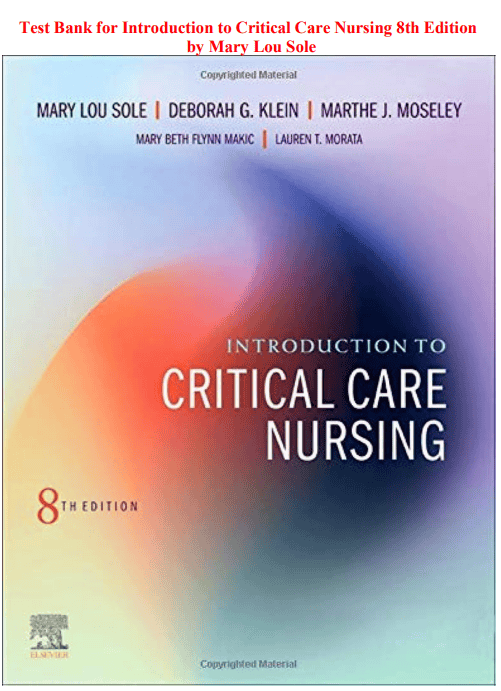
This comprehensive test bank is built for the 8th Edition of Introduction to Critical Care Nursing by Mary Lou Sole. It is one of the most authoritative and widely used critical care nursing textbooks in undergraduate and graduate nursing education — and this test bank helps you command every chapter of it with the focused, high-acuity clinical practice that critical care demands.
Whether you are preparing for a critical care nursing course exam, a progressive care unit competency evaluation, or the CCRN certification examination, this resource delivers the depth, precision, and clinical complexity that critical care nursing requires.
What’s Inside?
- Hundreds of practice questions covering every chapter
- Multiple-choice, select-all-that-apply, priority, and complex clinical scenario questions
- Complete answer keys with thorough, evidence-based clinical rationales
- Questions aligned with NCLEX-RN and CCRN examination content standards
- Coverage of all major critical care body systems, monitoring technologies, and advanced nursing interventions
Who Is This Test Bank For?
This resource is ideal for:
- Undergraduate RN nursing students in critical care or advanced medical-surgical courses
- New graduate nurses completing critical care unit orientation and competency programs
- CCRN and PCCN certification examination candidates
- Graduate nursing students in acute care or critical care NP programs
- Nursing faculty developing critical care course exams and clinical competency assessments
- Experienced nurses transitioning from general nursing into ICU or progressive care settings
- Flight nurses and transport nurses seeking to reinforce critical care foundations
Topics Covered Include:
- Foundations of critical care nursing practice and the ICU environment
- Legal, ethical, and end-of-life considerations in critical care
- Hemodynamic monitoring — arterial lines, CVP, and pulmonary artery catheters
- Cardiac rhythm interpretation and dysrhythmia management
- 12-lead ECG interpretation in the critical care setting
- Airway management and endotracheal intubation principles
- Mechanical ventilation — modes, settings, alarms, and weaning
- Cardiovascular disorders — heart failure, acute coronary syndromes, and cardiogenic shock
- Shock states — hypovolemic, distributive, obstructive, and cardiogenic
- Respiratory failure — ARDS, pulmonary embolism, and ventilator-associated pneumonia
- Neurological critical care — TBI, stroke, ICP monitoring, and status epilepticus
- Renal failure and continuous renal replacement therapy
- Gastrointestinal critical care — GI bleeding, hepatic failure, and acute pancreatitis
- Hematological emergencies and disseminated intravascular coagulation
- Endocrine emergencies — diabetic ketoacidosis, HHS, and thyroid storm
- Multisystem trauma and burns critical care
- Sepsis, systemic inflammatory response, and multiorgan dysfunction syndrome
- Pain, agitation, and delirium management in the ICU
- Nutrition support in critically ill patients
- Caring for the critically ill older adult
Why This Test Bank Delivers Results
Critical care nursing questions are the most complex questions in nursing education.
They demand simultaneous application of pathophysiology, pharmacology, hemodynamic principles, and clinical prioritization. A single question might require you to interpret a pulmonary artery waveform, recognize its clinical significance, identify the most appropriate nursing intervention, and understand why all other options are incorrect — all at once.
That is the cognitive load of the CCRN. That is the cognitive load of the bedside ICU nurse. And that is exactly the level of thinking this test bank builds.
Every question is grounded in real critical care clinical scenarios drawn from the framework Mary Lou Sole establishes throughout the textbook. You will not simply recall definitions of hemodynamic parameters. You will interpret them in context — recognizing when a CVP of 2 mmHg signals volume depletion versus when a PAWP of 24 mmHg indicates left ventricular failure. You will manage ventilator alarms, recognize ventilator-associated complications, prioritize care for the septic patient in multi-organ failure, and navigate the ethical complexities of end-of-life decision-making in the ICU.
Detailed rationales do not just identify correct answers. They walk through the hemodynamic reasoning, pathophysiological mechanisms, evidence-based protocols, and clinical decision-making frameworks behind every question. That level of explanation is what transforms a practice question into a genuine learning opportunity — and a learning opportunity into clinical mastery.
Questions are organized chapter by chapter for structured, systematic study. Whether you are building your critical care knowledge from the ground up or fine-tuning your CCRN exam preparation, this test bank supports every stage of your clinical development.
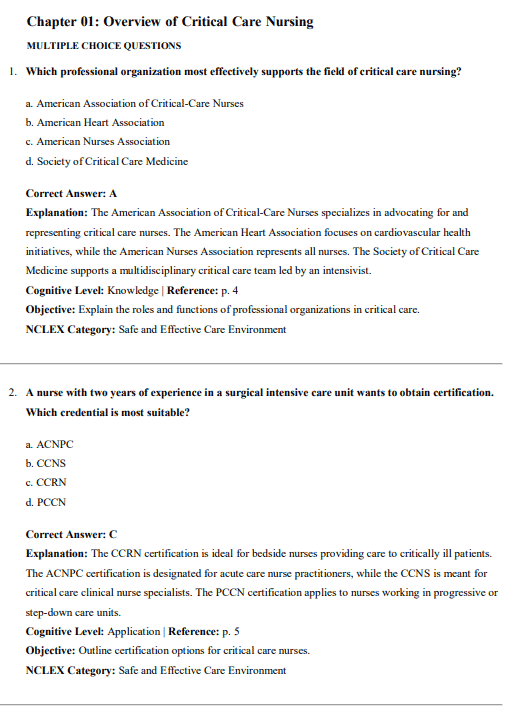
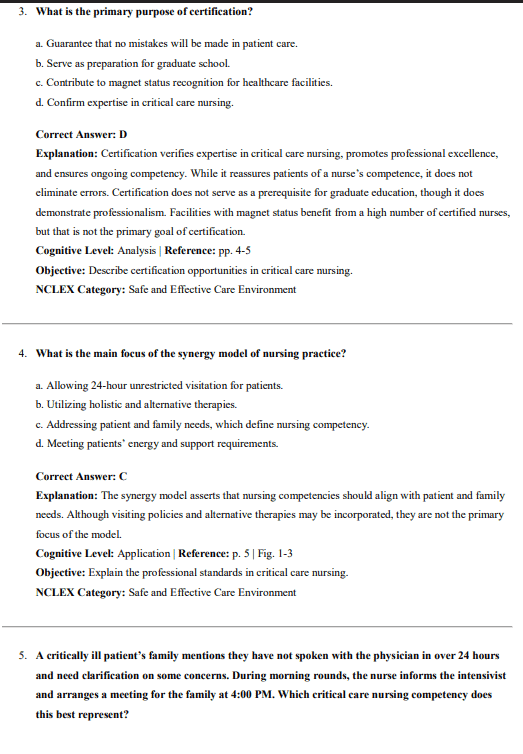
Sample Questions
Question 1
A nurse is caring for a patient in the ICU following coronary artery bypass grafting. The patient’s pulmonary artery wedge pressure is 22 mmHg, cardiac output is 3.1 L/min, and systemic vascular resistance is elevated. The patient is hypotensive with cool, mottled extremities. Which condition does this hemodynamic profile most likely represent?
- A) Hypovolemic shock
- B) Distributive shock
- C) Cardiogenic shock
- D) Obstructive shock
Correct Answer: C
Rationale: This hemodynamic profile is the classic presentation of cardiogenic shock — the most feared complication following cardiac surgery. An elevated pulmonary artery wedge pressure indicates elevated left ventricular filling pressure and pulmonary congestion, reflecting a failing, fluid-overloaded left ventricle. A cardiac output of 3.1 L/min is critically low for a post-surgical adult. Elevated systemic vascular resistance reflects compensatory peripheral vasoconstriction as the body attempts to maintain perfusion pressure despite low cardiac output. Cool, mottled extremities confirm poor peripheral perfusion. Hypovolemic shock would present with low PAWP, not elevated. Distributive shock — as in sepsis or anaphylaxis — presents with low SVR and warm extremities. Obstructive shock — from tension pneumothorax or cardiac tamponade — presents with obstructed venous return rather than elevated filling pressures from ventricular failure.
Question 2
A mechanically ventilated patient in the ICU suddenly triggers a high-pressure alarm on the ventilator. The patient’s SpO₂ has dropped from 97% to 88% over the past five minutes. The patient is visibly agitated and tachycardic. Which nursing action should be performed first?
- A) Increase the FiO₂ to 100% and notify the respiratory therapist
- B) Administer a prescribed PRN sedative to reduce patient agitation
- C) Manually ventilate the patient with a bag-valve-mask device while assessing the cause of the alarm
- D) Suction the endotracheal tube and reassess the alarm
Correct Answer: C
Rationale: When a mechanically ventilated patient deteriorates acutely — dropping SpO₂ with a concurrent high-pressure alarm — the immediate priority is to disconnect the patient from the ventilator and manually ventilate with a bag-valve-mask device. This ensures the patient receives adequate ventilation regardless of the ventilator cause while the nurse simultaneously assesses for life-threatening causes using the DOPE mnemonic — Displacement of the endotracheal tube, Obstruction, Pneumothorax, and Equipment failure. Manual ventilation tells the nurse immediately whether the problem is patient-related or ventilator-related — if the BVM delivers breaths with normal resistance, the ventilator is the likely culprit. Increasing FiO₂ alone does not address the mechanical cause of deterioration. Sedation before identifying the cause is dangerous. Suctioning is one step in the assessment but should follow manual ventilation initiation, not precede it.
Question 3
A nurse is caring for a patient with severe sepsis who meets criteria for the Sepsis-3 definition with a SOFA score of 4. The patient has received two liters of IV crystalloid but remains hypotensive with a mean arterial pressure of 58 mmHg. Which intervention reflects current Surviving Sepsis Campaign guidelines?
- A) Administer an additional two liters of IV crystalloid before considering vasopressors
- B) Initiate norepinephrine as the first-line vasopressor to achieve MAP of 65 mmHg or greater
- C) Begin dopamine infusion at a renal protective dose to preserve kidney perfusion
- D) Withhold vasopressors until blood cultures have been collected and antibiotics administered
Correct Answer: B
Rationale: Current Surviving Sepsis Campaign guidelines recommend norepinephrine as the first-line vasopressor for septic shock — not dopamine — due to its superior hemodynamic profile and lower risk of tachyarrhythmias. The MAP target is 65 mmHg or greater. When a patient remains hypotensive after adequate initial fluid resuscitation — typically 30 mL/kg IV crystalloid — vasopressors should be initiated without further delay to prevent ongoing organ hypoperfusion. Continuing to administer additional IV fluids without vasopressor support in a patient who has not responded to initial resuscitation risks fluid overload, pulmonary edema, and worsening outcomes. Low-dose dopamine for renal protection has been definitively disproven in clinical trials and is no longer recommended. While blood cultures and antibiotics are critical sepsis interventions, vasopressor initiation should not be delayed pending their completion when hemodynamic instability persists.
Question 4
A nurse is monitoring a patient with a traumatic brain injury. The patient’s ICP has been ranging between 18–22 mmHg. The current MAP is 78 mmHg. Which statement best reflects the nurse’s understanding of cerebral perfusion pressure in this patient?
- A) The cerebral perfusion pressure is adequate at approximately 100 mmHg
- B) The cerebral perfusion pressure is critically low at approximately 56 mmHg
- C) The cerebral perfusion pressure is within the target range at approximately 60 mmHg
- D) The cerebral perfusion pressure cannot be calculated without a direct cerebral blood flow measurement
Correct Answer: C
Rationale: Cerebral perfusion pressure is calculated as CPP = MAP − ICP. With a MAP of 78 mmHg and an ICP of approximately 20 mmHg, the CPP is 78 − 20 = 58 mmHg — which rounds to approximately 60 mmHg when using the midrange ICP value of 18 mmHg (78 − 18 = 60). The target CPP range in traumatic brain injury management per Brain Trauma Foundation guidelines is 60–70 mmHg. A CPP of 60 mmHg is therefore at the lower acceptable limit and requires close monitoring but does not represent a critical emergency requiring immediate escalation. A CPP below 50 mmHg would indicate critically inadequate cerebral perfusion. CPP is a calculated value derived entirely from MAP and ICP — direct cerebral blood flow measurement is not required.
Question 5
A nurse is caring for a patient with acute respiratory distress syndrome who is being ventilated using lung-protective ventilation strategy. The prescribed tidal volume is 6 mL/kg of ideal body weight. The patient weighs 80 kg. The nurse notes peak inspiratory pressures consistently above 35 cmH₂O. Which intervention is most consistent with current ARDS Network guidelines?
- A) Increase the tidal volume to improve minute ventilation and reduce peak pressures
- B) Decrease the tidal volume to 4–5 mL/kg and accept permissive hypercapnia if necessary
- C) Increase the PEEP level to recruit collapsed alveoli and reduce peak pressures
- D) Switch the ventilator mode to pressure support to allow spontaneous breathing
Correct Answer: B
Rationale: Lung-protective ventilation in ARDS is founded on limiting volutrauma and barotrauma to prevent ventilator-induced lung injury. The ARDS Network protocol recommends tidal volumes of 6 mL/kg of ideal body weight with a plateau pressure target below 30 cmH₂O. When peak pressures exceed 35 cmH₂O consistently, the appropriate response is to further reduce tidal volume — to 4–5 mL/kg — even if this results in permissive hypercapnia. Permissive hypercapnia — accepting elevated PaCO₂ to prioritize lung protection — is a well-established and intentional strategy in ARDS management. Increasing tidal volume worsens barotrauma and directly contradicts lung-protective strategy. While PEEP adjustments play an important role in ARDS management, simply increasing PEEP without reducing tidal volume does not address the excessive peak pressures from overdistension. Pressure support ventilation requires spontaneous respiratory effort and is not appropriate in severe ARDS requiring full ventilatory support.
Frequently Asked Questions (FAQs)
What edition does this test bank cover?
This test bank is written specifically for the 8th Edition of Introduction to Critical Care Nursing by Mary Lou Sole. All questions are fully aligned with the current edition’s chapter organization, updated hemodynamic monitoring standards, current evidence-based critical care protocols, and the latest Surviving Sepsis Campaign and ARDS Network guidelines.
How are the questions organized?
Questions are arranged chapter by chapter, allowing you to study systematically through all critical care content areas or focus on specific high-acuity topics — such as hemodynamic monitoring, mechanical ventilation, shock states, or neurological critical care — based on your course exam schedule or CCRN certification preparation priorities.
Is this test bank aligned with the CCRN examination?
Yes. Questions are written to reflect the clinical complexity, hemodynamic reasoning, and application-level thinking assessed on the CCRN certification examination administered by AACN. The emphasis on critical interpretation, priority clinical decision-making, and complex multi-system patient scenarios directly mirrors the cognitive demands of CCRN board preparation.
Is this test bank appropriate for new graduate nurses entering critical care?
Absolutely. New graduates completing ICU orientation will find this test bank an invaluable resource for building the clinical reasoning and pathophysiological understanding that critical care practice demands. The detailed rationales are particularly valuable for new nurses developing the hemodynamic and ventilator management knowledge base that experienced critical care nurses rely on daily.
How quickly can I access the test bank after purchase?
Immediately. As soon as your purchase is complete, you receive instant digital access with no waiting period. Study on your own schedule, at your own pace, from any device.
Are the rationales grounded in current critical care evidence and guidelines?
Yes. Every rationale reflects current evidence-based critical care standards — including AACN practice guidelines, Surviving Sepsis Campaign recommendations, ARDS Network protocols, Brain Trauma Foundation guidelines, and ACC/AHA cardiac care standards — consistent with the evidence-based framework Mary Lou Sole establishes throughout the 8th Edition.
Can nursing faculty use this test bank for course assessments?
Absolutely. The chapter-by-chapter organization, complex clinical scenario emphasis, and varied question formats make this an outstanding resource for faculty building quizzes, unit exams, and comprehensive assessments for undergraduate critical care nursing courses and graduate acute care NP programs.


Janty956 –
Very very helpful
Jonny Wright –
The test helped me overcome exam anxiety
Gracemoh –
Exactly what I was looking for. Thanx
Helen Christie –
very very helpful
Donald H. –
a solid test bank.
Sasha Gerald –
Excellent
Chris martin –
It really helped me nail my ICU exams
Norah Helen –
Amazing study guide
Peterson S. –
perfectly organized test bank
Caleb Martins –
Perfect!
Betty N. –
A solid study guide
Gerald N –
Perfect study guide for ICU nursing
Winnie M. –
Very good
Melania Angel –
A very underrated resource for ICU studies
Kamara Reid –
This resource helped me face my finals with renewed confidence.
Grace W. –
I like it a lot
Theresa M. –
Very good
Bruno Molino –
Excellent resource for nursing exam preparation
Lucas Gabriel –
Helped me understand complex nursing concepts
Thomas K. –
The questions made studying more engaging
Lucas Gabriel –
Straightforward and really convenient
Nelly –
Useful practice before exam day
Terence V. –
Very helpful for reviewing difficult ICU nursing concepts.
Kevin May –
Questions were clear, relevant, and appropriately challenging.
Warren Brent –
Straightforward questions with helpful answer explanations.
Karen Njiru –
Convenient study resource for busy nursing students.
Leah Kiptum –
Great way to reinforce concepts learned in class.
Nelius M. –
I liked how the questions covered a wide range of ICU nursing topics.
Perpetual Gates –
Helped me feel more prepared for my exam