Clinical competence in medical-surgical nursing is not built in a single study session. It is built question by question, patient scenario by patient scenario, clinical decision by clinical decision.
Medical-surgical nursing is where the full scope of human illness meets the full depth of nursing knowledge. It is the specialty that demands you know cardiovascular pathophysiology as fluently as you know post-surgical wound assessment. Where you manage a patient in respiratory distress in one room and a patient requiring diabetes education in the next. Where you recognize early sepsis before the blood cultures have returned, de-escalate a patient’s anxiety before it becomes a safety concern, and delegate safely in a unit where everyone is stretched thin.
It is the clinical environment that produces the most well-rounded nurses in healthcare — and the content area that determines more NCLEX outcomes than any other single domain.
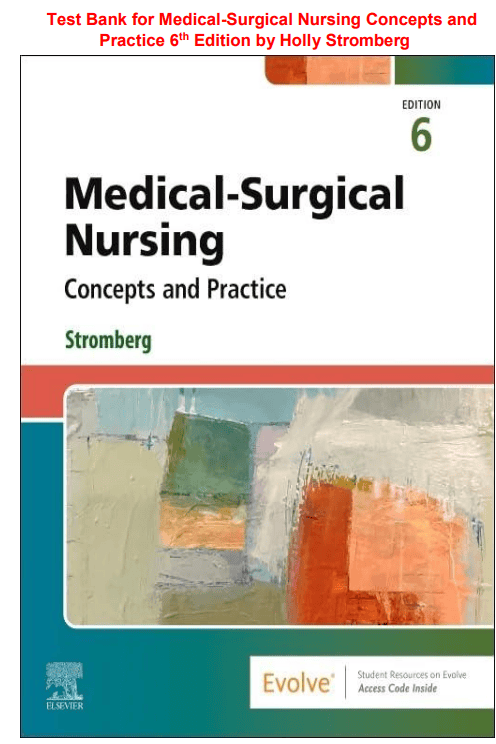
This comprehensive test bank is built for the 6th Edition of Medical-Surgical Nursing: Concepts and Practice by Holly Stromberg. It is one of the most widely used, most concept-driven, and most clinically respected medical-surgical nursing textbooks in undergraduate nursing education — and this test bank unlocks the full examination and clinical preparation value of every chapter.
Whether you are preparing for a unit exam, a comprehensive course final, an ATI proctored assessment, or the NCLEX-RN, this resource delivers the rigorous, systems-based, clinically applied practice that Stromberg’s 6th Edition demands — and that clinical nursing practice rewards every single shift.
What’s Inside?
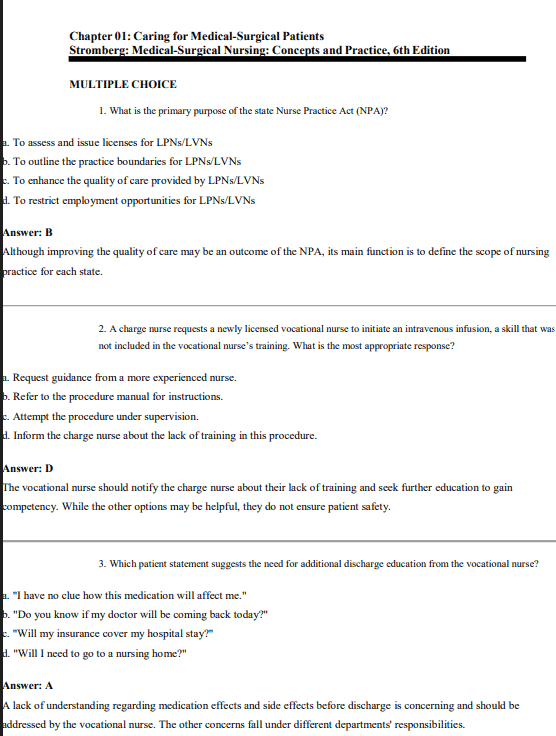
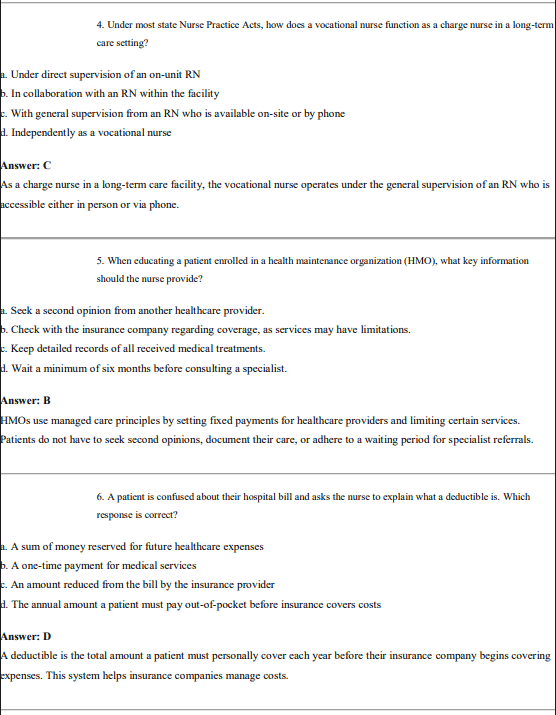
- Hundreds of practice questions mapped to every chapter
- Multiple-choice, select-all-that-apply, priority, delegation, and Next Generation NCLEX-style clinical scenario questions
- Complete answer keys with thorough, pathophysiologically grounded clinical rationales
- Questions aligned with current NCLEX-RN and Next Generation NCLEX examination standards
- Coverage of all major body systems, surgical nursing concepts, and evidence-based med-surg practice — fully aligned with the 6th Edition
Who Is This Test Bank For?
This resource is perfect for:
- Undergraduate RN nursing students in medical-surgical nursing courses using Stromberg’s 6th Edition
- NCLEX-RN candidates seeking comprehensive, systems-based med-surg content review
- LPN-to-RN bridge students updating and expanding medical-surgical nursing knowledge
- Nursing faculty building rigorous 6th Edition-aligned course exams and unit assessments
- Nursing students in accelerated BSN or second-degree programs covering medical-surgical content
- New graduate nurses reinforcing and consolidating med-surg clinical competency
- ATI pharmacology and medical-surgical assessment preparation students
Topics Covered Include:
- Foundations of medical-surgical nursing and evidence-based practice
- Fluid, electrolyte, and acid-base balance and clinical imbalances
- Perioperative nursing — preoperative, intraoperative, and postoperative care
- Pain — acute and chronic assessment and evidence-based management
- Oncology nursing and cancer care management
- Immune disorders — HIV/AIDS, autoimmune, and allergy conditions
- Integumentary disorders and wound management
- Sensory disorders — ophthalmic and auditory conditions
- Musculoskeletal disorders and orthopedic nursing care
- Neurological disorders — stroke, TBI, seizures, and neurodegenerative conditions
- Cardiovascular disorders — heart failure, ACS, dysrhythmias, and vascular conditions
- Hematological disorders — anemia, clotting disorders, and blood dyscrasias
- Respiratory disorders — pneumonia, COPD, asthma, and acute respiratory failure
- Gastrointestinal disorders and hepatobiliary conditions
- Endocrine disorders — diabetes mellitus, thyroid disease, and adrenal conditions
- Renal and urological disorders and chronic kidney disease
- Reproductive system disorders and sexually transmitted infections
- Mental health considerations in the medical-surgical care setting
Why This Test Bank Delivers Results
Holly Stromberg’s 6th Edition of Medical-Surgical Nursing: Concepts and Practice is built around a framework that distinguishes it from more encyclopedic med-surg resources — the conviction that nursing students learn best when clinical concepts are made concrete, when pathophysiology is directly connected to nursing assessment and intervention, and when the sheer volume of med-surg content is organized in a way that supports genuine understanding rather than overwhelming memorization.
This test bank honors and extends that framework — developing the applied clinical thinking that Stromberg’s concept-driven approach builds.
Every question in this test bank is designed to require more than content recall. You will identify the earliest clinical sign of increased intracranial pressure before herniation occurs — and explain which assessment parameter provides that warning. You will determine which of four assigned patients requires your immediate assessment at the beginning of a shift — not based on which diagnosis sounds most serious in the abstract, but based on the specific clinical data provided for each patient. You will distinguish between expected post-operative findings and early warning signs of surgical complications in a patient recovering from abdominal surgery. You will identify a safe delegation decision in a scenario where scope of practice boundaries are tested.
These are the clinical judgments the NCLEX tests. These are the decisions that protect patients. And this test bank builds them — systematically, body system by body system, clinical scenario by clinical scenario.
The 6th Edition reflects the most current evidence-based medical-surgical nursing practice — including updated clinical practice guidelines across all major body systems, current pharmacological management standards, and the most recent NCLEX-RN test plan including NGN clinical judgment integration. This test bank is fully aligned with every update.
Detailed rationales explain the pathophysiology, nursing priorities, evidence-based management standards, and clinical reasoning behind every correct answer. Questions are organized chapter by chapter for efficient, targeted study. Build the med-surg clinical competence that Stromberg demands — and that your patients depend on.
Sample Questions
Question 1
A nurse is caring for a patient admitted with a diagnosis of syndrome of inappropriate antidiuretic hormone. Laboratory results show serum sodium 119 mEq/L, serum osmolality 254 mOsm/kg, and urine osmolality 680 mOsm/kg. The patient is alert but reports a severe headache and is becoming increasingly confused. Which nursing action is the priority?
- A) Encourage oral fluid intake to correct the dilutional hyponatremia through increased urinary solute excretion
- B) Implement fluid restriction as prescribed, notify the provider of the worsening neurological symptoms, and prepare for hypertonic saline administration for severe symptomatic hyponatremia
- C) Administer a loop diuretic to increase free water excretion and correct the elevated urine osmolality
- D) Position the patient supine with legs elevated and reassess neurological status in two hours
Correct Answer: B
Rationale: This patient is presenting with severe symptomatic hyponatremia — serum sodium of 119 mEq/L with progressive neurological manifestations including severe headache and confusion. This is a neurological emergency. Severe hyponatremia causes cerebral edema as water moves from the hypotonic serum into brain cells along the osmotic gradient — producing the neurological symptoms observed. The urine osmolality of 680 mOsm/kg combined with low serum osmolality of 254 mOsm/kg confirms SIADH — the kidneys are inappropriately concentrating urine despite dilute serum, driven by autonomous ADH secretion. While fluid restriction remains the cornerstone of SIADH management, the development of severe neurological symptoms — headache with progressive confusion — indicates that the hyponatremia is now causing clinically significant cerebral compromise requiring more urgent intervention than fluid restriction alone. The provider must be notified immediately — hypertonic saline (3% NaCl) is indicated for severe symptomatic hyponatremia causing neurological manifestations to correct sodium more rapidly and reduce cerebral edema. Sodium must be corrected slowly — no more than 10–12 mEq/L per 24 hours — to prevent osmotic demyelination syndrome. Encouraging oral fluids worsens dilutional hyponatremia. Loop diuretics promote free water and sodium excretion — they are occasionally used adjunctively but do not address the acute neurological emergency. Supine positioning with leg elevation is inappropriate and does not address the pathological mechanism.
Question 2
A nurse is caring for a patient four hours post right total hip arthroplasty. During assessment, the nurse notes the patient’s right foot is pale and cool compared to the left, capillary refill is four seconds in the right great toe, the patient rates right lower extremity pain as 9 out of 10, and pedal pulse on the right is diminished compared to the left. The nurse had assessed equal bilateral pulses one hour ago. Which nursing action is the absolute priority?
- A) Elevate the right leg on two pillows to improve venous return and reduce distal edema
- B) Administer the prescribed PRN opioid analgesic for post-operative pain management and reassess in one hour
- C) Notify the surgeon immediately of the acute change in neurovascular assessment suggesting possible acute arterial compromise and prepare for urgent surgical evaluation
- D) Apply ice to the right lower extremity to reduce swelling and reassess peripheral pulses in 30 minutes
Correct Answer: C
Rationale: This clinical presentation — acute onset of pallor, coolness, prolonged capillary refill, severe pain, and diminished pulse in the operative extremity compared to one hour ago when pulses were equal — is the classic presentation of acute arterial compromise, potentially from vascular injury sustained during the hip arthroplasty or from acute thrombus formation. The critical clinical indicator is the change from baseline — pulses that were equal one hour ago are now asymmetrically diminished — indicating an acute neurovascular deterioration that represents a vascular emergency. The six Ps of acute arterial occlusion — pain, pallor, pulselessness, poikilothermia, paresthesia, and paralysis — are beginning to manifest in this patient. Acute arterial occlusion results in ischemia that can progress to irreversible muscle and nerve damage within hours. The surgeon must be notified immediately for emergent vascular assessment. Elevating the leg is contraindicated in arterial insufficiency — elevation reduces arterial perfusion pressure and worsens distal ischemia. Administering pain medication before addressing the vascular emergency delays critical intervention. Ice application further reduces arterial blood flow through vasoconstriction, worsening the ischemia. Waiting 30 minutes in a patient with evolving acute arterial compromise risks irreversible limb ischemia. This is a time-critical surgical emergency.
Question 3
A nurse is reviewing morning laboratory results for a patient with chronic liver failure secondary to alcoholic cirrhosis. Results show — INR 3.8, platelet count 62,000/mm³, albumin 1.9 g/dL, total bilirubin 8.4 mg/dL, and ammonia 98 mcmol/L. The patient is increasingly lethargic with asterixis noted on assessment. Which clinical condition does the elevated ammonia and neurological findings most likely indicate, and which nursing intervention is the priority?
- A) Wernicke’s encephalopathy from thiamine deficiency — administer prescribed IV thiamine immediately
- B) Hepatic encephalopathy from ammonia accumulation — notify the provider, administer lactulose as prescribed, and monitor neurological status frequently for progression
- C) Alcohol withdrawal delirium — initiate CIWA protocol and administer prescribed benzodiazepine
- D) Opioid toxicity from analgesic accumulation — hold all scheduled analgesics and administer naloxone
Correct Answer: B
Rationale: This patient’s clinical presentation — increasing lethargy, asterixis (flapping tremor), and elevated serum ammonia of 98 mcmol/L in the context of chronic liver failure with severely impaired synthetic function — is the classic presentation of hepatic encephalopathy. In liver failure, the hepatic urea cycle cannot adequately convert ammonia — generated from protein catabolism and gut bacterial activity — into urea for renal excretion. Ammonia accumulates in the systemic circulation and crosses the blood-brain barrier, where it is taken up by astrocytes, producing cerebral dysfunction. Asterixis — the bilateral flapping tremor of the outstretched hands — is a classic sign of metabolic encephalopathy, particularly hepatic encephalopathy. The laboratory profile confirms severe hepatic synthetic failure — INR of 3.8 reflects severely impaired clotting factor production, albumin of 1.9 g/dL reflects severely impaired albumin synthesis, thrombocytopenia from portal hypertension-related sequestration, and hyperbilirubinemia from impaired bilirubin conjugation. The priority intervention is notification of the provider and administration of lactulose — the first-line treatment for hepatic encephalopathy. Lactulose acidifies the colon to trap ammonia as non-absorbable ammonium ion, reduces ammonia-producing intestinal bacteria, and acts as a cathartic to eliminate ammonia-laden intestinal contents. Dietary protein modification and possible rifaximin addition are secondary interventions. While Wernicke’s encephalopathy is a concern in alcohol-dependent patients, the specific combination of elevated ammonia and asterixis points to hepatic encephalopathy. CIWA protocol addresses alcohol withdrawal — the clinical picture here is metabolic, not withdrawal.
Question 4
A charge nurse is beginning the night shift and must prioritize patient assessments. Which patient should be seen first?
- A) A 54-year-old with stable angina who received their scheduled nitroglycerin patch three hours ago and is watching television comfortably
- B) A 67-year-old who is two days post sigmoid colectomy and reports their surgical incision is “feeling tighter” — current vital signs show temperature 38.8°C, heart rate 102 bpm, and respiratory rate 20 breaths per minute
- C) A 45-year-old with type 2 diabetes whose evening blood glucose is 218 mg/dL and is requesting their evening snack
- D) A 71-year-old with chronic heart failure who is sleeping comfortably with oxygen saturation of 94% on 2 L/min nasal cannula, baseline for this patient
Correct Answer: B
Rationale: Clinical prioritization requires identifying the patient demonstrating the most acute and potentially life-threatening change from expected post-operative recovery. The post-sigmoid colectomy patient on day two is presenting with a clinical picture that raises serious concern for early surgical site infection, anastomotic leak, or developing sepsis — fever of 38.8°C, tachycardia of 102 bpm, and the subjective report that their surgical incision feels “tighter” suggesting increasing wound tension, possible edema, or fluid accumulation. The combination of these systemic inflammatory signs with a subjective wound change on post-operative day two requires immediate nursing assessment. Anastomotic leak — a serious, potentially life-threatening complication of bowel surgery — typically manifests between days three and seven but can begin earlier, often presenting with fever, tachycardia, and localized abdominal discomfort. Unrecognized, it can progress to fecal peritonitis and septic shock with rapid mortality. The stable angina patient is comfortable and stable with no acute change. The diabetic patient with a blood glucose of 218 mg/dL needs attention but is not in acute danger. The chronic heart failure patient is at their documented baseline — 94% SpO₂ on 2 L/min is their established normal, not a new deterioration. Acute changes in a post-operative patient with systemic inflammatory signs always take priority over stable or baseline clinical situations.
Question 5
A nurse is providing discharge education to a patient being discharged home after treatment for a pulmonary embolism. The patient will continue warfarin therapy and has been prescribed a diet plan. Which patient statement indicates the teaching has been effective?
- A) “I should eat extra spinach and kale every day since these green vegetables will help thin my blood along with the warfarin.”
- B) “I will keep my vitamin K intake consistent rather than eliminating leafy green vegetables — sudden changes in how much I eat will affect my INR.”
- C) “I can stop taking warfarin once I feel completely better since I am only on it temporarily.”
- D) “I should take ibuprofen for any aches and pains since aspirin can interact with warfarin.”
Correct Answer: B
Rationale: This statement demonstrates accurate understanding of the most important dietary principle in warfarin management — consistency of vitamin K intake rather than elimination. Warfarin works by inhibiting vitamin K-dependent clotting factors II, VII, IX, and X. Vitamin K — found abundantly in leafy green vegetables including spinach, kale, broccoli, and Brussels sprouts — is the pharmacological antagonist of warfarin’s mechanism. Dramatic fluctuations in dietary vitamin K intake create corresponding fluctuations in INR — sudden large increases in vitamin K intake reduce warfarin’s anticoagulant effect and lower INR, while sudden decreases in vitamin K intake enhance warfarin’s effect and elevate INR, increasing bleeding risk. The evidence-based dietary recommendation is to maintain consistent vitamin K intake — the patient does not need to avoid green vegetables but must eat them in approximately consistent amounts day to day. Eating extra spinach and kale would antagonize warfarin and reduce anticoagulation — opposite of the intended effect. Stopping warfarin when feeling better is dangerous — pulmonary embolism treatment typically requires three to six months of anticoagulation and stopping independently risks recurrent thromboembolic event. Both ibuprofen and aspirin are contraindicated with warfarin — NSAIDs inhibit platelet aggregation and can displace warfarin from plasma protein binding, significantly increasing bleeding risk. Acetaminophen is the recommended analgesic for patients on warfarin for mild to moderate pain.
Frequently Asked Questions (FAQs)
What edition does this test bank cover?
This test bank is written specifically for the 6th Edition of Medical-Surgical Nursing: Concepts and Practice by Holly Stromberg. All questions are fully aligned with the current edition’s chapter organization, updated clinical content, evidence-based practice standards, and current NCLEX-RN and NGN examination frameworks.
How are the questions organized?
Questions are arranged chapter by chapter, allowing you to study systematically through every major body system or target specific content areas — such as cardiovascular, neurological, or endocrine nursing — based on your upcoming exam priorities or identified knowledge gaps.
Is this test bank aligned with the NCLEX-RN and Next Generation NCLEX?
Yes. Questions are written to reflect current NCLEX-RN examination standards and incorporate the clinical judgment emphasis of the Next Generation NCLEX framework. Priority, delegation, clinical deterioration recognition, and complex scenario questions are featured throughout — directly mirroring the cognitive demands of both traditional and NGN examination formats.
Is this the same as previously created test bank content for this textbook?
No. This version contains entirely new sample questions, updated rationales, and a fresh meta description — completely distinct from any previous version. The clinical scenarios, pharmacological examples, and rationale explanations are all original to this iteration.
Is this test bank useful for NCLEX-RN candidates reviewing med-surg content?
Absolutely. Medical-surgical content represents the largest single NCLEX-RN content category. This test bank provides systematic chapter-by-chapter coverage combined with application-level clinical reasoning — making it one of the most effective NCLEX med-surg review resources available for students using Stromberg’s 6th Edition.
How quickly can I access the test bank after purchase?
Immediately. As soon as your purchase is complete, you receive instant digital access with no waiting period. Study on your own schedule, at your own pace, from any device.
Are the rationales detailed enough to support genuine clinical learning?
Yes. Every rationale explains the pathophysiology, nursing priorities, and clinical reasoning behind the correct answer — building the deep, transferable understanding that Stromberg’s concept-based framework emphasizes and that clinical practice demands.
Can nursing faculty use this test bank for course assessments?
Absolutely. The chapter-by-chapter organization, varied question formats, and clinical scenario emphasis make this an outstanding resource for faculty building unit exams, comprehensive finals, and NCLEX-preparatory assessments for undergraduate medical-surgical nursing courses aligned with the 6th Edition.
Josh189 –
Perfectly organized, quality content. I recommend
Beverly –
top quality, well organized content
Henry Wilcox –
Total Game-Changer. Perfect for overcoming exam anxiety. The questions mirror the actual tests perfectly.
Miriam G. –
My second test bank on this site, and I really love it.
Beth Future RN –
the class has been extremely tough, but this test bank has seen me through
Winnie M. –
Well organized and searchable document making it very easy for me to find what I need
Gerald N –
Exactly what I wanted
Chris martin –
Perfect test bank
Nelly –
Excellent
Bruno Molino –
The resource helped me nail my med-surg midterm and final exams.
Norah Helen –
I like it
Dorcas M. –
Perfectly organized for quick exam prep.
Helen Christie –
The documents’s quality exceeded exceeded my expectations
Lisa Horton –
So good it exceeded my expectations
Liam Mbogo –
Excellent practice material for nursing students
Lucas Gabriel –
Very good
Mary Lincoln –
Good variety of nursing questions
Kamara Reid –
Great practice material before my nursing exam
Leo Fernandez –
Great way to identify knowledge gaps quickly.
Nelius M. –
Easy to use and packed with valuable practice questions.
Jeremy Bryant –
Definitely helped me feel more confident before my exam.
Joyce Burns –
Excellent supplement for nursing school studying.
Helena Peters –
Questions covered topics I needed to review most.
Perpetual Gates –
greatly improved my test-taking confidence
Leah Kiptum –
Valuable study aid for nursing students.
Marcus R. –
Challenging questions that improved critical thinking.
Peris Hart –
These practice questions helped me identify the areas I needed to review more.