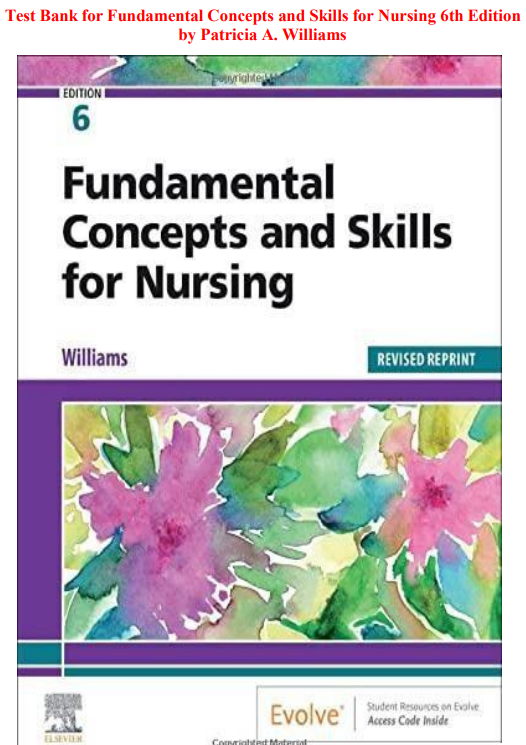
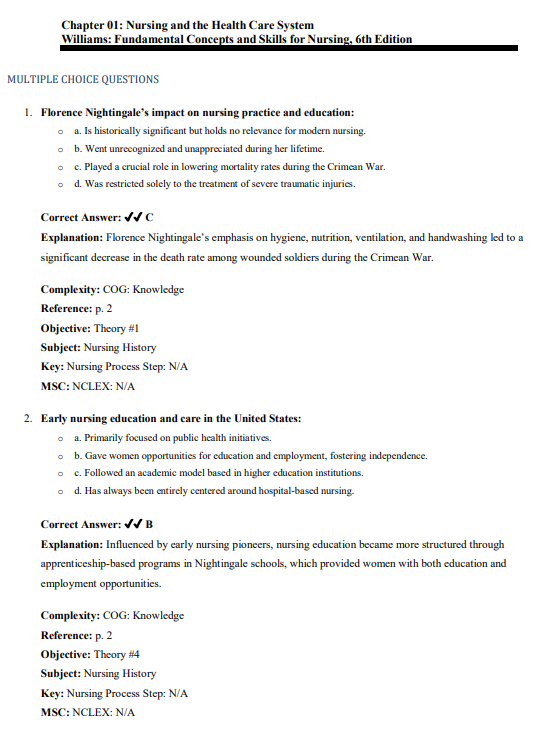
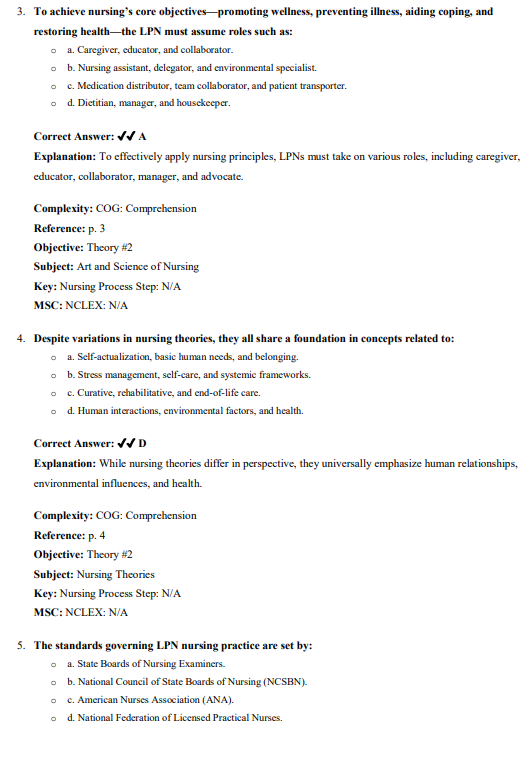
Every exceptional nurse begins at the same place. The fundamentals.
Before you master pharmacology, before you interpret a 12-lead ECG, before you manage a ventilated patient in the ICU — you need a foundation so solid that every clinical skill you build on top of it holds firm. You need to understand the nursing process not as a textbook framework but as the instinct that guides every patient interaction. You need to perform a head-to-toe assessment with confidence. You need to administer medications safely, communicate therapeutically, document accurately, and recognize when a patient is deteriorating before the numbers confirm it.
That foundation is what nursing fundamentals builds. And this test bank helps you build it right.
This comprehensive test bank is built for the 6th Edition of Fundamental Concepts and Skills for Nursing by Patricia A. Williams. It is one of the most student-accessible, clinically relevant, and thoroughly organized fundamentals textbooks in undergraduate nursing education — and this test bank helps you extract every ounce of exam value from every chapter.
Whether you are just beginning your nursing journey, preparing for a fundamentals course exam, or laying the groundwork for NCLEX success, this resource delivers the focused, clinical application-based practice that nursing fundamentals demands — and that nursing practice rewards every single day.
What’s Inside?
- Hundreds of practice questions covering every chapter
- Multiple-choice, select-all-that-apply, true/false, and clinical scenario questions
- Complete answer keys with thorough, clearly written clinical rationales
- Questions aligned with current NCLEX-RN and NCLEX-PN examination standards
- Coverage of all foundational nursing concepts, clinical skills, and patient care applications
Who Is This Test Bank For?
This resource is perfect for:
- First and second-year undergraduate RN nursing students in fundamentals courses
- LPN and LVN students building foundational nursing knowledge and skills
- RN-to-BSN students reviewing and reinforcing core nursing concepts
- NCLEX-RN and NCLEX-PN candidates refreshing foundational nursing content
- Nursing faculty developing fundamentals course exams and skills-based assessments
- Nursing students in accelerated BSN or second-degree programs covering fundamentals
- Students whose programs use the 6th Edition of Patricia A. Williams as their course text
Topics Covered Include:
- Nursing as a profession — history, trends, and contemporary practice
- The healthcare system — settings, roles, and interprofessional collaboration
- Legal and ethical dimensions of nursing practice
- Values, beliefs, and cultural considerations in patient-centered care
- Communication — therapeutic techniques, barriers, and documentation
- Patient education — principles, planning, and evaluation of learning
- The nursing process — assessment, diagnosis, planning, implementation, and evaluation
- Critical thinking and clinical judgment in nursing practice
- Documentation, reporting, and electronic health records
- Infection control — medical and surgical asepsis and standard precautions
- Safety — fall prevention, restraints, and environmental hazard management
- Vital signs — temperature, pulse, respiration, blood pressure, and oxygen saturation
- Physical assessment — head-to-toe examination techniques and findings
- Hygiene and personal care — bathing, oral care, and skin integrity
- Mobility and immobility — positioning, transfers, and range-of-motion exercises
- Rest and sleep — assessment and nursing interventions for sleep disorders
- Nutrition and metabolism — nutritional assessment and enteral feeding
- Hydration and fluid balance — IV therapy and fluid management
- Elimination — urinary and bowel function, catheterization, and ostomy care
- Oxygenation — respiratory assessment, oxygen therapy, and airway management
- Wound care — wound assessment, dressing changes, and pressure injury prevention
- Medication administration — oral, parenteral, topical, and special routes
- Pain assessment and management — pharmacological and non-pharmacological approaches
- Perioperative nursing care — preoperative, intraoperative, and postoperative nursing
- Death, dying, loss, and end-of-life nursing care
Why This Test Bank Delivers Results
Nursing fundamentals is both the most important and the most underestimated course in nursing school.
Students who build a strong fundamentals foundation carry it with them through every subsequent nursing course, every clinical rotation, every NCLEX question, and every shift of their nursing career. Students who approach fundamentals as a course to get through — rather than a foundation to build — discover the deficit later, when the clinical stakes are higher and the margin for knowledge gaps is narrower.
This test bank is designed to make sure you build it right.
Patricia A. Williams wrote the 6th Edition with a clear purpose — to make foundational nursing concepts accessible, applicable, and clinically meaningful for today’s nursing students. This test bank honors that purpose. Every question is written not to trick you with obscure details but to develop the clinical reasoning, patient safety awareness, and nursing process application that fundamentals is designed to build.
You will work through clinical scenarios that test your ability to apply the nursing process — not just recite its five steps. You will answer medication safety questions that require you to think like a practicing nurse — not just memorize the rights of administration. You will encounter prioritization questions that build the clinical judgment foundation that more advanced nursing courses — and the NCLEX — will continue to develop.
The 6th Edition reflects the most current evidence-based nursing practice standards and incorporates the foundational elements of the Next Generation NCLEX clinical judgment framework. This test bank is fully aligned with those updates — ensuring your fundamentals preparation is as current as the nursing practice it prepares you for.
Detailed rationales explain the nursing principles, clinical reasoning, and evidence-based practice guidelines behind every correct answer. Questions are organized chapter by chapter for structured, systematic study. Target the content areas where your foundational knowledge needs the most reinforcement. Build the clinical confidence that every nursing student needs — and that every patient deserves.
Sample Questions
Question 1
A student nurse is preparing to administer a scheduled oral medication to a patient. Before entering the patient’s room, the student reviews the medication administration record and notes that the medication was also listed as administered by the previous nurse four hours ago, which is earlier than scheduled. Which action is most appropriate?
- A) Administer the medication as scheduled since it appears on the current medication administration record
- B) Skip the dose and document it as already administered based on the previous nurse’s entry
- C) Hold the medication, verify the discrepancy with the charge nurse and the previous nurse, and clarify the administration record before proceeding
- D) Contact the provider to request a new order since the medication schedule appears inconsistent
Correct Answer: C
Rationale: This scenario represents a potential medication documentation discrepancy — a patient safety concern that requires clarification before any action is taken. Administering the medication without investigating the discrepancy risks double-dosing the patient, which could cause adverse effects or toxicity depending on the drug. The student nurse must hold the medication, report the discrepancy to the charge nurse, and attempt to clarify with the nurse who documented the previous administration before proceeding. This reflects the fundamental nursing responsibility of medication safety verification — one of the most critical patient safety practices in all of nursing. Skipping the dose without clarification could result in a missed dose if the previous entry was a documentation error. Contacting the provider is premature before the discrepancy is investigated at the nursing level. The nursing process — specifically assessment before implementation — governs this situation.
Question 2
A nurse is performing a focused assessment on a patient who returned from abdominal surgery two hours ago. The patient’s blood pressure has decreased from 126/82 mmHg on admission to 94/60 mmHg, the heart rate has increased from 78 to 112 bpm, and the patient appears pale, restless, and diaphoretic. The urine output for the past hour is 22 mL. Which action is the nurse’s priority?
- A) Administer the prescribed PRN oral analgesic for postoperative pain management
- B) Reposition the patient to a high Fowler’s position and reassess vital signs in 30 minutes
- C) Notify the surgeon immediately, establish IV access, and prepare for urgent fluid resuscitation
- D) Document the findings in the medical record and include them in the next shift handover
Correct Answer: C
Rationale: This clinical presentation — acute hypotension, tachycardia, pallor, restlessness, diaphoresis, and oliguria in the immediate postoperative period — represents the classic picture of hypovolemic shock, most likely from postoperative hemorrhage. Urine output below 30 mL per hour is a critical indicator of inadequate renal perfusion and systemic hypoperfusion. This is a life-threatening emergency requiring immediate intervention. The nurse must notify the surgeon immediately and simultaneously prepare for emergency fluid resuscitation — establishing large-bore IV access and preparing IV fluids or blood products as ordered. Administering oral analgesics is contraindicated in a hypotensive, potentially hemorrhaging patient. Positioning in high Fowler’s is inappropriate — the supine position with leg elevation improves venous return in hypovolemic shock. Waiting 30 minutes to reassess is an unacceptable delay when a patient is in apparent hemorrhagic shock. Documentation is important but cannot precede emergency intervention for an acute life-threatening change.
Question 3
A nurse is providing perineal care for a female patient who has an indwelling urinary catheter. Which technique reflects correct evidence-based catheter care practice?
- A) Clean the perineal area using circular motions starting from the outer labia toward the urethral meatus
- B) Clean the catheter tubing from the insertion site outward using a single downward stroke with a clean cloth
- C) Disconnect the catheter from the drainage tubing daily to irrigate with sterile saline and reduce infection risk
- D) Apply antiseptic solution to the catheter insertion site twice daily to prevent catheter-associated urinary tract infection
Correct Answer: B
Rationale: Evidence-based catheter care requires cleaning the catheter tubing from the urethral meatus outward — using a single downward stroke away from the body — to prevent the introduction of microorganisms from the environment toward the sterile urinary tract. This directional technique is a fundamental infection control principle in catheter care. Perineal care for female patients should proceed from the urethral meatus outward toward the rectum — front to back — not circular motions, which risk transferring rectal bacteria toward the urethra. Disconnecting the catheter from the drainage tubing for routine irrigation is never indicated in current evidence-based practice — it breaks the closed drainage system and dramatically increases the risk of catheter-associated urinary tract infection. Routine antiseptic application to the catheter insertion site is not recommended by current CDC guidelines and has not been shown to reduce CAUTI rates — it can cause skin irritation without clinical benefit.
Question 4
A nurse is preparing to apply wrist restraints to a confused patient who is at risk of removing their nasogastric tube. Which action is required before applying the restraints?
- A) Obtain verbal consent from the patient’s family member since the patient is confused
- B) Apply the restraints immediately to prevent tube removal and obtain a provider order within the next shift
- C) Obtain a provider order, assess and document the clinical justification, explain the procedure to the patient and family, and ensure the least restrictive alternative has been considered
- D) Apply the restraints and reassess the need every 24 hours without requiring a new provider order
Correct Answer: C
Rationale: The application of physical restraints in healthcare is governed by strict legal, ethical, and regulatory requirements — including The Joint Commission standards and CMS guidelines. Restraints may only be applied with a valid provider order, specific clinical justification, and documentation that less restrictive alternatives have been considered and found insufficient. The nurse must explain the procedure to both the patient and family even when the patient is confused — informed consent and communication remain ethical obligations regardless of cognitive status. Restraints must be applied correctly using the least restrictive device appropriate for the clinical situation. Reassessment is required every two hours — not every 24 hours — and a new provider order is typically required every 24 hours per facility policy. Applying restraints before a provider order is obtained — even with good clinical intent — is a violation of patient rights and regulatory standards. Restraint use must always be a last resort after all alternative safety measures have been exhausted.
Question 5
A nurse is performing a head-to-toe physical assessment on a newly admitted patient. During auscultation of the lungs, the nurse hears a low-pitched, continuous, musical sound during expiration that clears after the patient coughs. Which finding is the nurse documenting?
- A) Crackles — indicating fluid in the alveoli or small airways
- B) Pleural friction rub — indicating inflammation of the pleural surfaces
- C) Rhonchi — indicating secretions or obstruction in the larger airways
- D) Stridor — indicating upper airway obstruction requiring immediate intervention
Correct Answer: C
Rationale: Rhonchi are low-pitched, continuous, musical or snoring-quality breath sounds caused by secretions or partial obstruction in the larger bronchi and trachea. A defining characteristic of rhonchi — which distinguishes them clinically from other adventitious breath sounds — is that they may clear or change in quality following coughing, as the cough mobilizes secretions that are partially obstructing the airway. They are heard most prominently during expiration. Crackles — also called rales — are discontinuous, non-musical popping sounds caused by fluid in the alveoli or small airways and do not clear with coughing. Pleural friction rub is a grating or creaking sound heard during both inspiration and expiration, caused by inflamed pleural surfaces rubbing together — it does not clear with coughing. Stridor is a high-pitched, harsh inspiratory sound indicating upper airway obstruction — a clinical emergency requiring immediate assessment and intervention, not a finding that would clear with coughing.
Frequently Asked Questions (FAQs)
What edition does this test bank cover?
This test bank is written specifically for the 6th Edition of Fundamental Concepts and Skills for Nursing by Patricia A. Williams. All questions are fully aligned with the current edition’s chapter organization, updated clinical content, evidence-based nursing practice standards, and current NCLEX examination frameworks.
How is this test bank different from the 7th Edition test bank?
This test bank is written and organized specifically for the 6th Edition of Williams’ Fundamental Concepts and Skills for Nursing. The chapter structure, clinical content emphasis, and question alignment reflect the 6th Edition specifically. Students using the 6th Edition textbook will find this test bank most accurately aligned with their course material and chapter assignments.
How are the questions organized?
Questions are arranged chapter by chapter, allowing you to study systematically from the first week of nursing school through the final exam — or focus on specific content areas, such as medication administration, infection control, or wound care, based on your upcoming assessment schedule or identified knowledge gaps.
Is this test bank aligned with the NCLEX-RN and NCLEX-PN?
Yes. Questions are written to reflect current NCLEX-RN and NCLEX-PN examination standards, including application-level and clinical reasoning questions that mirror the thinking the NCLEX demands. Fundamentals content — including medication safety, infection control, patient assessment, and basic clinical skills — is heavily represented across both licensing examinations.
Is this test bank appropriate for LPN and LVN students?
Absolutely. Fundamental Concepts and Skills for Nursing by Williams is widely used in LPN and LVN programs. This test bank is equally relevant for PN-level students — covering the core foundational nursing content, clinical skill applications, and patient safety principles that the NCLEX-PN tests across all client needs categories.
How quickly can I access the test bank after purchase?
Immediately. As soon as your purchase is complete, you receive instant digital access with no waiting period. Study on your own schedule, at your own pace, from any device.
Are the rationales detailed enough to support genuine foundational learning?
Yes. Every rationale explains the nursing principles, clinical reasoning, and evidence-based practice standards behind the correct answer — not just identifies it. This approach builds the kind of deep foundational understanding that Patricia A. Williams emphasizes throughout the 6th Edition — and that clinical practice demands at every level of nursing.
Can nursing faculty use this test bank for course assessments?
Absolutely. The chapter-by-chapter organization, varied question formats, clinical skill emphasis, and NCLEX-aligned question construction make this an outstanding resource for faculty building unit exams, skills laboratory assessments, and comprehensive course finals for undergraduate fundamentals of nursing courses at both the RN and PN level.
Michelle –
Good quality and very easy instant download.
Stephanie Laura –
Perfectly crafted for exam preps
Peterson S. –
Good quality
Norah Helen –
A solid study guide
Gerald N –
Perfect!
Lucille Maria –
I like it
Mary Lincoln –
Excellent quality
Benpoly –
Helped me feel more prepared for exams
Yunice M –
A convenient way to test nursing knowledge anytime
Kamara Reid –
Very useful for exam preparation and review