
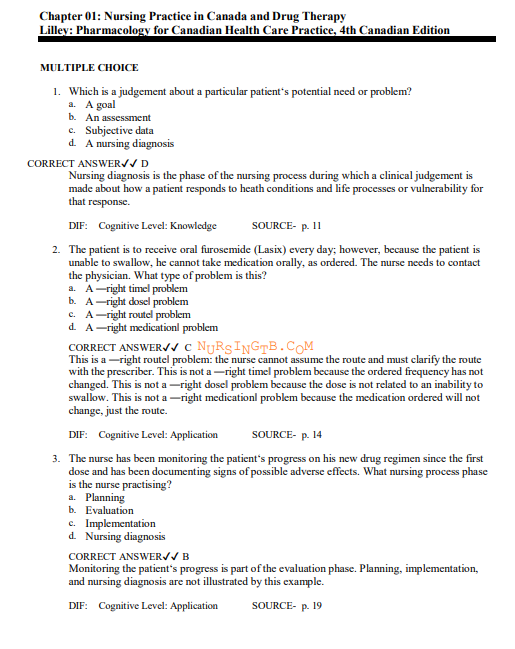

Canadian nursing pharmacology is not simply American pharmacology with a different currency.
It has its own drug approval processes, its own Health Canada regulatory framework, its own provincial and territorial prescribing regulations, its own formulary considerations, and its own patient population context. When a Canadian nursing student learns pharmacology, they need resources that reflect the healthcare system they are actually entering — with Canadian drug trade names, Canadian clinical practice guidelines, and the Canadian nursing scope of practice within which medication administration occurs.
That is precisely what Lilley’s Pharmacology for Canadian Health Care Practice delivers. And that is precisely what this test bank is built to reinforce.
This comprehensive test bank is built for the 4th Edition of Lilley’s Pharmacology for Canadian Health Care Practice by Kara Sealock. It is the most widely used and most carefully Canadianized pharmacology textbook in Canadian undergraduate nursing education — integrating the trusted Lilley pharmacology framework with Canadian drug names, Health Canada regulatory content, Canadian clinical practice standards, and the Canadian nursing context that makes it genuinely relevant to nursing students across every province and territory.
This test bank helps you master every chapter with the focused, patient-centered, nursing-process-driven practice that Canadian clinical pharmacology demands — and that the NCLEX-RN and CPNRE test rigorously.
Whether you are preparing for a pharmacology course exam, an ATI pharmacology assessment, or the NCLEX-RN or CPNRE licensing examination, this resource delivers the drug knowledge, clinical reasoning, and medication safety focus that Sealock’s Canadian adaptation demands — and that every Canadian patient deserves from their nurse.
What’s Inside?
- Hundreds of practice questions covering every chapter
- Multiple-choice, select-all-that-apply, alternate-format, and clinical scenario questions
- Complete answer keys with thorough, clinically grounded pharmacological rationales
- Questions aligned with current NCLEX-RN and CPNRE examination standards
- Canadian drug names, Health Canada regulatory content, and Canadian clinical practice guidelines integrated throughout
- Coverage of all major drug classifications, nursing implications, patient education priorities, and pharmacological safety across every body system
Who Is This Test Bank For?
This resource is perfect for:
- Canadian undergraduate RN nursing students in pharmacology courses using the 4th Edition
- Canadian LPN and RPN students building foundational clinical pharmacology knowledge
- NCLEX-RN candidates in Canada seeking comprehensive pharmacology content review
- CPNRE candidates reviewing pharmacological content for Canadian practical nurse licensing
- Canadian nursing students completing ATI pharmacology assessments and proctored examinations
- Nursing faculty in Canadian schools of nursing developing pharmacology course exams
- LPN-to-RN bridge students in Canadian programs updating pharmacological knowledge
- International nursing students transitioning into the Canadian healthcare system
Topics Covered Include:
- Introduction to pharmacology — Canadian drug regulation and Health Canada oversight
- Pharmacokinetics — absorption, distribution, metabolism, and excretion in clinical context
- Pharmacodynamics — drug-receptor interactions and dose-response relationships
- Medication safety — the rights of medication administration and Canadian patient safety standards
- The nursing process applied to pharmacological care in the Canadian context
- Drug interactions, adverse drug reactions, and hypersensitivity responses
- Lifespan pharmacology — pediatric, geriatric, and pregnancy pharmacological considerations
- Cultural considerations in Canadian pharmacology practice
- Analgesics — opioid and non-opioid pain management including Canadian opioid guidelines
- Anti-inflammatory agents — NSAIDs, corticosteroids, and antirheumatic drugs
- Antibiotics — major Canadian formulary antibiotics and antimicrobial stewardship
- Antivirals, antifungals, and antiparasitic agents
- Cardiovascular pharmacology — antihypertensives, antidysrhythmics, and heart failure medications
- Canadian cardiovascular clinical practice guidelines and drug therapy
- Anticoagulants, antiplatelets, and thrombolytic therapy
- Diuretic therapy and renal pharmacology
- Central nervous system drugs — antidepressants, antipsychotics, and anxiolytics
- Antiepileptic drug therapy and neurological pharmacology
- Endocrine pharmacology — insulin, oral antidiabetics, thyroid, and adrenal agents
- Canadian Diabetes Association treatment guidelines and pharmacotherapy
- Respiratory pharmacology — bronchodilators, corticosteroids, and antihistamines
- Gastrointestinal pharmacology
- Oncology pharmacology principles and biotherapy
- Immunological agents — Canadian immunization schedules and vaccine pharmacology
- Reproductive and women’s health pharmacology
- Vitamins, minerals, and natural health product considerations under Health Canada
Why This Test Bank Delivers Results
Kara Sealock’s Canadian adaptation of Lilley’s Pharmacology is built around a fundamental insight that generic international pharmacology textbooks consistently miss — that Canadian nursing students need more than translated drug names and converted metric values. They need a pharmacology education that is embedded in the Canadian healthcare system, reflects Canadian prescribing realities, and prepares them for the specific clinical and regulatory environment they will practice in.
The 4th Edition delivers on that commitment more completely than any previous edition — with updated Health Canada drug approvals, revised Canadian clinical practice guidelines, expanded opioid prescribing context reflecting Canada’s evolving approach to the opioid crisis, updated Canadian immunization schedules, and pharmacology content that reflects both the national and provincial dimensions of Canadian healthcare regulation.
This test bank is built to match that standard — and to develop the clinical pharmacology competency that Canadian nursing practice demands.
Every question is constructed around the patient-centered nursing process approach that Sealock maintains throughout the Lilley framework. You will not simply identify a drug’s Canadian trade name or classify its mechanism of action. You will apply that knowledge to a real Canadian clinical scenario — assessing a patient before the first dose, recognizing an adverse effect that requires immediate nursing action, evaluating whether a therapeutic goal has been achieved, and educating a patient in language that supports safe medication management in the community.
Canadian-specific content is integrated throughout — including Health Canada’s regulatory role in drug approval and safety communication, the distinction between Canadian and American drug names where clinically significant, Canadian formulary considerations, Canadian antimicrobial stewardship principles, and the Canadian nursing scope of practice within which medication administration and patient education occur.
Detailed rationales explain the pharmacological mechanisms, nursing process applications, Canadian clinical practice standards, and patient safety principles behind every correct answer. The 4th Edition’s most current Canadian drug content is fully reflected.
Questions are organized chapter by chapter for structured, systematic study. Target drug classes where your knowledge is weakest. Build the medication safety mindset that Canadian clinical pharmacology demands — and that every Canadian patient deserves from their nurse.
Sample Questions
Question 1
A Canadian nurse is preparing to administer warfarin to a patient with atrial fibrillation. The patient mentions they have been taking natural health products including St. John’s Wort purchased from a Canadian health food store. Health Canada has issued warnings about this natural health product. Which nursing response reflects the most accurate pharmacological knowledge and Canadian patient safety standard?
- A) Reassure the patient that Health Canada-approved natural health products are completely safe to combine with warfarin
- B) Explain that St. John’s Wort is a potent inducer of CYP3A4 and P-glycoprotein that significantly reduces warfarin plasma levels and anticoagulant effect — increasing thromboembolic risk — and that the provider must be notified immediately before the next warfarin dose
- C) Advise the patient to continue the St. John’s Wort since it is a natural product and therefore cannot interact with prescription medications
- D) Administer the warfarin as scheduled and document the natural health product use without contacting the provider
Correct Answer: B
Rationale: This question integrates Canadian pharmacology context with a critically important drug-natural health product interaction. In Canada, natural health products — including herbal remedies, vitamins, and homeopathic preparations — are regulated by Health Canada under the Natural Health Products Regulations, distinct from prescription drugs. However, Health Canada classification does not equate to clinical harmlessness when combined with prescription medications. St. John’s Wort (Hypericum perforatum) is one of the most clinically significant herbal drug interactions in pharmacology. It is a potent inducer of cytochrome P450 3A4 and P-glycoprotein — two major drug metabolism pathways. By inducing these pathways, St. John’s Wort dramatically accelerates warfarin metabolism, reducing plasma warfarin concentrations and anticoagulant effect. This can result in subtherapeutic INR levels and significantly increased risk of thromboembolic events — stroke, systemic embolism, or DVT — in a patient with atrial fibrillation who requires therapeutic anticoagulation. Health Canada has issued specific safety advisories regarding this interaction. The nurse must hold the warfarin dose until the provider is notified, as a dose adjustment or complete discontinuation of St. John’s Wort — with subsequent INR monitoring during the transition period — will be required. The regulatory status of a natural health product in Canada does not eliminate its pharmacological activity or drug interaction potential.
Question 2
A Canadian nurse is caring for a patient receiving IV vancomycin for a confirmed MRSA bloodstream infection. The nurse is aware that Health Canada has issued guidance on vancomycin therapeutic drug monitoring. During the infusion, the patient develops flushing of the face, neck, and upper chest with pruritus and mild hypotension. The patient denies dyspnea or throat tightness. Which condition does this presentation represent and what is the priority nursing intervention?
- A) Anaphylaxis requiring immediate epinephrine 0.3 mg IM and activation of the emergency response team
- B) Red man syndrome — a rate-related non-IgE-mediated infusion reaction requiring the nurse to slow or temporarily stop the infusion and administer diphenhydramine as prescribed
- C) Vancomycin nephrotoxicity requiring immediate discontinuation and permanent cessation of all vancomycin therapy
- D) Sepsis-related flushing unrelated to the vancomycin infusion requiring blood cultures and broad-spectrum antibiotic escalation
Correct Answer: B
Rationale: This clinical presentation is the classic description of red man syndrome — a rate-dependent infusion reaction associated with vancomycin administration. Red man syndrome is caused by direct mast cell degranulation and non-immune-mediated histamine release triggered by rapid vancomycin infusion — it is not a true IgE-mediated allergic reaction and does not represent anaphylaxis. The characteristic clinical features include erythema and flushing of the face, neck, and upper chest and back — the “red man” distribution — along with pruritus and sometimes mild hypotension. The absence of bronchospasm, urticaria, angioedema, dyspnea, and throat tightness distinguishes red man syndrome from anaphylaxis, which would require immediate epinephrine administration. Management of red man syndrome involves slowing the rate of infusion significantly or temporarily stopping it to allow histamine levels to decrease, administering an antihistamine such as diphenhydramine to block histamine receptors and reduce symptom severity, and resuming the infusion at a slower rate once symptoms resolve. Health Canada’s guidance on vancomycin administration recommends infusing each gram over at least 60 minutes — with longer infusion times for larger doses — specifically to prevent this predictable, dose-rate-related reaction. Documenting red man syndrome incorrectly as a vancomycin allergy could prevent a patient from receiving a critically needed antibiotic in future serious infections. Vancomycin nephrotoxicity is a delayed, dose-dependent adverse effect — not an acute infusion reaction.
Question 3
A Canadian nurse is providing medication education to a patient newly prescribed metformin for type 2 diabetes. The patient mentions they enjoy drinking alcohol socially, typically consuming three to four drinks at weekend gatherings. Which nursing education reflects the most clinically important pharmacological concern specific to this combination?
- A) Alcohol has no clinically significant interaction with metformin and social drinking can continue safely
- B) The combination of metformin and alcohol increases the risk of lactic acidosis — a rare but potentially fatal adverse effect — particularly with binge drinking, acute alcohol intoxication, and excessive consumption; moderate, responsible alcohol use should be discussed with the provider
- C) Alcohol significantly increases metformin absorption, requiring a dose reduction when drinking
- D) The primary concern is that alcohol will reduce metformin’s blood glucose-lowering effect, causing hyperglycemia
Correct Answer: B
Rationale: This patient education scenario addresses one of the most important drug-alcohol interactions in Canadian primary care pharmacology. Lactic acidosis is a rare but serious and potentially fatal adverse effect of metformin that occurs when metformin accumulates to toxic levels, impairing mitochondrial function and causing lactate to accumulate in the blood. Alcohol — particularly in excessive or binge quantities — increases the risk of metformin-associated lactic acidosis through multiple mechanisms. Excessive alcohol intake can cause dehydration and impaired renal perfusion, reducing metformin clearance and causing accumulation. Alcohol independently impairs hepatic lactate clearance, further increasing lactic acid levels. Additionally, heavy alcohol use can cause or worsen hepatic dysfunction — and hepatic impairment is itself a contraindication to metformin use due to the liver’s role in lactate metabolism. Canadian Diabetes Association guidelines and Canadian drug product monographs specifically address the metformin-alcohol interaction and recommend that patients avoid excessive alcohol use while taking metformin. Social or moderate alcohol consumption requires individual clinical assessment rather than a blanket prohibition, but the patient must understand the specific risk, the warning signs of lactic acidosis — unusual muscle pain, difficulty breathing, stomach pain, nausea, dizziness, and feeling cold — and the importance of discussing alcohol use patterns with their provider. Alcohol does not reduce metformin efficacy, and does not meaningfully alter metformin absorption as the primary concern.
Question 4
A Canadian nurse working in a community health setting is administering routine immunizations to an 18-month-old child according to the Canadian Immunization Guide. The child’s parent asks why their child needs so many vaccines at this age and expresses concern that vaccines could harm their child. Which nursing response best reflects Canadian evidence-based immunization practice and therapeutic communication?
- A) Dismiss the parent’s concerns as misinformation and administer the vaccines without further discussion
- B) Acknowledge the parent’s concerns with empathy, provide accurate evidence-based information about the safety, efficacy, and rationale for the Canadian immunization schedule, address specific misconceptions using current Public Health Agency of Canada evidence, and support informed decision-making
- C) Agree with the parent that the immunization schedule may be too aggressive and recommend delaying vaccines until the child is older
- D) Threaten the parent with mandatory vaccination legislation to ensure compliance
Correct Answer: B
Rationale: This scenario integrates Canadian immunization pharmacology with the therapeutic communication and patient-family education competencies that define evidence-based Canadian nursing practice. Vaccine hesitancy is a recognized public health challenge in Canada and globally — the Public Health Agency of Canada and provincial/territorial public health authorities have developed specific communication strategies for addressing vaccine hesitancy in a supportive, non-judgmental, and evidence-based manner. The nurse’s response must begin with genuine acknowledgment of the parent’s concerns — dismissing or invalidating parental concerns damages the therapeutic relationship and typically increases vaccine hesitancy rather than reducing it. Accurate, evidence-based information about the safety profile of Canadian immunization schedule vaccines, the rationale for administering multiple vaccines at the 18-month visit, and the consequences of delayed or missed immunizations — both for the individual child and for community herd immunity — should be provided clearly and in accessible language. The nurse should use evidence from the Canadian Immunization Guide, NACI recommendations, and PHAC materials. Supporting informed decision-making — rather than coercing or threatening — reflects both therapeutic communication principles and Canadian healthcare ethics. Agreeing to delay vaccines without clinical justification abandons the nurse’s professional advocacy role for the child’s health and contradicts current Canadian immunization evidence.
Question 5
A Canadian nurse is caring for an 80-year-old patient who has been self-medicating with diphenhydramine (Benadryl) 50 mg nightly for insomnia for the past three months. The patient mentions the medication “doesn’t work as well anymore” and asks for something stronger. Which nursing response most accurately reflects Canadian geriatric pharmacology principles and current evidence-based prescribing standards?
- A) Suggest the patient increase the diphenhydramine dose to 75 mg nightly since tolerance has developed
- B) Recommend switching to a benzodiazepine such as triazolam for more reliable sedation in elderly patients
- C) Explain that diphenhydramine is listed as potentially inappropriate for older adults due to significant anticholinergic risks including cognitive impairment, urinary retention, and fall risk; recommend non-pharmacological sleep strategies and provider consultation for safer evidence-based alternatives
- D) Reassure the patient that diphenhydramine is completely safe for long-term use and suggest purchasing a higher-dose formulation
Correct Answer: C
Rationale: This question applies Canadian geriatric pharmacology principles to a common over-the-counter medication scenario. In Canada, diphenhydramine is available without prescription under multiple brand names, making it a frequently self-administered medication in the elderly population. However, diphenhydramine is a first-generation antihistamine with significant anticholinergic properties — it is included on both the American Geriatrics Society Beers Criteria and the Canadian equivalent STOPP (Screening Tool of Older Persons’ Prescriptions) criteria as potentially inappropriate in older adults. The anticholinergic effects of diphenhydramine in elderly patients include significant cognitive impairment and confusion, urinary retention, constipation, dry mouth, blurred vision, tachycardia, and substantially increased fall risk — all of which carry serious clinical consequences in a vulnerable older adult population. The tolerance the patient has developed — the drug “doesn’t work as well” — reflects the development of pharmacological tolerance to the sedative effect of diphenhydramine. The nurse must educate the patient about these specific risks in language appropriate to their health literacy, recommend non-pharmacological insomnia interventions — sleep hygiene, cognitive behavioral therapy for insomnia, stimulus control therapy — as first-line treatment consistent with current Canadian guidelines, and strongly recommend provider consultation for safer evidence-based alternatives such as low-dose doxepin or melatonin-based therapies. Benzodiazepines are also on the STOPP criteria for older adults due to fall and cognitive impairment risks — they are not safer alternatives.
Frequently Asked Questions (FAQs)
What edition does this test bank cover?
This test bank is written specifically for the 4th Edition of Lilley’s Pharmacology for Canadian Health Care Practice by Kara Sealock. All questions are fully aligned with the current edition’s chapter organization, updated Canadian drug content, Health Canada regulatory information, current Canadian clinical practice guidelines, and current NCLEX-RN and CPNRE examination standards.
How are the questions organized?
Questions are arranged chapter by chapter, allowing you to study systematically through all Canadian clinical pharmacology content or focus on specific drug classes — such as cardiovascular agents, antibiotics, or endocrine medications — based on your course exam schedule or Canadian licensing examination preparation priorities. Canadian-specific content is integrated throughout every chapter’s question set.
Is this test bank aligned with both the NCLEX-RN and CPNRE?
Yes. Questions are written to reflect current NCLEX-RN examination standards — which Canadian nursing students now write for RN licensure — and also reflect the pharmacological content assessed on the CPNRE for practical nurse licensure in provinces that still use it. Pharmacological and medication safety content is heavily tested on both examinations and this test bank directly targets that content.
How does this test bank differ from the American Lilley pharmacology test bank?
This test bank is specifically built for Kara Sealock’s Canadian adaptation of Lilley’s Pharmacology. Canadian drug trade names, Health Canada regulatory content, Canadian clinical practice guidelines, Canadian immunization schedules, and Canadian nursing scope of practice considerations are integrated throughout — making this test bank directly relevant to Canadian nursing students in a way that American pharmacology test banks are not.
Is this test bank useful for students in all Canadian provinces and territories?
Yes. While provincial and territorial variations in scope of practice and formulary exist, the foundational pharmacological principles, drug classification knowledge, and nursing process application covered in this test bank are relevant to nursing students across all Canadian provinces and territories. Canadian national standards — including Health Canada regulatory content and Canadian clinical practice guidelines — are the primary reference frameworks throughout.
How quickly can I access the test bank after purchase?
Immediately. As soon as your purchase is complete, you receive instant digital access with no waiting period. Study on your own schedule, at your own pace, from any device.
Are the rationales detailed enough to support genuine pharmacological learning in the Canadian context?
Yes. Every rationale explains the pharmacological mechanisms, Canadian clinical practice standards, nursing process applications, and patient safety principles behind the correct answer — with Canadian-specific regulatory and clinical context integrated where relevant. This approach builds the pharmacological competency that Canadian nursing practice demands and that every Canadian patient deserves.
Can Canadian nursing faculty use this test bank for course assessments?
Absolutely. The chapter-by-chapter organization, Canadian content integration, varied question formats, and clinical scenario emphasis make this an outstanding resource for faculty in Canadian schools of nursing building unit exams, ATI-style assessments, and comprehensive pharmacology course finals for undergraduate RN and PN programs across Canada.

Morgan Fraiser –
An excellent test bank with detailed answers and rationales
Benpoly –
A solid study guide
Janny Cummings –
Improved my test-taking strategies
Winnie M. –
Useful for both studying and review
Peterson S. –
Great resource when preparing for finals
Lucille Maria –
Great questions that closely match pharmacology exam expectations.
SHoustone –
Fantastic resource for reviewing essential pharmacology material
Terence V. –
Practice questions made studying more engaging
Alicia Silva –
Great selection of questions for exam review.
Warren Brent –
Questions encourage careful thinking before choosing answers.
Chris martin –
Useful material for revisiting concepts at my own pace.
Benjamin Campbell –
Straightforward questions make practice sessions easy to navigate.
Danielle Kayle –
A practical resource for reviewing lessons independently.
Samuel Collins –
Good study aid for preparing with confidence.
Liam Mbogo –
Useful exercises for reinforcing difficult concepts.
Victoria Stewart –
Helpful resource for maintaining a consistent study routine.
Lucy Kamala –
Makes reviewing course content less overwhelming.
Kai Marcus –
Convenient questions for studying during short breaks
Leah Kiptum –
Supports better preparation through regular practice.