Become the Nurse Who Actually Uses Research to Improve Care
Most nurses have taken research courses. Few actually apply that knowledge to change practice. The gap between knowing about evidence and using it to improve patient outcomes remains frustratingly wide.
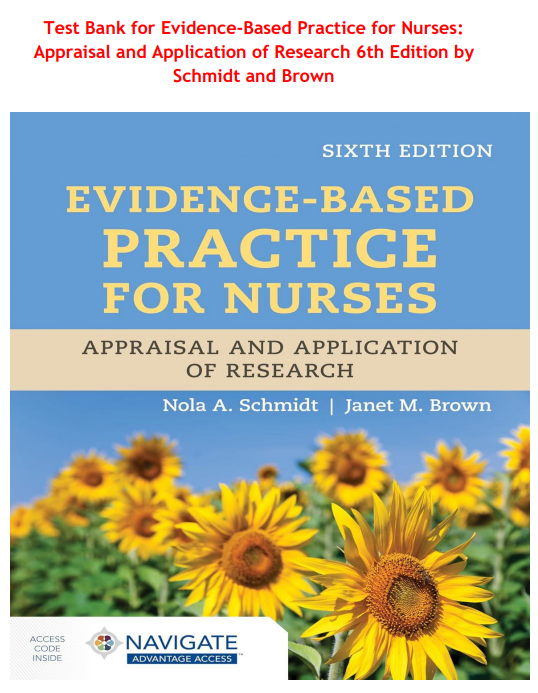
This test bank accompanies Evidence-Based Practice for Nurses 6th Edition by Schmidt and Brown. It builds the hands-on competencies that turn research consumers into practice innovators who measurably improve healthcare quality.
Stop treating EBP as checkbox compliance. Start wielding evidence as your most powerful tool for patient advocacy and care improvement.
Written for Nurses Who Work at the Bedside
Academic research textbooks often miss the mark for practicing clinicians. You need answers during your shift, not theoretical frameworks for your dissertation.
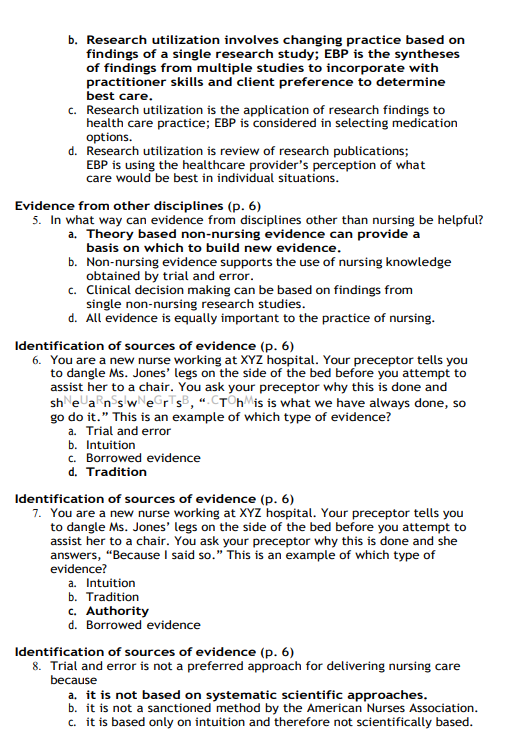
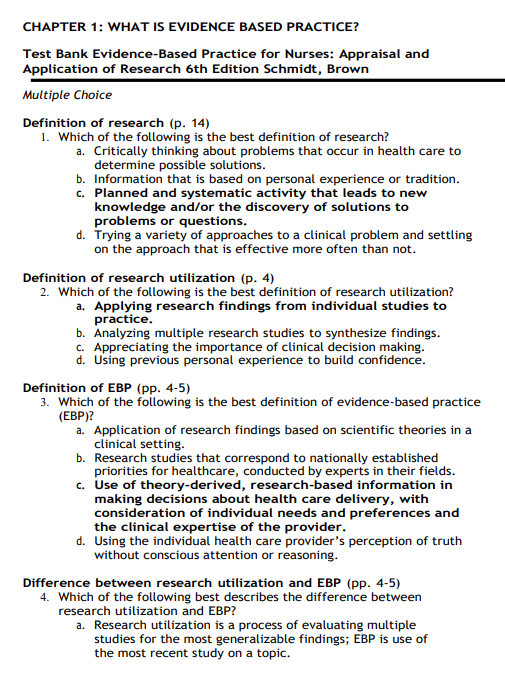
This test bank speaks directly to bedside realities. Questions address finding evidence quickly, evaluating studies efficiently, and implementing changes despite organizational barriers.
You’ll gain skills that work in real hospitals with real constraints—not just in ideal academic settings.
What Makes This Resource Different:
- Practical evidence application over theoretical knowledge
- Time-efficient search and appraisal strategies
- Implementation focus for busy clinical environments
- Barrier identification and management
- Stakeholder engagement and communication
- Real-world resource constraints consideration
- Sustainability planning for lasting change
- Questions reflecting actual clinical scenarios
- Applicable across all nursing specialties
Why This Approach Works Better
Traditional research education emphasizes study design and statistical theory. Important, yes. But insufficient for nurses who need to improve fall rates by next quarter or reduce catheter infections on their unit.
These questions prioritize actionable competencies. You’ll learn to extract the essential information from studies without getting lost in methodological details. You’ll identify practice-ready findings versus those requiring more research.
This efficiency makes EBP feasible for working nurses, not just academic researchers.
Master the Five EBP Steps That Matter
Evidence-based practice boils down to five critical actions: Ask focused questions, find best evidence, critically appraise what you found, apply it carefully, and assess whether it worked.
This test bank drills these five steps relentlessly until they become automatic.
Essential Practice Areas:
- Turning frustrations into answerable questions
- Rapid literature searching during breaks
- Quick quality checks for research validity
- Small-scale testing before full implementation
- Measuring outcomes that matter to stakeholders
- Building coalitions for practice change
- Presenting evidence to skeptical colleagues
- Documenting improvements for leadership
- Spreading successful innovations unit-wide
- Creating sustainable practice transformations
Ask Questions That Lead Somewhere
The difference between “Why do patients keep falling?” and a searchable PICOT question determines whether you find useful evidence or waste hours frustrated.
Questions teach precise question construction. You’ll transform common clinical irritations into specific, searchable inquiries. You’ll match question types to appropriate study designs.
This skill alone saves countless hours of unproductive searching.
Find Evidence Without Wasting Your Life
You have maybe twenty minutes before your next admission arrives. Literature searches must be efficient, not exhaustive.
These questions develop strategic searching. You’ll identify the two or three databases worth your time. You’ll construct searches that capture essentials without drowning you in irrelevant studies. You’ll recognize when you have enough evidence to move forward.
This efficiency makes EBP compatible with actual nursing workloads.
Spot Good Evidence Fast
You cannot read every study completely. Learning to assess quality rapidly separates useful evidence from methodological disasters.
Questions sharpen your appraisal radar. You’ll identify red flags suggesting bias or poor design within minutes. You’ll recognize studies whose samples, methods, or settings make them inapplicable to your population.
This discernment prevents wasting time on weak evidence that shouldn’t change practice.
Implement Changes That Stick
Finding great evidence means nothing if your initiative dies after two weeks. Understanding implementation science makes the difference between temporary enthusiasm and lasting improvement.
These questions teach practical change management. You’ll pilot small before rolling out large. You’ll identify and address resistance proactively. You’ll build coalitions across stakeholder groups.
This implementation wisdom turns evidence into actual patient benefit.
Measure What Actually Matters
Selecting wrong outcomes dooms evaluation efforts. Understanding meaningful measurement demonstrates EBP value to skeptical administrators.
Questions develop outcome selection expertise. You’ll choose metrics stakeholders care about. You’ll measure feasibly given available resources. You’ll present data persuasively to secure continued support.
This measurement competence proves EBP worth the investment.
Navigate Organizational Politics
Great evidence dies when organizational culture or politics block implementation. Understanding influence strategies and stakeholder management enables successful change despite resistance.
These questions address political realities directly. You’ll identify key decision-makers and influencers. You’ll frame evidence in terms matching organizational priorities. You’ll build gradual support rather than demanding immediate transformation.
This political savvy turns good ideas into actual practice changes.
Manage the Skeptics on Your Unit
Every unit has nurses who resist any change, evidence-based or not. Understanding resistance sources and management strategies prevents sabotaging otherwise solid initiatives.
Questions teach resistance management. You’ll identify whether resistance stems from knowledge deficits, bad past experiences, or legitimate concerns. You’ll address each resistance type appropriately.
This people skill proves as important as evidence quality for implementation success.
Communicate Evidence Persuasively
The best evidence presented poorly fails. The weakest evidence presented compellingly sometimes succeeds. Understanding persuasive communication bridges this gap.
These questions develop presentation skills. You’ll tailor messages to different audiences from bedside nurses to C-suite executives. You’ll use stories and data strategically. You’ll anticipate and preempt objections.
This communication competence gets evidence heard and adopted.
Work Within Budget Constraints
Ideal evidence-based interventions sometimes cost money your organization lacks. Understanding cost-effectiveness analysis and creative resource management enables improvements despite financial limitations.
Questions address resource realities. You’ll identify low-cost high-impact interventions. You’ll make compelling business cases for needed investments. You’ll find creative solutions when budgets prevent optimal approaches.
This fiscal awareness makes EBP sustainable in resource-constrained environments.
Lead Without Formal Authority
Most bedside nurses lack formal leadership positions yet must influence practice changes. Understanding informal leadership and grassroots change strategies enables impact without waiting for promotion.
These questions develop informal leadership. You’ll build credibility through small wins. You’ll engage colleagues as partners rather than subordinates. You’ll create momentum through demonstration rather than mandate.
This leadership approach empowers any nurse to drive improvement.
Connect EBP to Magnet Journey
Organizations pursuing or maintaining Magnet designation require demonstrated EBP competence. Understanding Magnet EBP expectations makes you valuable during recognition efforts.
Questions address Magnet-relevant competencies specifically. You’ll know what Magnet appraisers seek. You’ll document EBP activities appropriately. You’ll contribute meaningfully to organizational portfolios.
This Magnet knowledge increases your professional value significantly.
Survive (and Shine in) DNP Programs
DNP students must complete evidence-based practice projects demonstrating advanced implementation competence. Understanding rigorous EBP processes determines project success.
This test bank provides DNP-level preparation. You’ll design scholarly projects meeting academic standards. You’ll synthesize evidence comprehensively. You’ll evaluate outcomes rigorously.
This doctoral-level competence supports successful degree completion.
Build Your Professional Portfolio
EBP leadership distinguishes your resume and supports clinical ladder advancement. Understanding how to document and present your EBP work creates promotion opportunities.
Questions address professional development strategically. You’ll document projects for maximum impact. You’ll present at conferences professionally. You’ll publish in nursing journals.
This career development turns EBP competence into professional advancement.
Transform Frustration Into Innovation
Every clinical frustration represents a potential improvement opportunity. Understanding how to channel frustration into systematic practice improvement creates continuous innovation.
These questions develop opportunity recognition. You’ll view problems as improvement projects. You’ll engage colleagues in solution development. You’ll create cultures of inquiry on your units.
This mindset shift makes nursing perpetually engaging rather than repetitively frustrating.
Study Efficiently Despite Crazy Schedules
Nurses work nights, weekends, and rotating shifts. Study approaches must accommodate unpredictable schedules and exhaustion.
This test bank enables flexible learning. Practice during morning coffee. Review between patient admissions. Complete full tests during dedicated study time.
The organization respects that nursing students and clinicians lack predictable nine-to-five schedules.
Prepare for Actual EBP Projects
Hypothetical understanding differs from practical implementation ability. These questions simulate real project challenges you’ll face.
You’ll encounter realistic barriers like resistant colleagues, budget constraints, and competing organizational priorities. You’ll develop solutions that actually work in messy real-world conditions.
This preparation prevents naive optimism from crashing against clinical reality.
Join the Nurses Improving Healthcare
Evidence-based practice represents nursing’s contribution to healthcare quality improvement. Understanding EBP makes you part of the solution rather than perpetuating problems.
Questions inspire professional pride in evidence-based innovation. You’ll see yourself as healthcare improver, not just task-completer. You’ll recognize your potential to measurably improve outcomes.
This identity shift transforms how you view your nursing role.
Practical Expertise from Clinical Educators
Schmidt and Brown bring extensive experience teaching EBP to working nurses. They understand time constraints, organizational barriers, and implementation realities.
This test bank reflects that practical wisdom. Questions emphasize what works in real hospitals, not theoretical ideals.
Their expertise ensures you gain applicable skills, not just academic knowledge.
Your Tool for Making Nursing Better
Evidence-based practice competence empowers you to fix what frustrates you. Those recurring problems you complain about? You can actually solve them.
This test bank provides the skills turning complaints into improvements. Nurses who master these competencies lead unit innovations, reduce patient harm, and find renewed professional satisfaction.
Stop accepting broken processes. Start building the evidence-based practice expertise that makes you a force for positive change in healthcare.
Your patients deserve nurses who question ineffective traditions and implement proven improvements. This test bank helps you become that change agent who transforms care through evidence, persistence, and practical implementation wisdom.

Winnie M. –
Excellent study resource
Jarrod Bent –
Well organized and comprehensive
Caleb Martins –
Perfect
Lucille Maria –
We worth the money
Rosemary R –
Strong explanations made learning easier
Terence V. –
Great way to test nursing knowledge
Stephaniemclister –
Helped me pass my nursing exams confidently
Lisa Horton –
Helped me identify my weak areas
Beverly –
A valuable tool for nursing students