Pediatric primary care is where clinical science meets childhood in all its complexity.
A two-year-old’s ear infection calls for a completely different approach than an adolescent’s anxiety disorder. A newborn’s weight trajectory tells you more about feeding adequacy than any single measurement. A developmental red flag caught in a four-year-old at a well-child visit can change the course of that child’s life.
Pediatric primary care demands clinical breadth, developmental precision, and family-centered thinking. It is also one of the most heavily tested content areas on NP and PA certification exams.
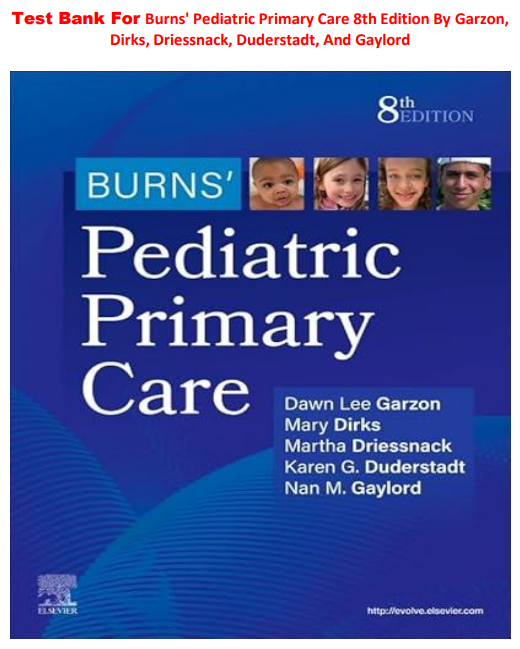
This test bank accompanies the 8th Edition of Burns’ Pediatric Primary Care by Garzon, Dirks, Driessnack, Duderstadt, and Gaylord, a leading pediatric primary care text in advanced practice nursing and PA education. It gives you focused, developmentally grounded, evidence-based practice for every chapter. Use it for graduate pediatric primary care exams, clinical practicum assessments, or NP and PA board certification.
Table of Contents
- Pediatric Primary Care
- Global and National Influences on Child Health Status
- Environmental Influences on Pediatric Health
- Justice, Equity, Inclusion, and Diversity
- Pediatric and Family Assessment
- Behavioral and Mental Health Promotion
- Sexuality and Gender Identity
- Developmental Principles and Theories
- Developmental Management of Newborns and Neonates
- Developmental Management of Infants
- Developmental Management of Early Childhood
- Developmental Management of Middle Childhood
- Developmental Management of Adolescents
- Nutrition
- Breastfeeding
- Sleep
- Elimination
- Physical Activity and Sports
- Immunizations
- Dental and Oral Health
- Pediatric Injury Prevention
- Child Maltreatment
- Prescribing Traditional and Complementary Therapies
- Pediatric Pain and Fever Management
- Pediatric Injuries and Toxic Exposures
- Pediatric Palliative Care
- Congenital and Inherited Disorders
- Neonatal Disorders
- Neurodivergence and Behavioral and Mental Health Disorders
- Eye and Vision Disorders
- Ear and Hearing Disorders
- Respiratory Disorders
- Cardiovascular Disorders
- Gastrointestinal Disorders
- Infectious Diseases
- Inflammatory Disorders
- Dermatologic Disorders
- Hematologic Disorders
- Endocrine and Metabolic Disorders
- Musculoskeletal Disorders
- Neurologic Disorders
- Genitourinary Disorders
- Gynecology and Reproductive Health
What’s Inside
- Hundreds of practice questions organized chapter by chapter
- Multiple-choice, select-all-that-apply, and complex clinical scenario formats
- Complete answer keys with evidence-based pediatric rationales
- Alignment with AANP, ANCC, CPNP, and NCCPA exam standards
- Coverage of the full scope of pediatric primary care, from newborn assessment through adolescent health
Who It’s For
- Pediatric NP and Family NP students in graduate pediatric primary care courses
- PA students on pediatric primary care rotations
- CPNP-PC and FNP-BC candidates
- PANCE and PANRE candidates reviewing pediatrics
- DNP students in pediatric primary care clinical coursework
- Nursing faculty writing graduate-level pediatric exams
- Advanced practice nurses and PAs moving into pediatric primary care
- School nurse practitioners and pediatric urgent care providers
Topics Covered
- Foundations of pediatric primary care: philosophy, ethics, and evidence-based practice
- Family-centered care and cultural considerations in pediatric practice
- Child health supervision: well-child visits across developmental stages
- Growth monitoring: weight, height, head circumference, and BMI assessment
- Developmental surveillance and screening: tools, red flags, and referral criteria
- Newborn assessment and newborn care in the primary care setting
- Infant, toddler, preschool, school-age, and adolescent development
- Immunization schedules, vaccine safety, and management of vaccine-hesitant families
- Nutrition across childhood: breastfeeding, formula, complementary foods, and adolescent nutrition
- Pediatric physical examination: age-appropriate techniques and findings
- Behavioral and mental health conditions: ADHD, anxiety, depression, and autism spectrum disorder
- Common acute conditions: otitis media, URI, pharyngitis, and skin infections
- Respiratory conditions: asthma, bronchiolitis, croup, and pneumonia
- Cardiovascular assessment and recognition of congenital heart disease in primary care
- Gastrointestinal conditions: GERD, constipation, and abdominal pain
- Genitourinary conditions and urinary tract infections
- Musculoskeletal conditions: limp, scoliosis, and sports injuries
- Neurological conditions: headache, seizures, and developmental disorders
- Dermatological conditions in pediatric primary care
- Endocrine conditions: type 1 and type 2 diabetes, thyroid disorders, and growth concerns
- Hematological conditions: iron deficiency anemia and sickle cell disease
- Eye and ear conditions in pediatric primary care
- Child maltreatment: recognition, reporting, and trauma-informed care
- Adolescent health: sexual health, substance use, eating disorders, and mental health
- Pediatric pharmacology: dosing principles, safety, and common medications
- Children with special healthcare needs and chronic condition management
Why This Test Bank Stands Out
Pediatric board questions are among the most clinically nuanced in advanced practice. They don’t just ask whether you know normal milestones; they ask you to tell typical variation from true developmental delay. They don’t just ask you to list vaccine contraindications; they present a complex child and ask for the safest immunization approach. They don’t just ask you to name common childhood illnesses; they ask you to separate bacterial from viral causes, choose evidence-based first-line treatment, and counsel families on return precautions.
This test bank builds that level of thinking. Its questions ask you to:
- Interpret a weight-faltering pattern in a six-month-old and choose the next step.
- Apply ADHD diagnostic criteria to a school-age child with overlapping behavioral concerns.
- Classify asthma severity, select a controller medication, and provide a written action plan.
The family-centered, developmental approach of Burns’ Pediatric Primary Care runs through every question. Pediatric primary care is not adult medicine in a smaller body, and this test bank never treats it that way.
Rationales explain the developmental context, guidelines, diagnostic reasoning, and management principles behind each answer, reflecting current AAP, CDC, and USPSTF recommendations. Questions are organized chapter by chapter, so you can target developmental stages, disease categories, or management areas based on your priorities.
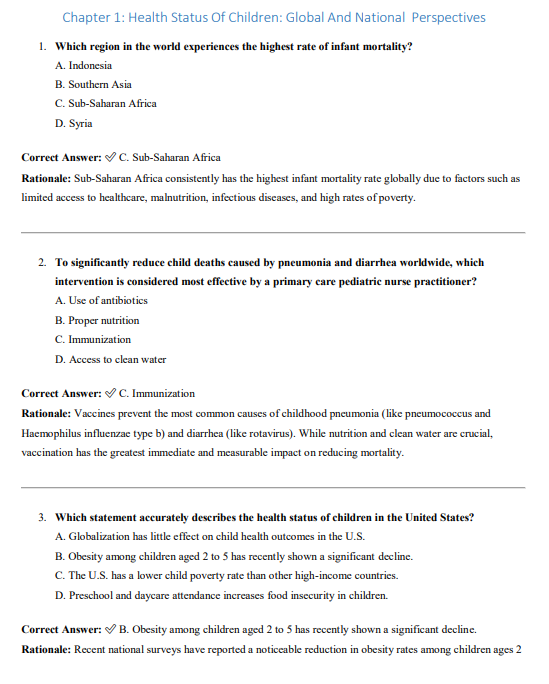
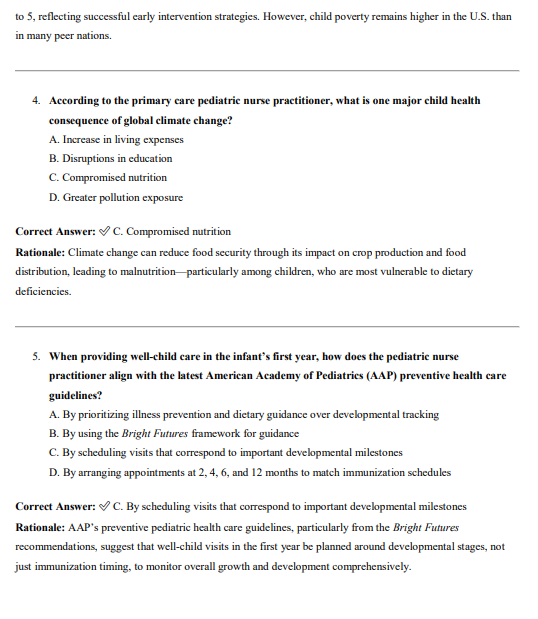
Sample Questions
Question 1
A nurse practitioner is performing a nine-month well-child visit. The parents are concerned that their baby isn’t saying any words yet. On the ASQ-3, the infant passes all communication items for this age: babbling with consonant sounds, responding to their name, and showing joint attention. What is the most appropriate response?
A) Refer immediately to a speech-language pathologist for expressive language delay
B) Order a hearing test immediately, since hearing loss is the most likely cause of absent words at nine months
C) Reassure the parents that single words aren’t expected until about 12 months and that communication development is on track
D) Diagnose expressive language delay and start early intervention services
Correct answer: C
Rationale: Meaningful single words are expected around 12 months, not nine. At nine months, normal expressive language includes consonant-vowel babbling, imitating sounds, and using vocalizations to communicate intent. This infant passed a validated screening tool, so the right step is reassurance plus anticipatory guidance about what to expect at 12 months, such as first words, pointing, and waving. Referral is premature when screening is passed and milestones are met. Hearing screening is part of routine care but isn’t urgent without a failed screen or risk factors, and diagnosing a language delay in an on-track infant would be inaccurate.
Question 2
A family nurse practitioner is evaluating a seven-year-old boy for behavioral concerns at school. His teacher reports that he is often out of his seat, interrupts constantly, loses materials daily, and can’t finish tasks. His parents report identical behavior at home since preschool. His physical exam and vision and hearing screens are normal. Which statement best reflects current AAP diagnostic criteria for ADHD?
A) ADHD can’t be diagnosed until age 12, so watchful waiting is appropriate
B) Symptoms in only one setting are enough, so school reports alone suffice
C) Diagnosis requires at least six symptoms of inattention or hyperactivity-impulsivity, present in two or more settings, with onset before age 12 and functional impairment
D) A brain MRI and EEG are required before confirming ADHD to rule out neurological causes
Correct answer: C
Rationale: AAP guidelines use DSM-5 criteria: at least six symptoms of inattention and/or hyperactivity-impulsivity, present in two or more settings (here, home and school), with clear functional impairment and onset before age 12. His parents report symptoms since preschool, which satisfies the onset criterion, and his presentation fits ADHD, combined presentation. The AAP guidance applies to children aged 4 to 18, so there is no need to wait until 12. Symptoms in a single setting don’t meet criteria. MRI and EEG are not part of routine ADHD diagnosis and are reserved for cases where history or exam suggests neurological pathology.
Question 3
A pediatric nurse practitioner is evaluating a 15-month-old with three days of fever up to 39.2°C, decreased oral intake, and irritability. The left tympanic membrane is erythematous, bulging, and immobile on pneumatic otoscopy. The child has no drug allergies. Which plan is most consistent with current AAP guidelines for acute otitis media?
A) A five-day course of azithromycin as first-line therapy to limit resistance
B) Watchful waiting with a safety-net prescription and return in 72 hours if not improving
C) High-dose amoxicillin, 80 to 90 mg/kg/day divided twice daily, for ten days
D) Immediate otolaryngology referral for tympanostomy tubes given the severity
Correct answer: C
Rationale: AAP guidelines recommend immediate antibiotic therapy for AOM in children 6 months and older with severe symptoms, defined as a temperature of 39°C or higher, moderate to severe ear pain, or pain lasting 48 hours or more, and for all children under 24 months with bilateral disease. This toddler has a fever of 39.2°C and three days of symptoms, so observation is not appropriate. High-dose amoxicillin (80 to 90 mg/kg/day in two divided doses) is first-line for children without penicillin allergy because it covers Streptococcus pneumoniae, and a ten-day course is recommended for children under two. Azithromycin is not first-line because of pneumococcal resistance and inferior efficacy. Watchful waiting is reserved for older or less severely ill children. Tube placement is not indicated for a first episode.
Question 4
A nurse practitioner is seeing a four-year-old girl for a well-child visit. She has multiple bruises in various stages of healing on her lower back, buttocks, and upper thighs. The bruises have irregular borders and some look patterned. Her mother says she is very active and bruises easily. The child is quiet and avoids eye contact. What is the most appropriate action?
A) Document the findings and reassess the bruises at a follow-up visit in two weeks
B) Advise the mother to have the child’s platelet count checked to rule out a bleeding disorder
C) Report suspected child physical abuse to child protective services and notify the appropriate authorities immediately
D) Discuss safe discipline techniques and give the mother written positive-parenting resources
Correct answer: C
Rationale: This presentation raises serious concern for non-accidental trauma. Bruises on the lower back, buttocks, and upper thighs are on protected surfaces, while accidental falls usually bruise bony prominences such as the shins, forehead, and knees. Patterned bruising suggests injury with an object, and bruises in different stages of healing indicate repeated injury over time. The child’s withdrawal and avoidance of eye contact are consistent with a trauma response. Health care providers are mandated reporters and must report reasonable suspicion of maltreatment immediately, without waiting for certainty. Delaying, investigating independently, or offering parenting education first is inappropriate and may carry legal consequences.
Question 5
A family nurse practitioner is managing an eight-year-old with persistent asthma. He has daily symptoms, uses his rescue inhaler four times a week, wakes at night twice a week, and has some activity limitation. His FEV₁ is 72% of predicted. Which classification and initial controller recommendation is most consistent with NAEPP guidelines?
A) Mild intermittent asthma: no daily controller, rescue inhaler as needed
B) Mild persistent asthma: start a low-dose inhaled corticosteroid
C) Moderate persistent asthma: start a medium-dose inhaled corticosteroid
D) Severe persistent asthma: start a high-dose inhaled corticosteroid plus a long-acting beta agonist
Correct answer: C
Rationale: NAEPP classification uses the most severe feature across impairment domains. Daily symptoms, some activity limitation, nighttime awakenings more than once a week but not nightly, and an FEV₁ of 60–80% predicted all place this child in moderate persistent asthma. His rescue inhaler use alone (more than two days a week but not daily) would fit mild persistent, but the other findings push the classification higher. A medium-dose inhaled corticosteroid is a recommended Step 3 controller option for school-age children. Mild intermittent asthma needs no daily controller, mild persistent is treated with a low-dose ICS, and high-dose ICS plus LABA is not initial therapy for moderate persistent disease.
Frequently Asked Questions
Which edition does this test bank cover?
The 8th Edition of Burns’ Pediatric Primary Care by Garzon, Dirks, Driessnack, Duderstadt, and Gaylord. Questions follow that edition’s chapter organization, updated clinical guidelines, and current evidence-based practice standards, including AAP, CDC, USPSTF, and NAEPP recommendations.
How are the questions organized?
Chapter by chapter. You can study the full scope of pediatric primary care in order or focus on areas such as growth and development, acute illness, or chronic disease management.
Is it aligned with NP and PA certification exams?
Yes. The questions reflect the clinical reasoning, developmental knowledge, and diagnostic decision-making assessed on the CPNP-PC, AANP FNP-C, ANCC FNP-BC, PANCE, and PANRE, including developmental assessment, evidence-based management, and complex pediatric scenarios.
Is it useful for family NP students who need pediatric content?
Yes. Pediatrics is a significant part of every FNP certification exam, and this test bank builds the developmental assessment, growth monitoring, and pediatric management skills those exams require.
How soon can I access it?
Immediately. You get instant digital access after purchase and can study on any device, on your own schedule.
Are the rationales based on current pediatric evidence?
Yes. They draw on AAP Bright Futures recommendations, CDC immunization schedules, NAEPP asthma guidelines, DSM-5 criteria, and current AAP clinical practice guidelines, consistent with the framework of the 8th Edition.
Can faculty use it for graduate course assessments?
Yes. The chapter-by-chapter organization, developmental emphasis, and scenario complexity suit quizzes, unit exams, case-based assessments, and comprehensive exams in graduate pediatric primary care NP and PA courses.

mercy –
Good quality!
June –
Perfect
Winnie M. –
A solid study resource
Rosemary R –
quality test bank
Norah Helen –
I like it
Gerald N –
Very very good
Kevin May –
It is a searchable pdf and I can easily find what I need
Lucille Maria –
Top quality study guide
Caleb Martins –
The test bank helped me nail my finals
Vmansteain –
Very good
Nelly –
Perfect study guide
Peterson S. –
Exactly what I needed to build exam confidence
Chris martin –
Excellent test bank
Leo Fernandez –
A solid test bank
Warren Brent –
Made review sessions way more productive.
Carol Kay –
Good variety of nursing questions to practice
Liam Mbogo –
Excellent practice resource for reviewing challenging nursing topics.
Kamara Reid –
Excellent practice for nursing students
Cayte N. –
Questions felt relevant to real pediatric nursing exams.
Karen Njiru –
Convenient and easy to study
Patty Townsend –
Great practice questions with detailed answers.
Helena Peters –
Increased my exam readiness significantly
Mary Lincoln –
Practice questions are challenging and very useful
Lucas Gabriel –
Great way to test my knowledge
Perpetual Gates –
Helpful explanations made studying more effective
Leah Kiptum –
Helpful for testing my clinical knowledge
Youri Nice –
Excellent practice resource for nursing courses
Romy Cleo –
Explanations were clear and easy to understand
Stevie Kims –
Easy to use and understand
Rachael M. –
Helpful for practicing exam-style questions
Phil Mark –
Made study sessions more productive
Ava Reed –
Useful questions for checking knowledge.
Jonathan Rogers –
Clear format makes reviewing straightforward.
Danny Milner –
Helpful practice questions for maintaining steady revision
Alexander Savic –
Convenient resource for practicing whenever extra time is available.
Harry Wilson –
Useful questions for refreshing foundational knowledge.
Francis Pelosi –
Good resource for practicing recall throughout the semester.
Anna Bilha –
Useful questions for checking understanding of course fundamentals.
Danielle Kayle –
Convenient study aid for revisiting topics whenever needed.
Emily Johnson –
Practice questions provide a structured way to review lessons.
Hannon Jerry –
Helpful resource for adding variety to exam preparation.
Dennys Kim –
Makes self-assessment a regular part of my study routine.
Charlotte Rivera –
A useful supplement for reviewing foundational healthcare topics.
Gloria Tate –
Provides a structured approach to nursing exam practice
Sarah Brown –
Helpful for strengthening recall of important course concepts
Selina Charles –
Makes reviewing course objectives easier.
Aurora Hezel –
Helpful study aid for improving topic familiarity.
Lucy Kamala –
Provides additional opportunities to practice important questions.