Every healthcare career stands on the same foundation.
Before you can recognize disease, you must understand normal. Before you can interpret an abnormal lab value, you need to know what normal physiology produces. Before you can assess a patient with confidence, you need a working knowledge of how every body system functions and what happens when that function breaks down.
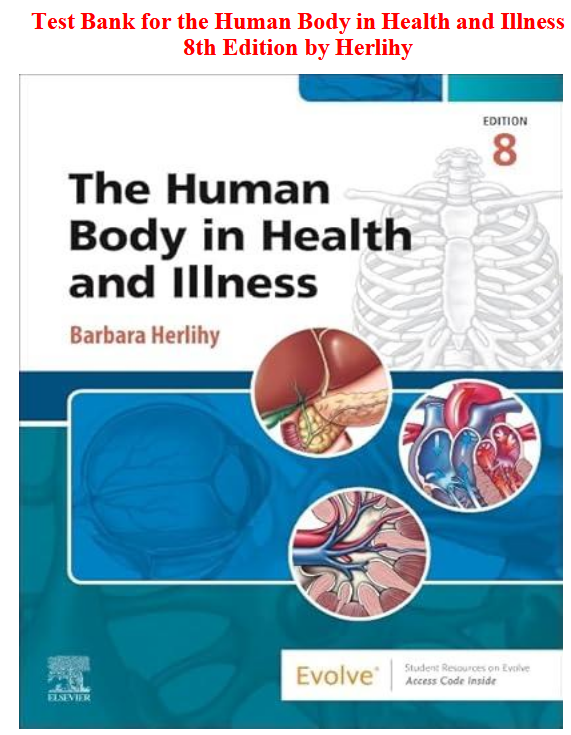
That foundation is what The Human Body in Health and Illness has given generations of nursing and allied health students, and the 8th Edition carries it forward with current, accessible, clinically connected anatomy and physiology content.
This test bank accompanies the 8th Edition of The Human Body in Health and Illness by Herlihy, a widely used, student-friendly text that makes foundational science accessible without losing the clinical depth nursing and allied health programs require. It turns that content into focused, exam-ready practice. Use it for a nursing prerequisite, a course exam, or early NCLEX preparation.
TABLE OF CONTENTS
1. Introduction to the Human Body
2. Basic Chemistry
3. Cells
4. Cell Metabolism
5. Microbiology Basics
6. Tissues and Membranes
7. Integumentary System and Body Temperature
8. Skeletal System
9. Muscular System
10. Nervous System: Nervous Tissue and Brain
11. Nervous System: Spinal Cord and Peripheral Nerves
12. Autonomic Nervous System
13. Sensory System
14. Endocrine System
15. Blood
16. Anatomy of the Heart
17. Function of the Heart
18. Anatomy of the Blood Vessels and Special Circulations
19. Functions of the Blood Vessels
20. Lymphatic System
21. Immune System
22. Respiratory System
23. Digestive System
24. Urinary System
25. Water, Electrolyte, and Acid-Base Balance
26. Reproductive Systems
27. Human Development and Heredity
What’s Inside
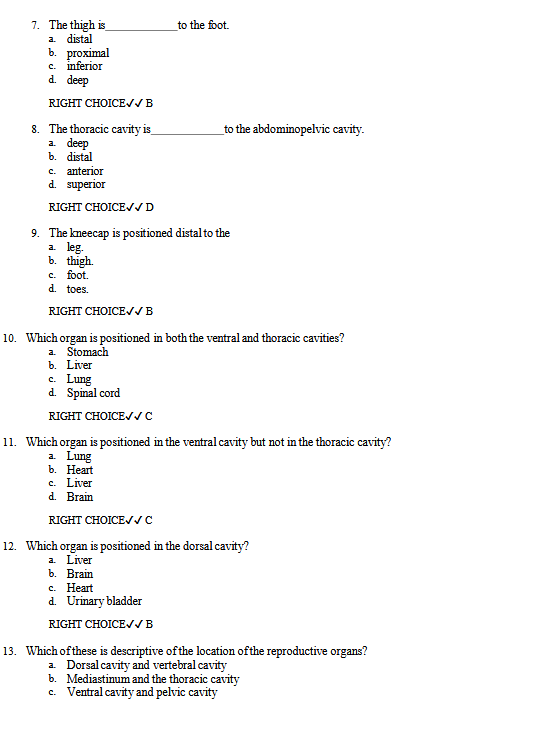
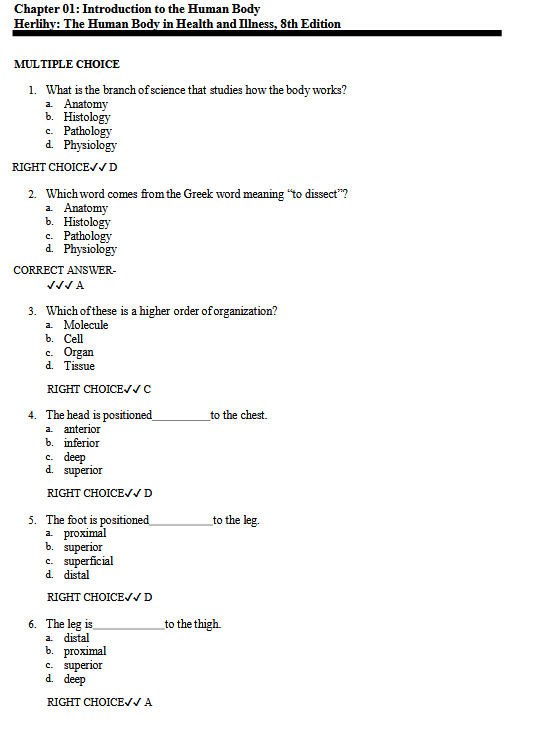
- Hundreds of practice questions covering every chapter
- Multiple-choice, true/false, matching, and clinical application questions
- Complete answer keys with clear, detailed rationales
- Questions on anatomical structures, physiological processes, and disease conditions
- Content aligned with nursing and allied health exam standards and updated for the 8th Edition
Who It’s For
- Pre-nursing students completing anatomy and physiology prerequisites
- Practical nursing and LPN students
- Allied health students in medical assisting, radiography, and respiratory therapy programs
- Nursing students reviewing core A&P concepts
- Science instructors building course exams and unit assessments
- Healthcare professionals who want a foundational science refresher
- Students whose programs have moved to the 8th Edition
Topics Covered
- Organization of the human body: cells, tissues, and body cavities
- Homeostasis and feedback mechanisms
- The integumentary system: skin, hair, and nails
- The skeletal system: bones, joints, and skeletal anatomy
- The muscular system: muscle types, contraction, and movement
- The nervous system: central, peripheral, and autonomic divisions
- Sensory systems: vision, hearing, taste, smell, and touch
- The endocrine system: hormones and glandular function
- The blood: composition, blood types, and clotting
- The cardiovascular system: heart anatomy, cardiac cycle, and blood vessels
- The lymphatic system and body immunity
- The respiratory system: anatomy, ventilation, and gas exchange
- The digestive system: organs, digestion, and absorption
- The urinary system: kidney function, urine formation, and fluid balance
- The reproductive system: male and female anatomy and physiology
- Acid-base balance and fluid and electrolyte regulation
- Disease conditions associated with each body system, with current clinical content
Why This Test Bank Works
Anatomy and physiology is the science that makes nursing make sense. When you understand how the cardiovascular system maintains cardiac output, you understand why heart failure causes the symptoms it does. When you know how the kidneys regulate fluid balance, you understand why chronic kidney disease leads to edema and electrolyte imbalance. When you grasp how the nervous system controls muscle function, you understand why a stroke produces its specific deficits.
Herlihy’s 8th Edition makes those connections explicit, linking normal structure and function to the disease states nurses and allied health professionals see every day. This test bank reinforces that approach.
Every question tests physiological understanding and clinical application, not just recall. You won’t simply label a diagram; you’ll explain why a structure’s anatomy determines its function. You won’t just memorize a hormone; you’ll understand what happens when it is deficient or excessive. You won’t only name a disease; you’ll connect it to the physiological breakdown behind it.
That applied understanding separates students who merely pass a prerequisite from those who build the lasting foundation that nursing school and practice depend on.
Rationales explain the science behind every correct answer in clear, accessible language. Questions are organized chapter by chapter, so you can target your weakest systems first and return to high-yield content as your exam approaches.
Sample Questions
Question 1
A nursing student is reviewing the cell membrane. Which characteristic is most directly responsible for its selective permeability?
A) A rigid cellulose wall surrounding the membrane
B) A phospholipid bilayer with embedded transport proteins that regulate what crosses the membrane
C) A uniform distribution of carbohydrate molecules across the membrane surface
D) Complete impermeability to everything except oxygen and carbon dioxide
Correct answer: B
Rationale: The membrane is a bilayer of phospholipids, with hydrophilic phosphate heads facing outward and hydrophobic fatty acid tails facing inward. Small, non-polar molecules such as oxygen and carbon dioxide diffuse across freely, while larger or charged molecules such as glucose, ions, and proteins cannot. Embedded channel proteins, carrier proteins, and active transport pumps control the passage of those substances, letting the cell regulate its internal environment, generate electrochemical gradients for nerve and muscle function, and manage nutrient uptake and waste removal. Cellulose walls belong to plant cells. Surface carbohydrates form glycoproteins and glycolipids for cell recognition, but they are not uniformly distributed and don’t determine permeability. The membrane is not impermeable to everything but gases, since many substances cross by transport mechanisms.
Question 2
A patient has a fracture involving the epiphyseal plate of the femur. For which population is this fracture most clinically significant, and why?
A) Elderly adults, because their epiphyseal plates are most prone to osteoporotic fracture
B) Children and adolescents, because the epiphyseal plate is the site of longitudinal bone growth, and injury can cause growth disturbance or limb length discrepancy
C) Pregnant women, because hormonal changes weaken the epiphyseal plate
D) Athletes only, because epiphyseal plates exist only in highly active people
Correct answer: B
Rationale: The epiphyseal (growth) plate is cartilage between the epiphysis and diaphysis of a long bone, where lengthwise growth occurs through childhood and adolescence. It closes by the end of puberty, typically between ages 18 and 25, leaving the epiphyseal line. Damage to a growth plate in a child can disrupt bone growth and lead to limb length discrepancy, angular deformity, or premature growth arrest, so these fractures need careful orthopedic evaluation. Adults, including elderly adults and pregnant women, no longer have open growth plates, and adult fractures are complicated by other factors such as osteoporosis. Growth plates are present in all growing children, not just athletes.
Question 3
A nursing student is studying the renin-angiotensin-aldosterone system. Which sequence correctly describes the cascade triggered by decreased blood pressure or decreased sodium delivery to the kidney?
A) The kidney releases aldosterone, which acts on the adrenal cortex to produce angiotensin
B) The kidney releases renin, which converts angiotensinogen to angiotensin I; ACE converts angiotensin I to angiotensin II, which stimulates aldosterone release from the adrenal cortex
C) The pituitary gland releases renin directly into the bloodstream, bypassing the kidney
D) Angiotensin II is released first and triggers renin production in the adrenal cortex
Correct answer: B
Rationale: When juxtaglomerular cells in the kidney detect low blood pressure, reduced sodium delivery to the distal tubule, or sympathetic stimulation, they release renin. Renin converts angiotensinogen, made by the liver and circulating continuously, into angiotensin I. ACE, found mainly in the pulmonary vascular endothelium, converts angiotensin I to angiotensin II, a potent vasoconstrictor that also prompts the adrenal cortex to release aldosterone. Aldosterone promotes sodium and water reabsorption in the renal tubules, raising blood volume and pressure. This cascade explains how ACE inhibitors and angiotensin receptor blockers work. Renin comes from the kidney, not the pituitary, and aldosterone is the end product of the cascade, not its trigger.
Question 4
A patient with COPD has a persistently elevated PaCO₂. Which renal compensatory mechanism lets this patient maintain a near-normal blood pH despite chronic respiratory acidosis?
A) The kidneys excrete excess bicarbonate to balance the carbon dioxide
B) The kidneys retain bicarbonate and excrete hydrogen ions to buffer the chronic acid load and move pH toward normal
C) The kidneys reabsorb more water to dilute the carbon dioxide
D) The kidneys play no role in acid-base balance; only the respiratory system regulates pH
Correct answer: B
Rationale: In chronic respiratory acidosis, the kidneys compensate metabolically. The renal tubules increase bicarbonate reabsorption and generation while excreting more hydrogen ions in the urine. The higher blood bicarbonate buffers the acid produced by retained CO₂ and brings pH back toward normal. This takes several days, which is why acute respiratory acidosis shows a marked pH drop while long-standing COPD often shows a near-normal pH despite a high PaCO₂. Excreting bicarbonate would worsen the acidosis, and reabsorbing water does not buffer acid. The kidneys work alongside the lungs and chemical buffers to maintain pH.
Question 5
A student is reviewing the female reproductive system. Which structure is the primary site of fertilization under normal conditions?
A) The uterus, where the fertilized egg implants and develops
B) The ampulla of the fallopian tube, where egg and sperm typically meet
C) The cervix, the entry point for sperm into the upper reproductive tract
D) The ovary, where the egg matures and is released
Correct answer: B
Rationale: Fertilization normally occurs in the ampulla, the widest and longest part of the fallopian tube, near the ovary. After ovulation, the fimbriae and cilia sweep the oocyte into the tube. Sperm travel through the cervix and uterus into the tube, where they meet the oocyte if both are viable at the same time. The resulting zygote travels toward the uterus over about five to seven days, dividing as it goes, and implants in the endometrium. The uterus is the site of implantation and fetal development, not fertilization. The cervix is a passageway and protective barrier. The ovary is where the oocyte matures and is released, but fertilization takes place farther along in the tube.
Frequently Asked Questions
Which edition does this test bank cover?
The 8th Edition of The Human Body in Health and Illness by Herlihy. Questions follow that edition’s chapter organization, updated physiological content, and refreshed disease condition coverage.
How is it different from the 7th Edition test bank?
It is written and organized specifically for the 8th Edition, which includes updated clinical content, refreshed disease examples, and a revised chapter organization compared with the 7th. Students using the 8th Edition should use this test bank for edition-specific exam preparation.
How are the questions organized?
Chapter by chapter, body system by body system, from cellular biology through the reproductive system. You can study in order or focus on the systems where you need the most improvement.
Is it useful for nursing school prerequisites?
Yes. It is designed for students completing anatomy and physiology prerequisites for nursing and allied health programs, and the questions match the level and style of pre-nursing and health science course exams.
Is it appropriate for LPN and allied health students?
Yes. The textbook is widely used in LPN, medical assisting, radiography, respiratory therapy, and surgical technology programs, and the test bank serves students in all of them wherever the 8th Edition is the course text.
How soon can I access it?
Immediately. You get instant digital access after purchase and can study on any device, on your own schedule.
Are the rationales accessible for pre-nursing students?
Yes. They explain the underlying science in clear language without assuming advanced clinical knowledge, while still building the application thinking nursing programs expect.
Can instructors use it for course assessments?
Yes. The chapter-by-chapter organization, varied question formats, and clinical application emphasis suit unit exams, quizzes, and comprehensive assessments in A&P courses for nursing and allied health programs using the 8th Edition.

Dennys –
the class has been tough but this test bank simplified things for me
Olivia George –
well worth the money
mercy –
top quality study guide
Theresa Grant –
perfect
joychristone –
exceeded my expectation
Gerald N –
Exactly what I needed
Theresa M. –
Excellent resource for my exam preps
Lucille Maria –
I like it
Chris martin –
well organized resource
Winnie M. –
Excellent!
Morgan Fraiser –
A very useful resource
Craig Bellamy –
Excellent practice questions
Terence V. –
Perfectly organized for quick exam prep
Janny Cummings –
A solid test bank.
Rosemary R –
Helped me build my exams confidence
Wilderson Baptiste (verified owner) –
How do you challenge yourself with the answer right underneath the question ?
Alicia Silva (verified owner) –
Excellent value for nursing exam success.
SHoustone –
Questions closely matched my actual nursing exam
Alan Kuqi –
Helped boost my confidence before exam day
Mary Kesh –
Great resource for building exam confidence
Carol Kay –
Great supplement to my A&P course material
Chris martin –
Saved study time with organized questions.
Lisa Horton –
Straight-forward questions and answers matching my course materials.
Patty Townsend –
With this, I can quickly review topics I struggle with
Leah Kiptum –
Very useful for reviewing before exams
Terry Anne –
Simple, clear, and easy to use.
Helen Christie –
Excellent study companion for nursing students.
Selina Meg –
Helped me review challenging A&P topics more efficiently
Tess Mwaure –
Great addition to my study materials
Steven Bell –
Helpful explanations provide additional learning support.
Isabella Morgan –
Good resource for reviewing difficult material.
Kevin Cook –
Convenient practice for busy study schedules.
Brendan Wright –
Questions provide focused opportunities to apply knowledge
Hannon Jerry –
Useful material for building familiarity with different topics
David Miller –
Helpful exercises for reinforcing lessons from previous modules.
Zakariah K. –
Useful resource for keeping revision organized and manageable.
Garry Samson –
Useful for refreshing knowledge before classroom quizzes.
Alan Aaron –
Helps identify concepts that require further attention.
Christopher Wilson –
A convenient addition to my study routine.