

Medication safety begins the moment you open a drug reference — and it never ends.
Every pill you hand to a patient, every IV line you spike, every syringe you draw up represents a clinical decision that requires pharmacological knowledge, nursing judgment, and an unwavering commitment to patient safety. Pharmacology is not a subject you learn once and move past. It is a living, clinical competency that you carry into every patient interaction for the rest of your nursing career.
And it starts here — with the fundamentals of clinical pharmacology that form the bedrock of safe medication practice.
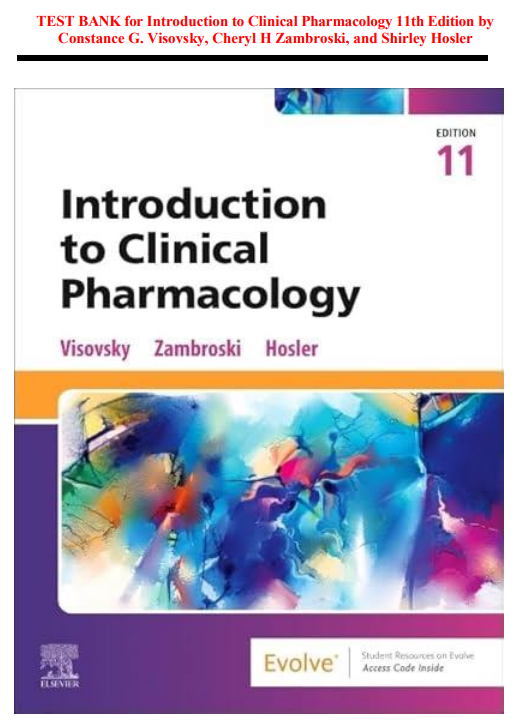
This comprehensive test bank is built for the 11th Edition of Introduction to Clinical Pharmacology by Constance G. Visovsky, Cheryl H. Zambroski, and Shirley Hosler. It is one of the most student-accessible, clinically relevant, and practically focused introductory pharmacology textbooks in LPN, LVN, and undergraduate nursing education — and this test bank helps you master every chapter with the focused, patient-safety-centered, nursing-process-driven practice that clinical pharmacology demands.
Whether you are preparing for a pharmacology course exam, an ATI pharmacology assessment, or the NCLEX-PN or NCLEX-RN, this resource delivers the drug knowledge, clinical reasoning, and medication safety focus that Visovsky, Zambroski, and Hosler have always emphasized — and that every patient deserves from their nurse.
What’s Inside?
- Hundreds of practice questions covering every chapter
- Multiple-choice, select-all-that-apply, alternate-format, and clinical scenario questions
- Complete answer keys with thorough, clinically grounded pharmacological rationales
- Questions aligned with current NCLEX-RN and NCLEX-PN examination standards
- Coverage of all major drug classifications, nursing implications, patient education priorities, and medication safety principles across every body system
Who Is This Test Bank For?
This resource is perfect for:
- LPN and LVN nursing students in introductory clinical pharmacology courses
- Undergraduate RN nursing students using Visovsky, Zambroski, and Hosler as their pharmacology text
- NCLEX-PN candidates seeking targeted pharmacology content review
- NCLEX-RN candidates refreshing foundational clinical pharmacology knowledge
- Nursing students completing ATI pharmacology assessments and proctored examinations
- Nursing faculty developing introductory pharmacology course exams and unit assessments
- LPN-to-RN bridge students reinforcing and expanding foundational pharmacological knowledge
- Healthcare students in allied health programs requiring introductory pharmacology competency
Topics Covered Include:
- Introduction to pharmacology — drug sources, names, and legal considerations
- Pharmacokinetics — absorption, distribution, metabolism, and excretion
- Pharmacodynamics — drug-receptor interactions and dose-response relationships
- Medication safety — the rights of medication administration and error prevention
- The nursing process applied to pharmacological care
- Drug interactions, adverse drug reactions, and hypersensitivity responses
- Lifespan pharmacology — pediatric, geriatric, and pregnancy considerations
- Vitamins, minerals, and herbal supplement considerations
- Analgesics — opioid and non-opioid pain management
- Anti-inflammatory agents — salicylates, NSAIDs, and corticosteroids
- Antibiotics — penicillins, cephalosporins, tetracyclines, macrolides, and fluoroquinolones
- Antivirals, antifungals, and antiparasitic medications
- Cardiovascular drug therapy — antihypertensives, antidysrhythmics, and heart failure medications
- Anticoagulants, antiplatelets, and thrombolytic agents
- Diuretics and renal pharmacology
- Central nervous system drugs — antidepressants, antipsychotics, and anxiolytics
- Antiepileptic drug therapy
- Neurological pharmacology — Parkinson’s disease and neurodegenerative conditions
- Endocrine pharmacology — insulin, oral antidiabetics, thyroid, and adrenal agents
- Respiratory pharmacotherapy — bronchodilators, corticosteroids, and antihistamines
- Gastrointestinal pharmacology — antacids, antiemetics, and bowel agents
- Immunological agents — vaccines, immunosuppressants, and biologic therapies
- Oncology pharmacology principles
- Dermatological, ophthalmic, and otic pharmacotherapy
- Reproductive and women’s health pharmacology
Why This Test Bank Delivers Results
Introduction to Clinical Pharmacology by Visovsky, Zambroski, and Hosler is built for a specific and critically important audience — nursing students who are encountering clinical pharmacology for the first time and need a textbook that makes drug therapy accessible, clinically meaningful, and directly applicable to nursing practice from the very first chapter.
The 11th Edition achieves that goal with greater precision and clinical relevance than any previous edition. It integrates the nursing process into every drug discussion — not as an afterthought, but as the organizing framework through which every pharmacological concept is taught, reinforced, and applied. It emphasizes medication safety at every level — from the rights of medication administration through the recognition of life-threatening adverse effects. And it presents clinical pharmacology at a level of accessibility that does not sacrifice clinical accuracy or depth.
This test bank is built to match that standard — and to develop the clinical pharmacology competency that LPN and RN practice demands.
Every question is constructed around the dual pillars of clinical pharmacology mastery — drug knowledge and nursing application. You will not simply identify a drug’s classification or mechanism of action. You will apply that knowledge to a real patient receiving that drug — assessing for contraindications before the first dose, recognizing adverse effects as they develop, evaluating therapeutic response after administration, and educating the patient in language that promotes safety and adherence.
The NCLEX-PN tests pharmacology extensively — and it tests it exactly this way. Not as isolated drug facts, but as applied clinical decisions embedded in patient care scenarios. The NCLEX-RN does the same — with additional complexity in clinical reasoning and patient management. This test bank prepares you for both — building the foundational pharmacological competency that LPN practice demands while also developing the clinical reasoning depth that bridges toward RN-level nursing.
Detailed rationales explain the pharmacological mechanisms, nursing process applications, patient safety principles, and clinical reasoning behind every correct answer. The 11th Edition’s most current drug content is fully reflected — including updated FDA safety communications, revised dosing guidelines, and current black box warning information.
Questions are organized chapter by chapter for structured, systematic study. Target drug classes where your knowledge is weakest. Return to high-yield pharmacological categories as your NCLEX or course exam approaches. Build the medication safety mindset that clinical pharmacology demands — and that every patient deserves from their nurse.
Sample Questions
Question 1
A nurse is preparing to administer furosemide 40 mg IV to a patient with acute heart failure. Before administering the medication, the nurse reviews the patient’s morning laboratory results — serum potassium 3.1 mEq/L, serum sodium 138 mEq/L, creatinine 1.2 mg/dL, and BUN 22 mg/dL. The patient’s cardiac monitor shows flattened T waves. Which nursing action is most appropriate?
- A) Administer the furosemide as ordered since it will reduce the fluid overload causing the heart failure
- B) Hold the furosemide, notify the provider of the critically low potassium level and ECG changes, and withhold the dose until potassium is corrected
- C) Administer the furosemide and add oral potassium chloride supplementation with the dose
- D) Reduce the furosemide dose to 20 mg IV and proceed with administration
Correct Answer: B
Rationale: This question requires the nurse to apply the nursing process — specifically assessment — before implementing the medication order. A serum potassium of 3.1 mEq/L represents significant hypokalemia — below the lower limit of normal of 3.5 mEq/L — and the flattened T waves on the cardiac monitor confirm that the hypokalemia is already producing cardiac manifestations. Furosemide is a loop diuretic that promotes renal potassium excretion — administering it to a patient with pre-existing hypokalemia and cardiac ECG changes would further lower the potassium level and significantly increase the risk of life-threatening cardiac dysrhythmias including ventricular tachycardia and ventricular fibrillation. The nurse must hold the medication and notify the provider immediately so that potassium replacement can be initiated before diuresis proceeds. Administering oral potassium with the IV furosemide is insufficient — oral potassium absorption is slower than IV loss from a loop diuretic, and the cardiac manifestations of existing hypokalemia require more urgent correction than oral supplementation provides. Reducing the dose does not eliminate the risk of further potassium depletion in a patient already at a dangerous potassium level with cardiac involvement.
Question 2
A nurse is caring for an elderly patient who has been taking digoxin 0.125 mg orally daily for chronic atrial fibrillation. The patient reports nausea, loss of appetite, and seeing yellow-green halos around lights for the past two days. The nurse assesses an apical pulse of 51 beats per minute. The morning serum digoxin level is 2.6 ng/mL. Which action reflects the most appropriate application of clinical pharmacology knowledge and the nursing process?
- A) Administer the scheduled digoxin dose since the dose is low and the patient is elderly
- B) Hold the scheduled digoxin dose, notify the provider immediately, assess serum electrolytes, and obtain an ECG to evaluate for dysrhythmias
- C) Administer the digoxin and encourage the patient to eat a full meal to reduce nausea
- D) Hold only the morning dose and administer the next scheduled dose as planned
Correct Answer: B
Rationale: This patient is exhibiting the classic clinical presentation of digoxin toxicity — nausea, anorexia, and xanthopsia (yellow-green visual halos) combined with bradycardia and a supratherapeutic serum digoxin level of 2.6 ng/mL, which exceeds the therapeutic range of 0.5–2.0 ng/mL. Digoxin has an extremely narrow therapeutic index — the difference between a therapeutic and toxic dose is small — making toxicity recognition a critical nursing competency. The apical pulse of 51 bpm exceeds the standard threshold for holding digoxin in adults — typically below 60 bpm. The nurse must hold the dose immediately and notify the provider urgently. Serum electrolytes — particularly potassium — must be assessed because hypokalemia potentiates digoxin toxicity dramatically. An ECG is essential to evaluate for digoxin-induced dysrhythmias including heart block and ventricular dysrhythmias. In elderly patients, digoxin toxicity occurs more easily due to decreased renal clearance and reduced volume of distribution — making careful monitoring essential in this population. Administering any dose of digoxin to a patient with confirmed toxicity signs and a supratherapeutic level is a serious, potentially life-threatening medication safety error.
Question 3
A nurse is providing discharge teaching to a patient who has been prescribed warfarin 5 mg orally daily following a deep vein thrombosis. Which patient statement indicates the teaching has been effective?
- A) “I can take ibuprofen for my headaches since it is available without a prescription and is safer than prescription pain medications.”
- B) “I should eat consistent amounts of leafy green vegetables rather than eliminating them from my diet entirely.”
- C) “I only need to have my INR checked when I feel like my blood is getting too thin.”
- D) “If I miss a dose I should take two doses the next day to make up for the missed one.”
Correct Answer: B
Rationale: This statement reflects accurate and sophisticated understanding of warfarin dietary management. Warfarin works by inhibiting vitamin K-dependent clotting factors — leafy green vegetables such as spinach, kale, and broccoli are rich in vitamin K and can reduce warfarin’s anticoagulant effect if consumed inconsistently. The evidence-based recommendation is not to eliminate vitamin K-containing foods — which is an unnecessary dietary restriction — but to maintain a consistent intake so that vitamin K’s influence on warfarin effect remains stable and predictable. Sudden increases in vitamin K intake reduce anticoagulation effect while sudden decreases increase it — consistency is the therapeutic key. Option A is dangerously incorrect — NSAIDs such as ibuprofen significantly increase bleeding risk in patients on warfarin by inhibiting platelet aggregation and displacing warfarin from plasma proteins. INR monitoring is a scheduled, protocol-driven clinical requirement — not a symptom-based decision. Missing a dose should be taken as soon as remembered the same day or skipped if close to the next dose — doubling doses significantly increases bleeding risk and is never appropriate.
Question 4
A nurse is administering metformin 1000 mg orally twice daily to a patient with type 2 diabetes. The patient reports they have been having significant diarrhea and nausea since starting the medication three days ago. Which nursing response is most appropriate?
- A) Hold the metformin immediately and notify the provider that the patient is having an allergic reaction
- B) Reassure the patient that gastrointestinal side effects are common when starting metformin, are typically transient, and taking the medication with food significantly reduces these symptoms
- C) Instruct the patient to stop taking the metformin until symptoms resolve and restart at half the dose
- D) Switch the patient to insulin therapy since metformin is clearly not tolerated
Correct Answer: B
Rationale: Gastrointestinal adverse effects — including nausea, diarrhea, abdominal cramping, and metallic taste — are the most common adverse effects of metformin and occur in a significant proportion of patients during initial therapy. These effects are dose-dependent and typically transient — resolving within the first two to four weeks as the body adjusts to the medication. The most effective strategy to reduce GI side effects is to take metformin with meals, which slows drug absorption and reduces the gastric irritation that drives these symptoms. Extended-release formulations of metformin also significantly reduce GI side effects compared to immediate-release. The nurse’s role is to provide accurate patient education that supports medication adherence — premature discontinuation of metformin due to manageable, expected side effects that are likely to resolve represents a missed opportunity to support the patient’s glycemic management. GI symptoms in this context do not represent an allergic reaction — true drug allergy would present with urticaria, angioedema, or anaphylaxis. Instructing the patient to self-discontinue without provider guidance is inappropriate nursing advice. Switching to insulin is a clinical decision that requires provider involvement and is not indicated for expected, transient GI side effects at three days of therapy.
Question 5
A nurse is caring for a patient who has been prescribed ciprofloxacin 500 mg orally twice daily for a urinary tract infection. The patient reports taking a calcium antacid daily for heartburn and asks whether they can continue taking it. Which nursing response reflects accurate clinical pharmacology knowledge?
- A) “Yes, you can take the calcium antacid at any time — it does not affect ciprofloxacin in any way.”
- B) “You should separate the calcium antacid from your ciprofloxacin by at least two hours — calcium and other divalent cations significantly reduce ciprofloxacin absorption when taken together.”
- C) “You must stop taking the antacid entirely until you have completed the full course of ciprofloxacin.”
- D) “Take the calcium antacid at the same time as the ciprofloxacin — taking them together actually helps reduce GI side effects from the antibiotic.”
Correct Answer: B
Rationale: Ciprofloxacin — a fluoroquinolone antibiotic — undergoes a clinically significant drug interaction with divalent and trivalent cations including calcium, magnesium, aluminum, iron, and zinc. These cations form insoluble chelate complexes with ciprofloxacin in the gastrointestinal tract, dramatically reducing drug absorption and bioavailability — potentially by as much as 50–90% — and rendering the antibiotic therapeutically ineffective. This interaction applies to calcium antacids, magnesium-containing antacids, iron supplements, dairy products, and calcium-fortified foods. The clinical management is straightforward — separate administration by at least two hours before or six hours after cation-containing products to allow adequate ciprofloxacin absorption before chelation can occur. Eliminating the antacid entirely is not necessary — the patient’s heartburn symptoms require management — but timing separation is essential. Taking the antacid simultaneously with ciprofloxacin will prevent adequate antibiotic absorption and risk treatment failure of the UTI — potentially leading to worsening infection, antibiotic resistance development, and the need for alternative therapy.
Frequently Asked Questions (FAQs)
What edition does this test bank cover?
This test bank is written specifically for the 11th Edition of Introduction to Clinical Pharmacology by Visovsky, Zambroski, and Hosler. All questions are fully aligned with the current edition’s chapter organization, updated drug content, current FDA safety communications, and evidence-based nursing pharmacology practice standards.
How are the questions organized?
Questions are arranged chapter by chapter, allowing you to study systematically through all clinical pharmacology content or focus on specific drug classes — such as cardiovascular agents, antibiotics, or CNS medications — based on your course exam schedule or NCLEX preparation priorities. The nursing process framework is integrated throughout every chapter’s question set.
Is this test bank primarily for LPN students or RN students?
Both. Introduction to Clinical Pharmacology by Visovsky, Zambroski, and Hosler is widely used in LPN, LVN, and undergraduate RN programs. This test bank is written to serve both audiences — the foundational pharmacology content, medication safety emphasis, and nursing process integration are equally relevant for PN-level and RN-level students. The NCLEX-PN and NCLEX-RN both test pharmacological content extensively and this test bank prepares students for both examinations.
Is this test bank aligned with the NCLEX-PN and NCLEX-RN?
Yes. Questions are written to reflect current NCLEX-PN and NCLEX-RN examination standards, with emphasis on pharmacological and parenteral therapy — one of the most heavily tested client needs subcategories on both licensing examinations. Clinical scenario questions mirror the application-level thinking both examinations demand from nursing pharmacology content.
How does this test bank differ from other nursing pharmacology test banks?
This test bank is written specifically for the 11th Edition of Visovsky, Zambroski, and Hosler’s Introduction to Clinical Pharmacology. The chapter organization, drug content emphasis, introductory-level pharmacology framework, and nursing process integration reflect this specific textbook. Students using this textbook will find this test bank most accurately aligned with their course material, chapter assignments, and pharmacology curriculum.
How quickly can I access the test bank after purchase?
Immediately. As soon as your purchase is complete, you receive instant digital access with no waiting period. Study on your own schedule, at your own pace, from any device.
Are the rationales detailed enough to support genuine pharmacological learning?
Yes. Every rationale explains the pharmacological mechanisms, nursing process application, patient safety principles, and clinical reasoning behind the correct answer — not just identifies it. This approach builds the foundational clinical pharmacology understanding that Visovsky, Zambroski, and Hosler emphasize throughout the 11th Edition — and that medication-safe nursing practice demands at every level of clinical care.
Can nursing faculty use this test bank for course assessments?
Absolutely. The chapter-by-chapter organization, nursing process integration, varied question formats, and clinical scenario emphasis make this an outstanding resource for faculty building unit exams, ATI-style assessments, and comprehensive pharmacology course finals for LPN, LVN, and undergraduate RN nursing programs.


McCarthy P. –
a solid study guide
Magdeline A. –
high-quality questions followed by accurate answers and clear and concise rationales.
Henry Wilcox –
a comprehensive study guide, perfect for quick exam preparation.
Dorcas M. –
Helped me pass my finals
Jannny –
Perfect
Lucille Maria –
A solid study guide
Chris martin –
To be honest, it’s much better than I expected.
Winnie M. –
Informative and practical
Caleb Martins c –
Great value for learners
Liam Mbogo –
Fantastic review tool for mastering nursing concepts
Kamara Reid (verified owner) –
Practice questions were accurate and up-to-date
Rosemary R –
Easy way to prepare for difficult nursing exams
Leo Fernandez –
Useful practice before taking challenging nursing exams
Lucas Gabriel –
Definitely helpful for nursing students preparing exams
Terence V. –
The test bank Made reviewing much less stressful