
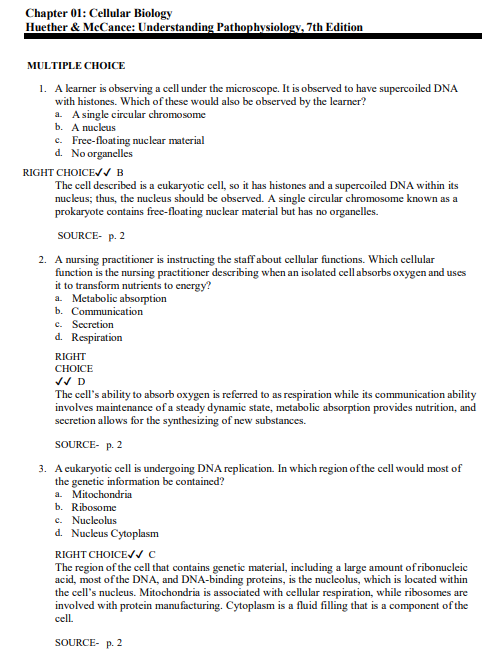
The best clinicians don’t just treat disease. They understand it.
They understand why a patient with left-sided heart failure wakes up gasping for air at night. They understand why a patient with Cushing’s syndrome gains weight in the trunk but loses muscle in the limbs. They understand why a small pulmonary embolism can cause sudden cardiac arrest while a large pleural effusion develops silently over weeks. That depth of understanding — the kind that predicts clinical presentations before they fully unfold — is what pathophysiology builds.
And it is what separates nurses who react from nurses who anticipate.
This comprehensive test bank is built for the 7th Edition of Understanding Pathophysiology by Huether, McCance, and Brashers. It is one of the most academically rigorous and clinically authoritative pathophysiology textbooks in nursing education — widely used in undergraduate, graduate, and accelerated nursing programs across the country. This test bank helps you master every chapter with the focused, mechanism-driven, clinically applied practice that pathophysiology mastery demands.
Whether you are preparing for a pathophysiology course exam, building your NCLEX clinical reasoning foundation, or laying the groundwork for graduate-level advanced pathophysiology, this resource delivers the depth, precision, and systems-based thinking that Huether, McCance, and Brashers demand — and that clinical practice rewards.
What’s Inside?
- Hundreds of practice questions covering every chapter
- Multiple-choice, true/false, matching, and complex clinical application questions
- Complete answer keys with thorough, mechanistically grounded rationales
- Questions covering cellular pathophysiology, disease mechanisms, clinical manifestations, diagnostic findings, and treatment principles
- Content aligned with NCLEX-RN, graduate nursing, and health professions examination standards
Who Is This Test Bank For?
This resource is ideal for:
- Undergraduate RN nursing students in pathophysiology courses
- Graduate nursing students in advanced pathophysiology courses
- DNP and MSN students reinforcing foundational disease mechanism knowledge
- NCLEX-RN candidates strengthening pathophysiological clinical reasoning
- RN-to-BSN students building advanced pathophysiological understanding
- Nursing faculty developing pathophysiology course exams and comprehensive assessments
- Allied health and pre-professional students using Huether and McCance as their course text
- Advanced practice nursing students preparing for APRN certification examinations
Topics Covered Include:
- Cellular biology — cell structure, function, and cellular communication
- Genes and genetic diseases — inheritance patterns and genetic disorders
- Epigenetics and disease
- Altered cellular and tissue biology — cellular injury, aging, and death
- Fluids, electrolytes, acids, and bases — imbalances and clinical consequences
- Innate and adaptive immunity — immune system function and dysregulation
- Inflammation and repair — acute and chronic inflammatory processes
- Infection and alterations in immunity — immunodeficiency and hypersensitivity
- Stress and disease — neuroendocrine and immune interactions
- Cancer biology — tumor development, invasion, and metastasis
- Cancer epidemiology and treatment principles
- Cardiovascular pathophysiology — heart failure, coronary artery disease, and valvular disorders
- Vascular disorders — hypertension, aneurysms, and peripheral arterial disease
- Alterations in pulmonary function — obstructive, restrictive, and vascular lung diseases
- Renal pathophysiology — acute and chronic kidney disease, glomerulonephritis
- Bladder and urinary tract disorders
- Alterations in digestive function — gastric, intestinal, and hepatic disorders
- Alterations in musculoskeletal function — bone disease, joint disorders, and skeletal muscle conditions
- Neurological pathophysiology — pain, TBI, stroke, and neurodegenerative disorders
- Alterations in cognitive systems — delirium, dementia, and disorders of consciousness
- Alterations in hormonal regulation — pituitary, thyroid, adrenal, and pancreatic disorders
- Alterations in the reproductive system — male and female pathological conditions
- Hematological disorders — anemia, leukemia, and clotting abnormalities
- Alterations in immunity and inflammation in children and older adults
Why This Test Bank Delivers Results
Understanding Pathophysiology by Huether, McCance, and Brashers is not an introductory textbook.
It is written for students who are ready to engage with disease mechanisms at a cellular, molecular, and systemic level simultaneously. It demands more than surface-level understanding — it demands the ability to trace a clinical presentation from its molecular origin through its tissue manifestation to its systemic consequences. That is a different cognitive challenge from most nursing textbooks. And this test bank rises to meet it.
Every question in this test bank is grounded in the mechanistic, cellular-to-systemic reasoning framework that Huether, McCance, and Brashers establish throughout the textbook. You will not simply identify disease names or match symptoms to diagnoses. You will explain why increased afterload in systemic hypertension leads to ventricular hypertrophy and eventual heart failure. You will connect the pathophysiological mechanism of type 1 diabetes — autoimmune destruction of beta cells — to the specific metabolic consequences of absolute insulin deficiency. You will trace the coagulation cascade disruption in disseminated intravascular coagulation from its triggering event to its paradoxical combination of simultaneous clotting and bleeding.
This is the level of pathophysiological reasoning that advanced nursing practice demands. This is the level that APRN certification exams assess. And this is the level this test bank builds — question by question, mechanism by mechanism, clinical consequence by clinical consequence.
Detailed rationales do not merely confirm correct answers. They walk through the cellular mechanisms, physiological disruptions, compensatory responses, and clinical significance behind every question. That level of mechanistic explanation transforms a practice question into a genuine learning opportunity — and repeated learning opportunities into deep, durable pathophysiological understanding.
Questions are organized chapter by chapter for structured, systematic study. Target the disease systems where your mechanistic understanding is weakest. Return to high-yield pathophysiological categories as your examination approaches. Build the cellular-to-systemic clinical thinking that Huether and McCance demand — and that the best clinicians carry with them throughout their careers.
Sample Questions
Question 1
A patient with chronic systemic hypertension develops concentric left ventricular hypertrophy over several years. Which pathophysiological mechanism most directly explains the development of left ventricular hypertrophy in this patient?
- A) Volume overload from fluid retention causing sarcomere replication in series and ventricular dilation
- B) Pressure overload from increased afterload causing sarcomere replication in parallel and ventricular wall thickening
- C) Myocardial ischemia from coronary artery disease causing cardiomyocyte death and fibrous replacement
- D) Neurohormonal activation of the renin-angiotensin-aldosterone system causing cardiomyocyte apoptosis
Correct Answer: B
Rationale: Chronic systemic hypertension creates sustained pressure overload on the left ventricle — the ventricle must generate greater force with each contraction to overcome the elevated systemic vascular resistance it faces during ejection. This mechanical stress activates intracellular signaling pathways — including activation of stretch-sensitive receptors, angiotensin II signaling, and adrenergic stimulation — that drive cardiomyocyte hypertrophy. In response to pressure overload, sarcomeres replicate in parallel — side by side — increasing myocardial wall thickness without a proportional increase in chamber volume. This produces concentric hypertrophy — a thick-walled, stiff ventricle with preserved or reduced internal chamber dimensions. Concentric hypertrophy initially maintains stroke volume against elevated afterload but ultimately impairs diastolic filling and increases myocardial oxygen demand. Volume overload — as in valvular regurgitation or fluid retention — produces sarcomere replication in series and eccentric hypertrophy with chamber dilation. Ischemic cardiomyopathy produces fibrosis rather than hypertrophy.
Question 2
A 34-year-old woman is diagnosed with systemic lupus erythematosus. Her laboratory results show elevated antinuclear antibodies, low complement levels, and the presence of anti-double-stranded DNA antibodies. Which immunological mechanism most directly explains the multi-organ tissue damage seen in SLE?
- A) Type I hypersensitivity reaction mediated by IgE antibodies and mast cell degranulation
- B) Type II hypersensitivity reaction causing direct antibody-mediated cytotoxicity of self cells
- C) Type III hypersensitivity reaction involving immune complex deposition in tissues and complement activation
- D) Type IV hypersensitivity reaction mediated by sensitized T lymphocytes causing delayed tissue damage
Correct Answer: C
Rationale: Systemic lupus erythematosus is the prototypical Type III hypersensitivity disorder — an immune complex disease. In SLE, defective immune tolerance allows autoreactive B cells to produce autoantibodies against nuclear antigens — particularly anti-double-stranded DNA and anti-Smith antibodies. These autoantibodies form antigen-antibody complexes that circulate in the bloodstream and deposit in the walls of small blood vessels, glomeruli, synovial membranes, and other tissues. Deposited immune complexes activate complement through the classical pathway — generating the anaphylatoxins C3a and C5a, which recruit neutrophils and macrophages to sites of deposition. The resulting inflammatory response causes the vasculitis, glomerulonephritis, arthritis, and serositis characteristic of SLE. Low complement levels reflect complement consumption by immune complex activation. Type I hypersensitivity mediates allergic responses. Type II causes cell-specific destruction as in hemolytic anemia. Type IV — delayed-type hypersensitivity — is T cell-mediated and does not involve antibodies or immune complexes.
Question 3
A patient develops acute respiratory distress syndrome following severe sepsis. The chest X-ray shows bilateral diffuse infiltrates and the PaO₂/FiO₂ ratio is 160 mmHg. Which pathophysiological mechanism most directly explains the profound hypoxemia in ARDS?
- A) Hypoventilation from respiratory muscle fatigue reducing alveolar oxygen delivery
- B) Diffusion impairment from increased alveolar-capillary membrane thickness slowing oxygen transfer
- C) Intrapulmonary shunting from fluid-filled and collapsed alveoli being perfused without ventilation
- D) Ventilation-perfusion mismatch from pulmonary vasoconstriction redistributing blood flow away from ventilated alveoli
Correct Answer: C
Rationale: ARDS is characterized by massive diffuse alveolar damage — the alveolar-capillary barrier is disrupted by inflammatory mediators from the underlying trigger (sepsis in this case), causing protein-rich inflammatory exudate to flood the alveolar spaces. Surfactant is destroyed, causing widespread alveolar collapse. The result is that large numbers of alveoli are filled with fluid and debris or are completely collapsed — unable to participate in gas exchange. However, these alveoli continue to receive pulmonary blood flow — creating massive intrapulmonary shunting. Blood passes through the lungs without being oxygenated, returning to the left heart with the same low oxygen content it had when it entered the pulmonary circulation. This shunt physiology is refractory to supplemental oxygen administration — the hallmark of ARDS hypoxemia — because oxygen cannot reach the fluid-filled alveoli regardless of the inspired concentration. While diffusion impairment and V/Q mismatch contribute to hypoxemia in ARDS, intrapulmonary shunting from alveolar flooding and collapse is the dominant mechanism of the profound, oxygen-resistant hypoxemia.
Question 4
A patient with a history of alcoholic cirrhosis develops hepatic encephalopathy. His family reports increasing confusion, personality changes, and sleep disturbances over the past week. His serum ammonia is markedly elevated. Which pathophysiological sequence most accurately explains the development of hepatic encephalopathy in this patient?
- A) Hepatic failure → reduced bile production → fat malabsorption → fat-soluble vitamin deficiency → cerebral dysfunction
- B) Portal hypertension → esophageal varices → gastrointestinal bleeding → iron deficiency → cerebral hypoxia
- C) Hepatic failure → reduced urea cycle function → ammonia accumulation → astrocyte swelling and cerebral dysfunction
- D) Hepatic failure → reduced albumin synthesis → cerebral edema from decreased oncotic pressure → encephalopathy
Correct Answer: C
Rationale: The liver is the primary site of ammonia detoxification — converting ammonia generated from protein metabolism and intestinal bacterial activity into urea through the urea cycle for renal excretion. In cirrhosis, hepatocellular dysfunction severely impairs the urea cycle, and portosystemic shunting allows ammonia-rich portal blood to bypass the liver entirely and enter the systemic circulation. Elevated systemic ammonia crosses the blood-brain barrier and is taken up by astrocytes — the primary ammonia-metabolizing cells in the brain. Astrocytes convert ammonia to glutamine through glutamine synthetase, but glutamine accumulation causes astrocyte swelling, cerebral osmotic stress, and neurological dysfunction. Additionally, ammonia disrupts neurotransmitter systems — increasing inhibitory GABAergic tone and altering the balance of aromatic and branched-chain amino acids — producing the constellation of confusion, sleep-wake cycle reversal, and asterixis characteristic of hepatic encephalopathy. Reduced bile production and albumin synthesis are consequences of liver failure but do not directly explain encephalopathy through the mechanisms described.
Question 5
A 55-year-old male with a 40-pack-year smoking history is diagnosed with small cell lung cancer. Staging reveals extensive-stage disease with brain metastases. In addition to oncological symptoms, the patient develops hyponatremia with serum sodium of 122 mEq/L, concentrated urine, and continued urinary sodium excretion despite low serum sodium. Which pathophysiological mechanism most directly explains these findings?
- A) Adrenal insufficiency from metastatic destruction of the adrenal glands reducing aldosterone secretion
- B) Paraneoplastic syndrome — ectopic ADH secretion from tumor cells causing syndrome of inappropriate antidiuretic hormone
- C) Cerebral salt wasting from brain metastases causing inappropriate renal sodium excretion
- D) Hypoalbuminemia from cancer cachexia causing dilutional hyponatremia from fluid shifts
Correct Answer: B
Rationale: Small cell lung cancer is the most common cause of paraneoplastic SIADH — syndrome of inappropriate antidiuretic hormone secretion. Small cell carcinoma cells are derived from neuroendocrine tissue and can autonomously produce and secrete antidiuretic hormone (ADH/vasopressin) completely independent of normal hypothalamic-pituitary regulation. Ectopic ADH causes the renal collecting ducts to continuously reabsorb water regardless of serum osmolality, producing progressive dilutional hyponatremia. The concentrated urine despite low serum sodium — and the continued urinary sodium excretion — are the diagnostic hallmarks of SIADH, reflecting ongoing ADH-driven water reabsorption. This is a classic paraneoplastic syndrome — a distant metabolic effect of the tumor rather than a direct effect of local invasion or metastasis. Adrenal insufficiency would cause hyperkalemia and hypotension in addition to hyponatremia. Cerebral salt wasting produces volume depletion — unlike SIADH, which produces euvolemia or mild volume expansion. Hypoalbuminemia causes oncotic edema states — not SIADH physiology.
Frequently Asked Questions (FAQs)
What edition does this test bank cover?
This test bank is written specifically for the 7th Edition of Understanding Pathophysiology by Huether, McCance, and Brashers. All questions are fully aligned with the current edition’s chapter organization, updated cellular and molecular pathophysiology content, and current evidence-based disease mechanism standards.
How are the questions organized?
Questions are arranged chapter by chapter — cellular biology through systemic disease — allowing you to study systematically through the entire course or focus on specific pathophysiological systems where your mechanistic understanding needs the most development, such as cardiovascular, pulmonary, renal, or neurological pathophysiology.
Is this test bank appropriate for both undergraduate and graduate nursing students?
Absolutely. Understanding Pathophysiology by Huether and McCance is used in both undergraduate pathophysiology courses and graduate advanced pathophysiology courses. This test bank is written to serve students at both levels — with questions ranging from foundational disease mechanism content to the cellular and molecular pathophysiology depth that graduate nursing programs require.
Is this test bank useful for NCLEX preparation?
Yes. The NCLEX increasingly integrates pathophysiological reasoning into clinical scenario questions — particularly Next Generation NCLEX items that require recognizing clinical deterioration, connecting assessment findings to underlying disease mechanisms, and selecting evidence-based nursing interventions. This test bank directly strengthens the pathophysiological clinical reasoning foundation that NGN questions demand.
Is this test bank useful for APRN certification examination preparation?
Yes. Advanced practice nursing certification examinations — including AANP and ANCC board exams — require pathophysiological depth beyond basic nursing licensure. The cellular-to-systemic disease mechanism understanding this test bank builds directly supports the advanced clinical reasoning these examinations assess.
How quickly can I access the test bank after purchase?
Immediately. As soon as your purchase is complete, you receive instant digital access with no waiting period. Study on your own schedule, at your own pace, from any device.
Are the rationales written at the level of depth that Huether and McCance demand?
Yes. Every rationale is written to reflect the cellular-to-systemic mechanistic reasoning framework of the textbook — explaining disease mechanisms, compensatory physiological responses, and clinical consequences in the depth that Understanding Pathophysiology demands and that advanced nursing practice requires.
Can nursing faculty use this test bank for course assessments?
Absolutely. The chapter-by-chapter organization, mechanistic question construction, and varied question formats make this an outstanding resource for faculty building unit exams, comprehensive course assessments, and graduate-level pathophysiology examinations at both the undergraduate and advanced practice nursing level.

Marcus –
I had a problem downloading the document but the admin quickly responded and sent me the document to my email. The test bank is very helpful.
Purity L. –
Perfect! exactly what I needed for this class
Gary M. –
A solid test bank.
Mitacho K –
Thanks for making this easily available to students
Norah Helen –
A very good study guide
Lucille Maria –
Excellent