Clinical nursing excellence is built one patient at a time — and one exam at a time.
Medical-surgical nursing is the cornerstone of clinical practice. It is the specialty that demands the broadest knowledge base, the sharpest assessment skills, and the most disciplined clinical reasoning of any area in nursing. It is where you manage patients with heart failure, diabetes, stroke, renal failure, cancer, and surgical complications — sometimes all in the same shift.
It is also the content area that defines your NCLEX result.
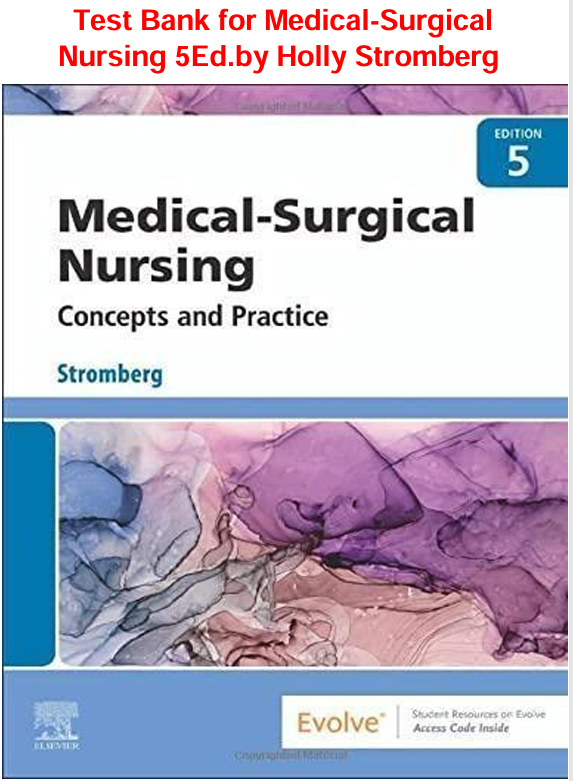
This comprehensive test bank is built for the 5th Edition of Medical-Surgical Nursing by Holly Stromberg. Written with a focus on foundational concepts, evidence-based practice, and clinical application, this textbook has helped thousands of nursing students build the med-surg competency they need for both licensing examinations and clinical practice. This test bank unlocks the full exam value of every chapter — turning your study time into targeted, clinically grounded preparation that delivers results.
Whether you are preparing for a unit exam, a comprehensive course final, or the NCLEX-RN, this resource gives you the systematic, scenario-based practice that medical-surgical nursing demands.
What’s Inside?
- Hundreds of practice questions mapped to every chapter
- Multiple-choice, select-all-that-apply, priority, and clinical scenario questions
- Complete answer keys with thorough, clinically grounded rationales
- Questions aligned with current NCLEX-RN examination standards
- Coverage of all major body systems, surgical nursing concepts, and evidence-based med-surg practice
Who Is This Test Bank For?
This resource is perfect for:
- Undergraduate RN nursing students in medical-surgical nursing courses using the 5th Edition
- NCLEX-RN candidates seeking comprehensive med-surg content review
- LPN-to-RN bridge students updating and expanding medical-surgical nursing knowledge
- Nursing faculty building rigorous 5th Edition-aligned course exams and unit assessments
- Nursing students in accelerated BSN or second-degree nursing programs
- New graduate nurses reinforcing and consolidating foundational med-surg clinical competency
Topics Covered Include:
- Foundations of medical-surgical nursing and evidence-based practice
- Fluid, electrolyte, and acid-base balance and imbalances
- Perioperative nursing — preoperative, intraoperative, and postoperative care
- Pain assessment, pharmacological and non-pharmacological management
- Oncology nursing and cancer care across body systems
- Immune disorders, HIV/AIDS, and autoimmune conditions
- Integumentary system disorders and wound management
- Sensory disorders — vision and hearing conditions
- Musculoskeletal disorders and orthopedic nursing care
- Neurological disorders — stroke, TBI, seizures, and neurodegenerative conditions
- Cardiovascular disorders — heart failure, MI, dysrhythmias, and vascular disease
- Hematological disorders — anemia, clotting disorders, and blood dyscrasias
- Respiratory disorders — pneumonia, COPD, asthma, and acute respiratory failure
- Gastrointestinal disorders and hepatobiliary conditions
- Endocrine disorders — diabetes mellitus, thyroid disease, and adrenal conditions
- Renal and urological disorders and chronic kidney disease management
- Reproductive system disorders and sexually transmitted infections
- Mental health considerations in the medical-surgical care setting
Why This Test Bank Delivers Results
The 5th Edition of Stromberg’s Medical-Surgical Nursing is built around a clear, student-accessible framework that prioritizes clinical application over encyclopedic memorization.
That same philosophy drives this test bank.
Every question is written to develop the clinical reasoning skills that medical-surgical nursing demands — not just the content recall that gets you through a single quiz. You will assess a patient with new chest pain and determine what finding requires immediate intervention. You will recognize the early warning signs of respiratory failure in a patient with COPD. You will identify a dangerous medication interaction before it reaches the patient. You will prioritize care for multiple patients at the beginning of a shift — determining who needs your immediate attention and why.
These are the clinical decisions the NCLEX tests. These are the situations your patients will present with day after day. And this test bank puts you in them — repeatedly and systematically — until the reasoning becomes instinct.
The 5th Edition places particular emphasis on patient safety, evidence-based nursing interventions, and the practical clinical skills that nursing students need to develop confidence in the clinical setting. This test bank reinforces every one of those emphases — building the connected, applied knowledge that Stromberg’s framework is designed to develop.
Detailed rationales explain the pathophysiology, nursing priorities, and evidence-based practice guidelines behind every correct answer. Questions are organized chapter by chapter for focused, efficient studying. Target the body systems where your knowledge gaps are greatest. Build the systematic, confident clinical thinking that medical-surgical nursing — and the NCLEX — demands.
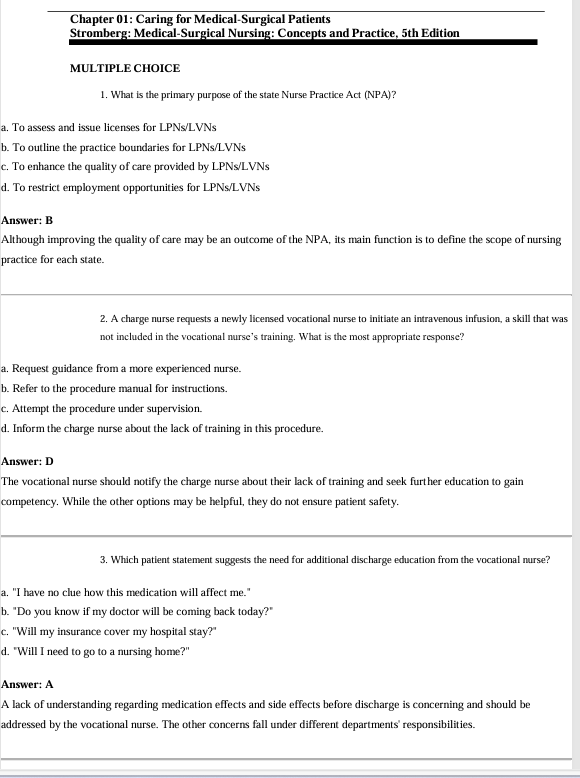
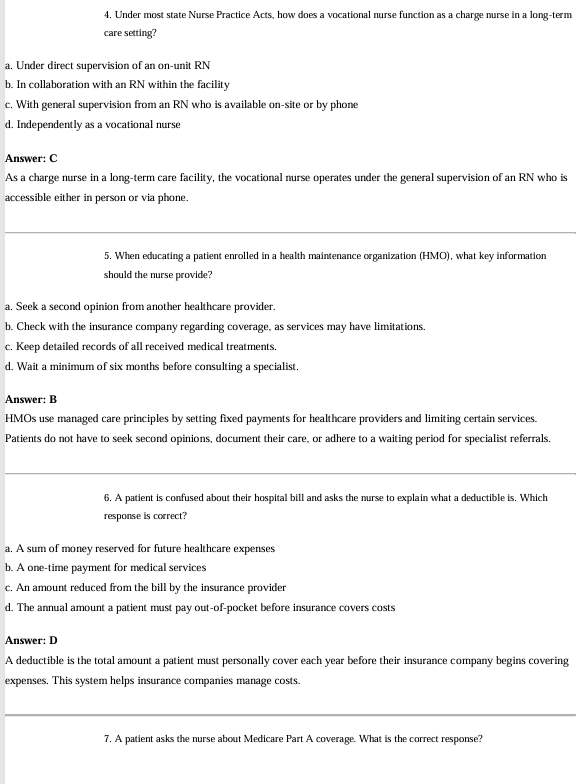
Sample Questions
Question 1
A nurse is caring for a patient with deep vein thrombosis of the left lower extremity who is receiving a continuous heparin infusion. The morning aPTT result is 210 seconds. The patient’s baseline aPTT was 32 seconds. The therapeutic range per hospital protocol is 60–100 seconds. Which nursing action is most appropriate?
- A) Continue the infusion at the current rate — the aPTT is within an acceptable therapeutic range
- B) Increase the heparin infusion rate slightly to ensure sustained anticoagulation
- C) Stop the heparin infusion, notify the provider, and assess the patient for signs of bleeding
- D) Obtain a repeat aPTT in four hours before making any changes to the infusion rate
Correct Answer: C
Rationale: An aPTT of 210 seconds is severely supratherapeutic — more than six times the patient’s baseline and more than twice the upper limit of the therapeutic range. This level of anticoagulation creates a high risk for serious or life-threatening hemorrhage. The nurse must stop the heparin infusion immediately and notify the provider for urgent management. A thorough assessment for signs of active bleeding is essential — including neurological assessment for intracranial hemorrhage, abdominal assessment for retroperitoneal bleeding, and inspection of all IV sites, urine, and stool for blood. The provider may order protamine sulfate — the heparin reversal agent — depending on the clinical situation. Continuing the infusion at any rate with a supratherapeutic aPTT of this magnitude is a serious patient safety error. Waiting four more hours before acting on a critically abnormal coagulation value is an unacceptable delay in care.
Question 2
A nurse is caring for a patient on the third postoperative day following a right hemicolectomy. During morning assessment, the patient reports sudden onset of right calf pain and swelling. The nurse observes that the right calf is visibly larger than the left and warm to the touch. The patient’s temperature is 37.9°C and heart rate is 96 bpm. Which nursing action is the priority?
- A) Encourage the patient to ambulate to improve venous circulation and reduce calf swelling
- B) Apply warm compresses to the right calf and elevate the extremity above heart level
- C) Notify the provider immediately, maintain the patient on bed rest, and avoid massaging the extremity
- D) Perform manual compression of the calf to assess for Homans’ sign and document the findings
Correct Answer: C
Rationale: This presentation is classic for deep vein thrombosis — unilateral calf pain, swelling, warmth, and low-grade fever in the immediate postoperative period. DVT is a serious postoperative complication with risk of pulmonary embolism if the thrombus dislodges. The provider must be notified immediately for diagnostic confirmation — typically lower extremity venous duplex ultrasound — and anticoagulation initiation. The patient must remain on bed rest to minimize the risk of thrombus dislodgement and pulmonary embolism until anticoagulation is established and the extent of thrombus is determined. The affected extremity must never be massaged — direct manipulation of a DVT significantly increases the risk of embolization. Ambulation and warm compresses are contraindicated in suspected acute DVT. Homans’ sign — forced dorsiflexion of the foot — has poor sensitivity and specificity for DVT and carries a theoretical risk of dislodging a thrombus; it is no longer recommended as a diagnostic assessment in current evidence-based nursing practice.
Question 3
A nurse is caring for a patient admitted with acute pancreatitis. The patient is NPO and receiving IV fluids. The patient asks why they cannot eat even though they are very hungry. Which explanation best reflects the pathophysiological rationale for NPO status in acute pancreatitis?
- A) “Eating would increase your risk of aspiration because of the nausea medications you are receiving.”
- B) “Food intake stimulates pancreatic enzyme secretion, which worsens inflammation and pain in the pancreas.”
- C) “Your intestines need complete rest after surgery, and food could cause a bowel obstruction.”
- D) “A liquid diet will be started tomorrow — we just need to wait for your lab results to normalize first.”
Correct Answer: B
Rationale: The therapeutic rationale for NPO status in acute pancreatitis is directly rooted in pancreatic physiology. Food — particularly fat and protein — stimulates the release of secretin and cholecystokinin from the duodenum, which in turn stimulate the pancreas to secrete digestive enzymes and bicarbonate-rich fluid. In acute pancreatitis, the pancreas is already experiencing autodigestion from prematurely activated enzymes — any additional stimulation of pancreatic secretion worsens enzyme activation, perpetuates inflammation, and intensifies pain. Pancreatic rest — achieved through NPO status and bowel rest — is the cornerstone of initial acute pancreatitis management. This patient education response is accurate, accessible, and directly connected to the pathophysiology of the condition. Options A, C, and D are either inaccurate, applicable to different clinical situations, or incomplete as explanations for the specific rationale of NPO in pancreatitis.
Question 4
A nurse is admitting a patient with suspected syndrome of inappropriate antidiuretic hormone. Laboratory results show serum sodium of 124 mEq/L, serum osmolality of 258 mOsm/kg, and urine osmolality of 620 mOsm/kg. The patient is alert but reports a severe headache and nausea. Which nursing intervention is the priority?
- A) Administer a bolus of hypertonic 3% saline solution immediately to correct the sodium deficit rapidly
- B) Encourage the patient to increase oral fluid intake to dilute the concentrated urine
- C) Implement fluid restriction as prescribed and monitor neurological status frequently
- D) Administer prescribed loop diuretic to promote free water excretion and correct hyponatremia
Correct Answer: C
Rationale: SIADH is characterized by hyponatremia with inappropriately concentrated urine despite low serum osmolality — the laboratory findings here are textbook SIADH. The cornerstone of initial management is fluid restriction — typically 800–1,000 mL per day — to prevent further water retention and allow serum sodium to gradually correct. Frequent neurological monitoring is essential because severe hyponatremia (sodium below 125 mEq/L) can cause cerebral edema, seizures, and herniation. Hypertonic saline is reserved for severe symptomatic hyponatremia with neurological compromise — altered consciousness, seizures, or coma. This patient is alert, making immediate hypertonic saline inappropriate as a first-line intervention. Encouraging oral fluid intake would worsen dilutional hyponatremia — the opposite of the required intervention. Loop diuretics may be used in SIADH management but are not the immediate priority before fluid restriction is established and the clinical picture is fully assessed.
Question 5
A nurse is performing a morning assessment on a patient with chronic liver failure who was admitted for worsening ascites. During the assessment, the nurse notes a flapping tremor of the hands when the patient extends their arms, increasing confusion compared to yesterday, and a musty sweet odor to the breath. Which condition do these findings most likely indicate and what is the priority nursing action?
- A) Alcohol withdrawal — administer prescribed benzodiazepine and place on CIWA protocol
- B) Hepatic encephalopathy — notify the provider, hold dietary protein, and prepare to administer lactulose as prescribed
- C) Hypoglycemia — obtain a bedside glucose reading and administer oral glucose if the patient can swallow safely
- D) Opioid toxicity — assess respiratory rate and prepare to administer naloxone if indicated
Correct Answer: B
Rationale: This clinical presentation — asterixis (flapping tremor), increasing confusion, and fetor hepaticus (the characteristic musty-sweet breath odor caused by exhaled mercaptans from hepatic failure) — is the classic triad of hepatic encephalopathy. Hepatic encephalopathy occurs when the failing liver cannot adequately detoxify ammonia from protein metabolism, allowing neurotoxic ammonia to accumulate and cross the blood-brain barrier, causing neurological dysfunction. The provider must be notified immediately. Dietary protein is typically restricted or modified during acute encephalopathy to reduce ammonia production. Lactulose is the first-line treatment — it acidifies the colon to trap ammonia as ammonium ion, reduces ammonia-producing bacteria, and acts as a cathartic to eliminate ammonia-laden stool. Rifaximin may be added for refractory cases. Ammonia level should be obtained. The clinical presentation does not support alcohol withdrawal, hypoglycemia, or opioid toxicity — each of which presents with distinct clinical features not present in this scenario.
Frequently Asked Questions (FAQs)
What edition does this test bank cover?
This test bank is written specifically for the 5th Edition of Medical-Surgical Nursing by Holly Stromberg. All questions are fully aligned with the 5th Edition’s chapter organization, clinical content, and evidence-based practice standards. Students using the 5th Edition should use this test bank — not the 6th Edition version — for fully aligned exam preparation.
How is this test bank different from the 6th Edition test bank?
This test bank is written and organized specifically for the 5th Edition of Stromberg’s Medical-Surgical Nursing. The chapter structure, clinical content emphasis, and question alignment reflect the 5th Edition specifically. While there is significant content overlap between editions, students using the 5th Edition textbook will find this test bank most accurately aligned with their course material.
How are the questions organized?
Questions are arranged chapter by chapter, allowing you to study systematically through every major body system or target specific content areas — such as cardiovascular, neurological, or endocrine nursing — based on your upcoming exam priorities or identified knowledge gaps.
Is this test bank aligned with the NCLEX-RN?
Yes. Questions are written to reflect current NCLEX-RN examination standards, with emphasis on application-level and analysis-level clinical reasoning questions. Priority setting, delegation, clinical deterioration recognition, and complex patient scenario questions are featured throughout — directly mirroring the cognitive demands of the NCLEX examination.
Is this test bank useful for NCLEX-RN candidates reviewing med-surg content?
Absolutely. Medical-surgical nursing represents the largest single content category on the NCLEX-RN. This test bank provides systematic, chapter-by-chapter content coverage combined with application-level clinical reasoning questions — making it one of the most effective standalone NCLEX med-surg review resources available for students using the Stromberg 5th Edition.
How quickly can I access the test bank after purchase?
Immediately. As soon as your purchase is complete, you receive instant digital access with no waiting period. Study on your own schedule, at your own pace, from any device.
Are the rationales detailed enough to support genuine clinical learning?
Yes. Every rationale explains the pathophysiology, nursing priorities, and clinical reasoning behind the correct answer — not just identifies it. This approach builds the deep, transferable understanding that clinical practice demands — and that the NCLEX rewards.
Can nursing faculty use this test bank for course assessments?
Absolutely. The chapter-by-chapter organization, varied question formats, and clinical scenario emphasis make this an outstanding resource for faculty building unit exams, comprehensive course finals, and NCLEX-preparatory assessments for undergraduate medical-surgical nursing courses aligned with the 5th Edition.
Janet –
Well worth the money
whitney –
This document make studying med-surg nursing extremely efficient.
Winnie M. –
Perfect!
Rosemary R –
Well worth the money
Peterson S. –
An excellent resource for med-surg nursing exams prep
Liam Mbogo –
Questions were pretty close to exam style.
Dorcas M. –
Nice resource when you need extra practice
Caleb Martins –
Excellent practice resource for reviewing challenging nursing topics.
Alicia Silva –
Made studying for exams much less stressful.
Carol Kay –
Useful test bank for reviewing key concepts.