Disease doesn’t happen randomly. It follows rules.
Every symptom has a mechanism. Every clinical finding has a physiological explanation. Every treatment decision is grounded in an understanding of what has gone wrong — at the cellular level, the tissue level, the organ level, and the system level. That is what pathophysiology teaches. And that is why it is one of the most important — and most challenging — courses in any health professions program.
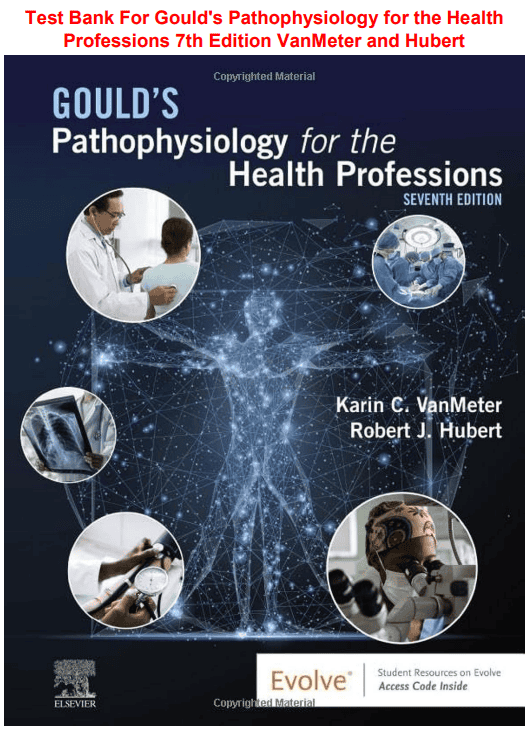
This comprehensive test bank is built for the 7th Edition of Gould’s Pathophysiology for the Health Professions by VanMeter and Hubert. It is one of the most widely used and clinically respected pathophysiology textbooks across nursing, allied health, and pre-professional healthcare education — and this test bank helps you master every chapter of it with the focused, disease-mechanism-driven practice that health professions education demands.
Whether you are preparing for a pathophysiology course exam, a nursing licensure examination, or the foundational science portions of professional board exams, this resource delivers the depth, clinical application, and systems-based reasoning that pathophysiology mastery requires.
What’s Inside?
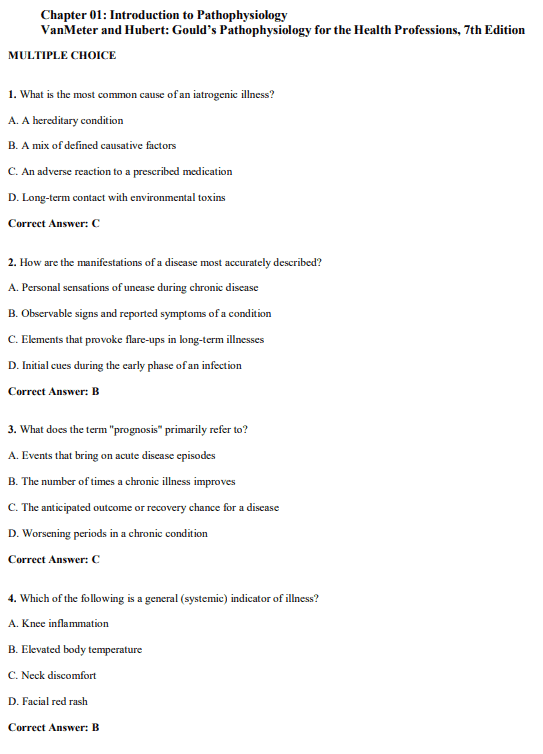
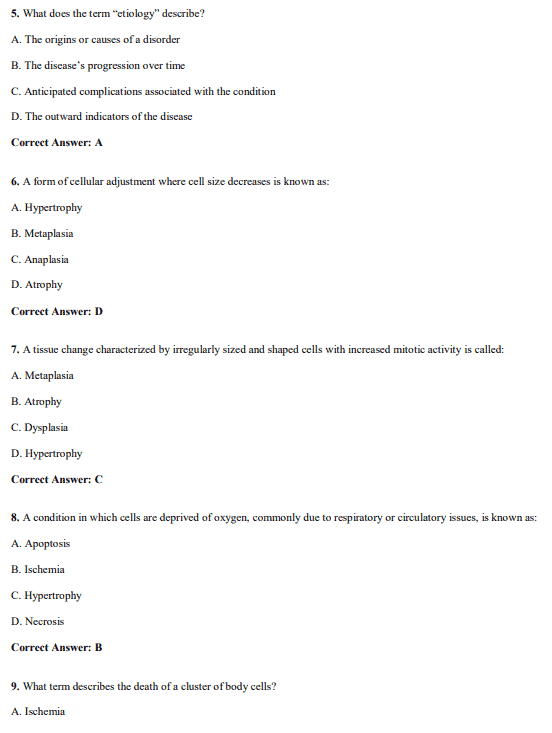
- Hundreds of practice questions covering every chapter
- Multiple-choice, true/false, matching, and clinical application questions
- Complete answer keys with thorough, clearly written rationales
- Questions covering disease mechanisms, clinical manifestations, diagnostic findings, and treatment principles
- Content aligned with nursing, allied health, and health professions program examination standards
Who Is This Test Bank For?
This resource is perfect for:
- Undergraduate nursing students in pathophysiology courses
- LPN-to-RN and RN-to-BSN students building pathophysiological knowledge
- Allied health students in radiography, respiratory therapy, and surgical technology programs
- Pre-professional students in pre-medicine, pre-PA, and pre-pharmacy programs
- NCLEX-RN candidates reinforcing pathophysiological content for clinical reasoning questions
- Health professions faculty building course exams and comprehensive unit assessments
- Healthcare professionals seeking to deepen their understanding of disease mechanisms
Topics Covered Include:
- Introduction to pathophysiology — cellular adaptation, injury, and death
- Inflammation, tissue repair, and wound healing
- Immunity — innate and adaptive immune responses
- Infection — bacterial, viral, fungal, and parasitic disease mechanisms
- Neoplasia — cancer biology, tumor classification, and oncological principles
- Fluid, electrolyte, and acid-base imbalances
- Cardiovascular pathophysiology — heart failure, coronary artery disease, and dysrhythmias
- Vascular disorders — hypertension, atherosclerosis, and peripheral vascular disease
- Blood disorders — anemia, clotting disorders, and leukemia
- Respiratory pathophysiology — obstructive and restrictive lung diseases
- Digestive system disorders — peptic ulcer disease, inflammatory bowel disease, and hepatic conditions
- Urinary system pathophysiology — renal failure, glomerulonephritis, and urinary tract disorders
- Nervous system disorders — stroke, traumatic brain injury, and neurodegenerative diseases
- Endocrine pathophysiology — diabetes mellitus, thyroid disorders, and adrenal conditions
- Musculoskeletal disorders — osteoporosis, arthritis, and bone tumors
- Integumentary disorders — infections, inflammatory conditions, and skin cancer
- Reproductive system disorders — male and female pathological conditions
- Eye and ear disorders
- Mental health disorders — anxiety, depression, and schizophrenia pathophysiology
- Pediatric and geriatric pathophysiological considerations
Why This Test Bank Delivers Results
Pathophysiology is the bridge between basic science and clinical practice.
It is the course where everything you learned in anatomy and physiology starts to matter clinically. Where cellular biology explains why a myocardial infarction produces the chest pain it does. Where immunology explains why autoimmune diseases behave the way they do. Where fluid dynamics explains the edema, ascites, and effusions you will encounter at the bedside.
Students who truly understand pathophysiology do not just memorize disease presentations — they predict them. They do not just recall treatment protocols — they understand why those protocols work. They do not just recognize abnormal findings — they trace them back to their underlying mechanisms.
This test bank is built to develop exactly that kind of mechanistic, systems-based clinical thinking.
Every question is grounded in real pathophysiological reasoning drawn from the VanMeter and Hubert framework. You will not simply identify disease names. You will explain why left-sided heart failure produces pulmonary edema while right-sided heart failure produces peripheral edema. You will connect a patient’s low hemoglobin to the specific mechanism of their anemia. You will interpret the clinical significance of an elevated creatinine in the context of acute versus chronic kidney disease. You will recognize why a patient’s respiratory alkalosis is a compensatory response rather than a primary disorder.
Detailed rationales explain the disease mechanisms, pathophysiological reasoning, and clinical significance behind every correct answer. That depth is what transforms pathophysiology from a memorization challenge into a clinical thinking tool — and a clinical thinking tool into genuine healthcare competence.
Questions are organized chapter by chapter for structured, systematic study. Target the disease systems where your understanding is weakest. Return to high-yield pathophysiological categories as your exam approaches. Build the mechanistic clinical reasoning that health professions education — and patient care — demands.
Sample Questions
Question 1
A patient presents with sudden onset of severe crushing chest pain radiating to the left arm, diaphoresis, and nausea. An ECG shows ST-segment elevation in leads II, III, and aVF. Which pathophysiological mechanism best explains the development of ST-segment elevation in this patient?
- A) Ventricular hypertrophy causing increased electrical resistance across the myocardium
- B) Complete occlusion of a coronary artery causing transmural myocardial ischemia and injury
- C) Partial occlusion of a coronary artery causing subendocardial ischemia without full-thickness injury
- D) Coronary artery vasospasm causing transient ischemia that resolves without myocardial necrosis
Correct Answer: B
Rationale: ST-segment elevation on ECG reflects transmural myocardial injury — full-thickness ischemia extending from the endocardium through the epicardium. This occurs when a coronary artery is completely occluded — typically by rupture of an atherosclerotic plaque followed by acute thrombus formation — cutting off blood supply to the entire thickness of the myocardial wall supplied by that artery. ST elevation in leads II, III, and aVF indicates inferior wall MI, corresponding to right coronary artery occlusion. Partial occlusion producing subendocardial ischemia causes ST depression — not elevation — and corresponds to non-ST elevation MI. Ventricular hypertrophy produces voltage changes and repolarization abnormalities but not the acute ST elevation pattern of evolving infarction. Coronary vasospasm causes transient ST elevation that resolves with vasodilator therapy — the sustained elevation here indicates complete occlusion requiring emergent reperfusion.
Question 2
A 45-year-old patient with a history of chronic alcohol use presents with jaundice, ascites, and peripheral edema. Laboratory results show significantly decreased serum albumin and prolonged prothrombin time. Which pathophysiological mechanism best explains the development of ascites in this patient?
- A) Increased renal sodium retention caused by elevated aldosterone from adrenal hyperplasia
- B) Portal hypertension and decreased oncotic pressure from reduced hepatic albumin synthesis
- C) Lymphatic obstruction caused by tumor compression of the thoracic duct
- D) Increased capillary permeability from systemic inflammatory response to alcohol
Correct Answer: B
Rationale: Ascites in chronic liver disease results from two converging pathophysiological mechanisms. First, hepatic fibrosis and cirrhosis obstruct portal venous flow, causing portal hypertension — elevated hydrostatic pressure in the portal circulation that forces fluid out of the splanchnic capillaries into the peritoneal cavity. Second, the damaged liver loses its ability to synthesize albumin — the primary determinant of plasma oncotic pressure. Reduced serum albumin lowers the oncotic pressure that normally holds fluid within the capillaries, allowing fluid to accumulate in the peritoneal space. The combination of elevated hydrostatic pressure and reduced oncotic pressure creates the Starling forces imbalance responsible for ascites formation. The prolonged PT confirms hepatic synthetic dysfunction. While secondary hyperaldosteronism contributes to sodium and water retention in cirrhosis, it is not the primary mechanism of ascites formation in this context.
Question 3
A patient with type 1 diabetes mellitus is brought to the emergency department by family members who report increasing confusion and rapid breathing over the past several hours. Laboratory results show blood glucose of 480 mg/dL, serum bicarbonate of 10 mEq/L, and arterial pH of 7.18. The patient’s breathing is deep and rapid. Which pathophysiological process best explains these findings?
- A) Hyperosmolar hyperglycemic state from severe insulin resistance without ketogenesis
- B) Diabetic ketoacidosis from absolute insulin deficiency causing unregulated lipolysis and ketone production
- C) Lactic acidosis from tissue hypoperfusion secondary to hyperglycemic dehydration
- D) Respiratory alkalosis from hyperventilation caused by anxiety and confusion
Correct Answer: B
Rationale: This presentation is classic diabetic ketoacidosis — the life-threatening metabolic emergency of absolute insulin deficiency in type 1 diabetes. Without insulin, cells cannot utilize glucose — triggering the counter-regulatory response of glucagon release, which drives unregulated lipolysis. Free fatty acids flood the liver and are converted to ketone bodies — acetoacetate and beta-hydroxybutyrate — producing a high anion gap metabolic acidosis. The body compensates through Kussmaul breathing — the deep, rapid respirations designed to blow off CO₂ and partially correct the acidosis. The low bicarbonate and pH of 7.18 confirm severe metabolic acidosis. Hyperosmolar hyperglycemic state occurs in type 2 diabetes with relative — not absolute — insulin deficiency; residual insulin prevents ketogenesis. The pH of 7.18 confirms this is a primary metabolic acidosis — not respiratory alkalosis, which would show elevated pH.
Question 4
A patient is diagnosed with community-acquired pneumonia caused by Streptococcus pneumoniae. On chest X-ray, the right lower lobe shows consolidation. Which sequence of pathophysiological events best explains the development of lobar consolidation in bacterial pneumonia?
- A) Bronchospasm → mucus plugging → atelectasis → alveolar collapse without exudate
- B) Bacterial invasion → inflammatory exudate filling alveoli → neutrophil migration → consolidation
- C) Pulmonary embolism → infarction → necrosis → cavity formation in the lung parenchyma
- D) Interstitial edema → lymphatic obstruction → pleural effusion → lobar compression
Correct Answer: B
Rationale: Lobar consolidation in bacterial pneumonia results from the acute inflammatory response to bacterial invasion of the alveolar space. When bacteria such as Streptococcus pneumoniae colonize the alveoli, the innate immune response is activated — mast cells release inflammatory mediators, capillaries dilate and become permeable, and protein-rich inflammatory exudate floods the alveolar spaces. Neutrophils migrate into the alveoli to phagocytose bacteria. This combination of exudate, cellular debris, and bacteria fills and solidifies the alveolar spaces — replacing air with fluid and producing the radiographic consolidation seen on chest X-ray. Consolidation impairs gas exchange because alveoli are filled rather than air-containing. Bronchospasm and atelectasis describe obstructive collapse without exudate. Pulmonary embolism produces infarction, not classic lobar consolidation. Interstitial edema describes pulmonary edema from cardiac causes — a different pathological pattern.
Question 5
A 68-year-old woman is diagnosed with osteoporosis following a low-impact fracture of the vertebral body. Her bone mineral density T-score is −2.8. Which pathophysiological mechanism most directly contributes to postmenopausal osteoporosis?
- A) Decreased parathyroid hormone secretion reducing osteoclast activity and bone resorption
- B) Estrogen deficiency removing inhibition of osteoclast activity and accelerating bone resorption
- C) Increased calcitonin production stimulating excessive osteoblast activity and bone formation
- D) Vitamin D excess causing hypercalcemia and calcium deposition in soft tissues rather than bone
Correct Answer: B
Rationale: Estrogen plays a critical protective role in bone metabolism by inhibiting osteoclast activity — the cells responsible for bone resorption. Estrogen promotes osteoclast apoptosis and suppresses the RANK-L signaling pathway that drives osteoclast differentiation and activation. Following menopause, the dramatic decline in estrogen removes this inhibitory effect — osteoclast activity increases markedly, bone resorption accelerates, and bone formation by osteoblasts cannot keep pace. The net result is progressive loss of bone mineral density — osteoporosis. A T-score of −2.8 confirms osteoporosis (T-score at or below −2.5). PTH increases osteoclast activity — it does not decrease it. Calcitonin inhibits — rather than stimulates — osteoclast activity, and is sometimes used therapeutically in osteoporosis management. Vitamin D deficiency — not excess — contributes to osteoporosis by reducing intestinal calcium absorption.
Frequently Asked Questions (FAQs)
What edition does this test bank cover?
This test bank is written specifically for the 7th Edition of Gould’s Pathophysiology for the Health Professions by VanMeter and Hubert. All questions are fully aligned with the current edition’s chapter organization, updated disease content, and current evidence-based pathophysiological principles.
How are the questions organized?
Questions are arranged chapter by chapter — disease system by disease system — allowing you to study systematically through the entire course or focus on specific pathophysiological areas where your exam performance needs the most improvement, such as cardiovascular, renal, or endocrine pathophysiology.
Is this test bank useful for NCLEX preparation?
Absolutely. The NCLEX increasingly tests pathophysiological reasoning — particularly in clinical scenario questions that require you to connect assessment findings to underlying disease mechanisms and select evidence-based nursing interventions. This test bank directly strengthens the pathophysiological foundation that NCLEX clinical reasoning questions demand.
Is this test bank appropriate for allied health and pre-professional students?
Yes. Gould’s Pathophysiology is used across nursing, allied health, pre-medicine, pre-PA, and pre-pharmacy programs. This test bank is valuable for any student in a program that uses VanMeter and Hubert’s textbook — wherever foundational disease mechanism knowledge is assessed, this resource is directly relevant.
How quickly can I access the test bank after purchase?
Immediately. As soon as your purchase is complete, you receive instant digital access with no waiting period. Study on your own schedule, at your own pace, from any device.
Are the rationales detailed enough to support genuine pathophysiological understanding — not just test prep?
Yes. Every rationale explains the disease mechanisms, physiological disruptions, and clinical significance behind the correct answer in clear, accessible language. This approach builds the kind of mechanistic clinical reasoning that carries students through pathophysiology exams, board examinations, and clinical practice alike.
Can health professions faculty use this test bank for course assessments?
Absolutely. The chapter-by-chapter organization, varied question formats, and clinical application emphasis make this an outstanding resource for faculty building unit exams, quizzes, and comprehensive assessments for pathophysiology courses across nursing, allied health, and pre-professional health programs.
Winnie583 –
I initially had some doubts, but I will forever be grateful. The quality of the test bank exceeded my expectations.
Jeff –
Great content and perfectly organized
Emynaz –
Perfect
Marcus –
Good
Barbara Kimani –
a solid study guide
Lucille Maria –
Good quality document
Carol Kay –
Very very helpful
Rosemary R –
An excellent study guide for pathophysiology
Chris martin –
Delivered much better content than I expected. Thanx
Norah Helen –
Excellent!
Maryanne –
Very good
Grace W. –
What a resource! Well organized, detailed, and relevant.
Peterson S. –
Very very useful
Melania Angel –
Great for reviewing material before a test.
Caleb Martins –
Great supplement to my study routine.
Alan Kuqi –
Good variety of questions and useful rationales
Lisa Horton –
A practical study tool for all healthcare students.
Marcus R. –
Good variety of questions across different patho topics.