
Primary care is where advanced practice nursing comes alive.
It’s where you see the full spectrum of human health — from routine wellness visits to complex chronic disease management, from pediatric development to geriatric decline, from acute illness to long-term prevention. It demands clinical breadth, diagnostic precision, and the kind of interprofessional thinking that modern healthcare systems require.
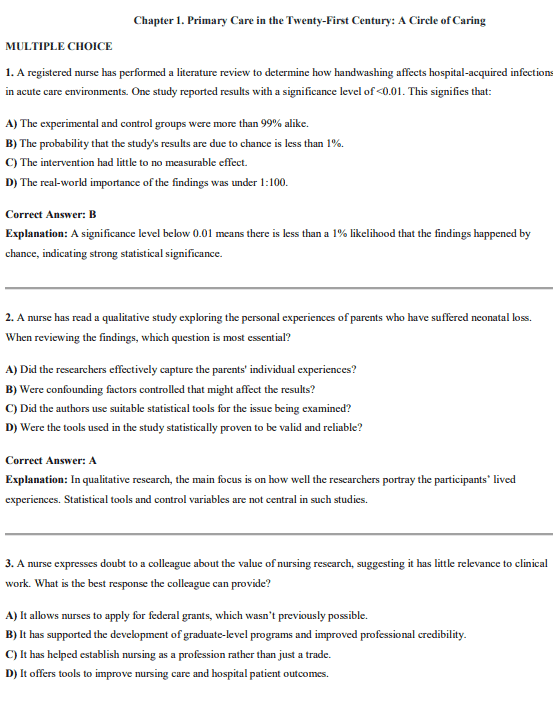
This comprehensive test bank is built for the 6th Edition of Primary Care: The Art and Science of Advanced Practice Nursing – An Interprofessional Approach by Dunphy, Winland-Brown, Porter, and Thomas. It is one of the most respected advanced practice nursing primary care textbooks in graduate nursing education — and this test bank helps you master every chapter of it.
Whether you are preparing for a graduate course exam, clinical practicum assessments, or NP board certification, this resource delivers the rigorous, scenario-driven practice that advanced practice nursing demands.
What’s Inside?
- Hundreds of chapter-by-chapter practice questions
- Multiple-choice, select-all-that-apply, and complex clinical scenario questions
- Complete answer keys with thorough, evidence-based rationales
- Questions aligned with AANP and ANCC NP certification examination standards
- Coverage of the full scope of primary care — from health promotion to complex disease management across the lifespan
Who Is This Test Bank For?
This resource is ideal for:
- Family NP students in graduate and post-graduate nursing programs
- Adult-Gerontology Primary Care NP students
- PA students completing primary care clinical rotations
- AANP-C and ANCC FNP-BC certification exam candidates
- DNP students completing primary care clinical coursework
- Nursing faculty developing graduate-level primary care course exams
- Advanced practice nurses transitioning into primary care roles
Topics Covered Include:
- Foundations of advanced practice nursing and interprofessional collaboration
- Health promotion, disease prevention, and wellness across the lifespan
- Evidence-based practice and clinical decision-making frameworks
- Comprehensive health assessment and physical examination
- Diagnostic reasoning, differential diagnosis, and clinical problem-solving
- Cardiovascular disorders — hypertension, coronary artery disease, heart failure
- Respiratory conditions — asthma, COPD, pneumonia, and upper respiratory infections
- Gastrointestinal disorders and hepatic conditions
- Endocrine disorders — diabetes mellitus, thyroid disease, and metabolic syndrome
- Neurological conditions — headache, seizure disorders, and peripheral neuropathy
- Musculoskeletal and rheumatological conditions
- Dermatological disorders in primary care
- Mental health and behavioral conditions in the primary care setting
- Genitourinary and reproductive health across genders
- Hematological and oncological conditions in primary care
- Eye, ear, nose, and throat disorders
- Pediatric primary care — growth, development, and common childhood conditions
- Geriatric primary care — functional assessment and age-related conditions
- Pharmacotherapeutics in advanced practice primary care
- Interprofessional collaboration and care coordination
Why This Test Bank Stands Out
Primary care NP board exams are among the most challenging in advanced practice nursing.
They test not just what you know — but how you think. Can you build a differential diagnosis from a chief complaint? Can you select the right diagnostic workup? Can you interpret findings, choose a treatment plan, and counsel a patient — all while applying current evidence-based guidelines? That’s what the AANP and ANCC examine. That’s what this test bank prepares you for.
Every question in this test bank is grounded in real primary care clinical scenarios. You won’t simply recall facts — you’ll apply diagnostic reasoning, interpret laboratory and imaging findings, select first-line pharmacological treatments, and manage complex patients across the lifespan. The questions mirror the cognitive complexity of NP certification exams and reflect the interprofessional approach that Dunphy, Winland-Brown, Porter, and Thomas embed throughout the textbook.
Detailed rationales go beyond identifying correct answers. They walk through the clinical reasoning process — explaining why one diagnosis fits the presentation, why one treatment aligns with current guidelines, and why other options fall short. That depth of explanation is what separates this test bank from generic question banks.
Questions are organized chapter by chapter for structured, systematic study. Work through the entire textbook methodically, or zero in on high-yield clinical areas — cardiovascular, endocrine, respiratory, or pediatrics — based on your certification exam prep priorities.
Sample Questions
Question 1
A 58-year-old male presents with a three-month history of exertional chest pressure that resolves with rest, mild dyspnea on exertion, and diaphoresis. His blood pressure is 148/92 mmHg, BMI is 31, and he has a 25-pack-year smoking history. ECG at rest is normal. Which is the most appropriate next step in management?
- A) Reassure the patient and recommend lifestyle modifications
- B) Prescribe sublingual nitroglycerin and schedule a follow-up in four weeks
- C) Refer for stress testing and initiate antianginal therapy
- D) Order a chest X-ray and complete metabolic panel only
Correct Answer: C
Rationale: This patient’s presentation — exertional chest pressure relieved by rest, diaphoresis, dyspnea, hypertension, obesity, and significant smoking history — is classic for stable angina with high cardiovascular risk. A normal resting ECG does not rule out significant coronary artery disease. Current ACC/AHA guidelines recommend exercise stress testing as the initial diagnostic evaluation for stable chest pain with intermediate-to-high pre-test probability of CAD. Antianginal therapy — including beta-blockers or long-acting nitrates — should be initiated alongside diagnostic workup. Lifestyle modification alone is grossly insufficient given this risk profile. Delaying with only a chest X-ray and metabolic panel misses the primary cardiac concern entirely.
Question 2
A 67-year-old woman with type 2 diabetes and stage 3 CKD presents for a routine follow-up. Her current HbA1c is 8.4%. Her eGFR is 42 mL/min/1.73m². She is currently taking metformin 1000mg twice daily. Which medication adjustment is most appropriate?
- A) Continue metformin at the current dose and add a sulfonylurea
- B) Discontinue metformin and initiate an SGLT-2 inhibitor
- C) Reduce metformin dose and add a GLP-1 receptor agonist
- D) Discontinue metformin and start insulin therapy immediately
Correct Answer: C
Rationale: Current ADA guidelines recommend reducing metformin to 500–1000mg daily when eGFR falls between 30–45 mL/min/1.73m² — not discontinuing it entirely, which occurs at eGFR below 30. Adding a GLP-1 receptor agonist is appropriate at this stage — it provides additional glycemic control, has cardiovascular benefit, and is generally safe in moderate CKD. SGLT-2 inhibitors are increasingly used in CKD for their nephroprotective effects but require individualized assessment at this eGFR level and are not universally first-line additions in stage 3 CKD. Sulfonylureas carry significant hypoglycemia risk in CKD due to reduced renal clearance. Immediate insulin is not indicated without more severe uncontrolled hyperglycemia or specific contraindications to oral agents.
Question 3
A 32-year-old woman presents with a two-week history of fatigue, cold intolerance, constipation, dry skin, and a five-pound weight gain. Her TSH is 9.2 mIU/L and free T4 is 0.7 ng/dL. She has no known medical history. What is the most appropriate initial management?
- A) Repeat thyroid function tests in three months before initiating treatment
- B) Initiate levothyroxine therapy and recheck TSH in four to six weeks
- C) Order thyroid ultrasound before initiating any pharmacological treatment
- D) Refer to endocrinology before initiating thyroid replacement therapy
Correct Answer: B
Rationale: This patient has overt hypothyroidism — defined by an elevated TSH above 10 mIU/L combined with a low free T4 and symptomatic presentation. Current clinical guidelines support initiating levothyroxine therapy in primary care without specialist referral for uncomplicated overt hypothyroidism in otherwise healthy adults. The starting dose is typically 1.6 mcg/kg/day, with TSH rechecked four to six weeks after initiation to assess response and guide dose titration. Delaying treatment to repeat labs in three months is inappropriate given symptomatic overt hypothyroidism. Thyroid ultrasound is indicated for nodules or goiter — not for confirming hypothyroidism. Endocrinology referral is appropriate for complex cases such as pregnancy, cardiac disease, or treatment resistance.
Question 4
A nurse practitioner is evaluating a 45-year-old male with a three-day history of productive cough with yellow-green sputum, fever of 38.8°C, right-sided pleuritic chest pain, and decreased breath sounds at the right base. Chest X-ray reveals a right lower lobe infiltrate. He has no significant medical history and no recent hospitalizations. Which management plan is most appropriate?
- A) Prescribe a five-day course of azithromycin and arrange follow-up in two weeks
- B) Initiate outpatient treatment with amoxicillin-clavulanate and follow up in 48 hours
- C) Admit to hospital for intravenous antibiotic therapy
- D) Order sputum culture and defer antibiotic treatment until results return
Correct Answer: B
Rationale: This patient has community-acquired pneumonia (CAP) in an otherwise healthy adult with no comorbidities and no indications for hospitalization. Using the CURB-65 severity scoring tool, this patient scores low — supporting outpatient management. Current IDSA/ATS guidelines recommend amoxicillin as first-line monotherapy for outpatient CAP in patients without comorbidities, with amoxicillin-clavulanate appropriate when broader coverage is clinically warranted. A 48-hour follow-up is essential to assess treatment response. Azithromycin monotherapy is no longer preferred as first-line due to rising macrolide resistance in Streptococcus pneumoniae. Deferring treatment pending culture results is inappropriate — antibiotics should be initiated promptly in confirmed CAP. Hospitalization is not indicated given the low CURB-65 score and absence of comorbidities.
Question 5
A 70-year-old woman presents for her annual wellness visit. She reports no acute complaints but mentions increasing forgetfulness over the past year. Her MMSE score is 24/30. She lives alone and her daughter reports concerns about medication management and driving safety. Which is the most appropriate next step?
- A) Reassure the patient and family that mild forgetfulness is a normal part of aging
- B) Order a comprehensive cognitive workup including labs, neuropsychological testing, and brain imaging
- C) Diagnose mild cognitive impairment and refer immediately to a memory care facility
- D) Prescribe donepezil and schedule a follow-up in three months
Correct Answer: B
Rationale: An MMSE score of 24/30 falls in the range suggestive of mild cognitive impairment (MCI) — a clinically significant finding that warrants thorough evaluation, not dismissal as normal aging. The comprehensive workup for new cognitive decline includes metabolic and thyroid function tests, vitamin B12 level, CBC, and depression screening to rule out reversible causes. Neuropsychological testing provides objective cognitive domain assessment. Brain imaging — typically MRI — evaluates structural causes including vascular disease or early dementia. Functional concerns raised by the family — medication management and driving safety — reinforce the need for prompt, thorough assessment. Immediate memory care facility referral and empiric pharmacotherapy without completed workup are both premature and clinically inappropriate at this stage.
Frequently Asked Questions (FAQs)
What edition does this test bank cover?
This test bank is written specifically for the 6th Edition of Primary Care: The Art and Science of Advanced Practice Nursing – An Interprofessional Approach by Dunphy, Winland-Brown, Porter, and Thomas. All questions are fully aligned with the current edition’s chapter structure, updated clinical guidelines, and evidence-based content.
How are the questions organized?
Questions are arranged chapter by chapter, allowing you to study systematically through the full scope of primary care content or focus on specific clinical areas — such as cardiovascular, endocrine, or pediatric primary care — based on your certification exam prep priorities or current course focus.
Is this test bank aligned with NP certification exams?
Yes. Questions are written to reflect the clinical reasoning, diagnostic decision-making, and knowledge depth assessed on the AANP-C and ANCC FNP-BC certification examinations. The emphasis on differential diagnosis, evidence-based treatment selection, and complex patient management directly mirrors the cognitive demands of NP board exams.
Is this resource useful for PA students?
Absolutely. PA students completing primary care rotations or preparing for PANCE and PANRE content in internal medicine, family medicine, and preventive care will find this test bank highly relevant. The interprofessional approach of the textbook — and this test bank — reflects the collaborative practice model that PA education emphasizes.
How quickly can I access the test bank after purchase?
Immediately. As soon as your purchase is complete, you receive instant digital access with no waiting period. Study on your own schedule, at your own pace, from any device.
Are the rationales grounded in current clinical guidelines?
Yes. Every rationale reflects current evidence-based clinical guidelines — including ACC/AHA, ADA, IDSA, USPSTF, and other major clinical authority recommendations — consistent with the evidence-based approach embedded throughout the 6th Edition textbook.
Can nursing faculty use this test bank for graduate course assessments?
Absolutely. The chapter-by-chapter organization, clinical scenario emphasis, and graduate-level question complexity make this an excellent resource for faculty developing quizzes, unit exams, case-based assessments, and comprehensive final examinations for graduate-level primary care NP courses.

Winnie583 –
Affordable but top quality
Josesa8065 –
High-quality content and very well organized
Essybridget –
Perfect! It’s worth more than the price.
Caleb Martins –
Well worth the money
Cayte N. –
Very good
Bruno Molino –
An excellent study guide
Mary Lincoln –
Perfectly organized test bank
Lucille Maria –
A very useful resource
Lisa Horton –
A lot of these questions appeared in the finals as they are.