Mental health care is one of the most human parts of nursing.
It asks you to look beyond symptoms and diagnoses — to truly see the person in front of you. To understand behavior. To recognize crisis. To communicate therapeutically when words are the most powerful tool you have. It is complex, deeply rewarding, and heavily tested in every nursing program.
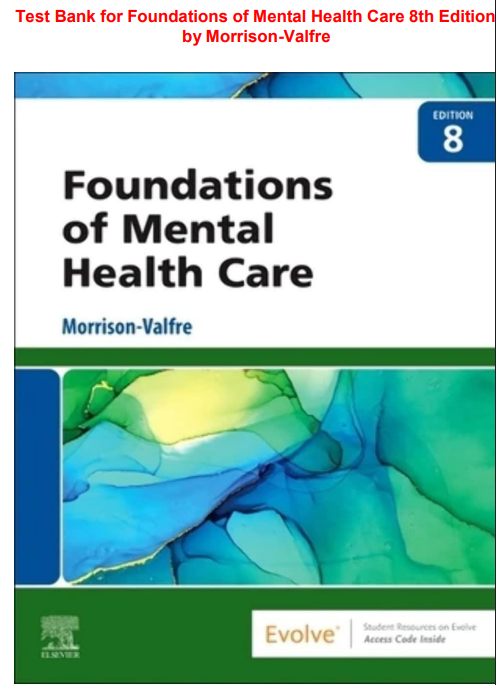
This comprehensive test bank is built for the 8th Edition of Foundations of Mental Health Care by Morrison-Valfre. It is the go-to study resource for nursing students who want to move beyond surface-level understanding and develop the kind of genuine clinical insight that mental health nursing demands.
Whether you’re preparing for a psychiatric nursing course exam, an ATI assessment, or the NCLEX, this test bank gives you the focused, scenario-based practice that builds real competence — not just test-taking shortcuts.
What’s Inside?
- Hundreds of practice questions covering every chapter
- Multiple-choice, select-all-that-apply, and therapeutic communication scenario questions
- Complete answer keys with thorough, clinically grounded rationales
- Questions aligned with current NCLEX-RN and NCLEX-PN examination standards
- Coverage of psychiatric disorders, therapeutic interventions, psychopharmacology, and mental health nursing across the lifespan
Who Is This Test Bank For?
This resource is ideal for:
- Undergraduate RN and LPN nursing students in psychiatric and mental health nursing courses
- NCLEX-RN and NCLEX-PN candidates reviewing mental health content
- RN-to-BSN students building psychiatric nursing competency
- Nursing faculty developing psychiatric nursing course exams and ATI-style assessments
- Mental health technicians and behavioral health staff pursuing nursing licensure
- Nursing students in accelerated or second-degree programs covering psychiatric content
Topics Covered Include:
- History and foundations of mental health care
- Legal and ethical issues in psychiatric nursing
- Theories of mental health and human behavior
- Therapeutic communication and the nurse-patient relationship
- The mental status examination and psychiatric assessment
- Psychopharmacology and psychiatric medication management
- Anxiety disorders and obsessive-compulsive spectrum disorders
- Mood disorders — depression, bipolar disorder, and related conditions
- Schizophrenia spectrum and other psychotic disorders
- Personality disorders and maladaptive behavior patterns
- Substance use disorders and addiction nursing
- Eating disorders and body image disturbances
- Trauma, PTSD, and stress-related disorders
- Cognitive disorders — delirium, dementia, and neurocognitive conditions
- Child and adolescent mental health disorders
- Older adult psychiatric care and age-related mental health changes
- Crisis intervention, suicide assessment, and de-escalation
- Community mental health and psychiatric rehabilitation
Why This Test Bank Stands Out
Mental health nursing content is uniquely challenging.
The disorders overlap. The medications are complex. The therapeutic communication questions feel deceptively simple — until you’re choosing between four responses that all sound reasonable. And crisis management questions demand the kind of quick, prioritized clinical thinking that only comes with practice.
This test bank is built for exactly that kind of practice.
Every question reflects real psychiatric nursing scenarios. You won’t just identify a diagnosis — you’ll select the most therapeutic nursing response, recognize early signs of medication toxicity, prioritize interventions during a psychiatric crisis, or distinguish between normal grief and clinical depression. These are the questions that appear on the NCLEX. These are the situations you’ll face in clinical practice.
Detailed rationales don’t just confirm correct answers. They explain the psychiatric principles, therapeutic communication frameworks, and evidence-based practice guidelines behind every question. That’s what turns practice sessions into genuine learning — and genuine learning into clinical confidence.
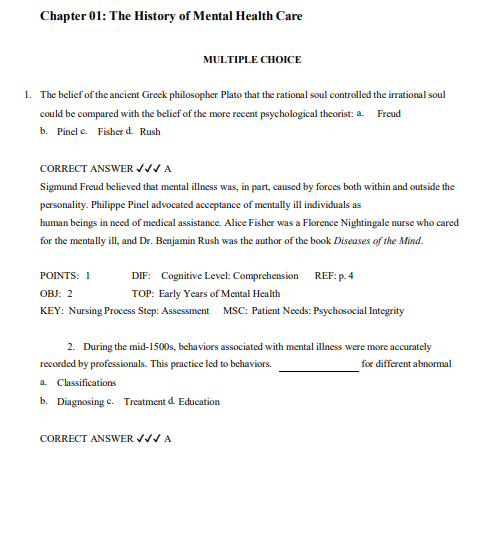
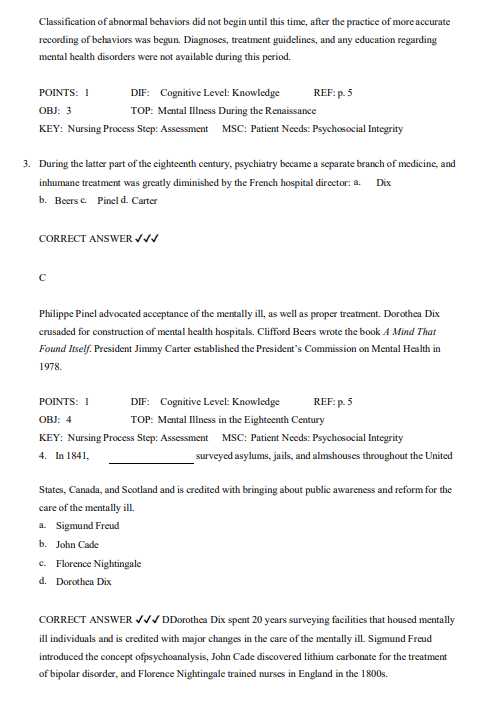
Questions are organized chapter by chapter for structured, systematic study. Target your weakest areas first. Return to challenging topics as your exam approaches. This test bank supports every stage of your mental health nursing course — from the first week to the final exam.
Sample Questions
Question 1
A nurse is caring for a patient with schizophrenia who states, “The television is sending me secret messages that only I can understand.” Which nursing response is most therapeutic?
- A) “That’s not possible. Televisions can’t send personal messages.”
- B) “I understand that feels very real to you. Can you tell me more about how this makes you feel?”
- C) “Let’s turn off the television so the messages will stop.”
- D) “You are experiencing a hallucination. This is a symptom of your illness.”
Correct Answer: B
Rationale: The patient is experiencing a delusion of reference — a false belief that external events or objects have special personal significance. The most therapeutic response acknowledges the patient’s emotional experience without reinforcing or arguing against the delusion. Option A directly confronts and contradicts the delusion, which damages trust and rarely changes delusional thinking. Option C inadvertently validates the delusion by treating it as real. Option D is clinically accurate but delivered without empathy and is likely to feel dismissive. Therapeutic communication in psychiatric nursing prioritizes emotional validation and relationship-building over immediate correction of false beliefs.
Question 2
A nurse is assessing a patient who was admitted following a suicide attempt. Which question is most appropriate for directly assessing current suicide risk?
- A) “You seem to be feeling better today. Are you feeling happier?”
- B) “Can you tell me why you decided to hurt yourself?”
- C) “Are you having any thoughts of suicide or harming yourself right now?”
- D) “Do you understand that suicide is a permanent solution to a temporary problem?”
Correct Answer: C
Rationale: Direct, clear questioning is the most effective and evidence-based approach to suicide risk assessment. Research consistently shows that asking directly about suicidal ideation does not plant the idea — it opens communication and allows for honest risk assessment. Option A uses a leading question that discourages disclosure of negative feelings. Option B focuses on past behavior and may feel accusatory, potentially shutting down communication. Option D is a clichéd, judgmental statement that minimizes the patient’s distress and is therapeutically inappropriate. Current psychiatric nursing guidelines — including those from The Joint Commission and SAMHSA — recommend direct, non-judgmental suicide inquiry.
Question 3
A patient taking lithium carbonate for bipolar disorder reports nausea, tremors, and blurred vision. Their last serum lithium level was 1.6 mEq/L. What is the priority nursing action?
- A) Reassure the patient that these are expected side effects of lithium therapy
- B) Encourage increased fluid and sodium intake and recheck levels in one week
- C) Hold the next lithium dose and notify the prescriber immediately
- D) Administer an antiemetic and document the findings in the chart
Correct Answer: C
Rationale: The therapeutic range for lithium is 0.6–1.2 mEq/L for maintenance therapy. A level of 1.6 mEq/L exceeds this range and falls into early lithium toxicity territory. Symptoms of early toxicity include nausea, fine tremors, blurred vision, diarrhea, and drowsiness. These are not normal side effects — they are warning signs of a potentially serious and life-threatening condition if levels continue to rise. The priority action is to hold the medication and notify the prescriber immediately so the level can be re-evaluated and the dosage adjusted. Administering antiemetics and waiting a week ignores a critical safety concern.
Question 4
A nurse is working with a patient diagnosed with major depressive disorder who says, “There is no point in trying anymore. Nothing will ever get better.” Which nursing response best demonstrates therapeutic communication?
- A) “Everyone feels that way sometimes. Things will improve with time.”
- B) “You have so much to live for. Think about your family and loved ones.”
- C) “It sounds like you’re feeling completely hopeless right now. Can you tell me more about what’s been happening?”
- D) “I think you should speak with your doctor about adjusting your medication.”
Correct Answer: C
Rationale: This response demonstrates active listening, empathic reflection, and open-ended questioning — the cornerstones of therapeutic communication in mental health nursing. Reflecting the patient’s emotion (“feeling completely hopeless”) validates their experience and communicates that they are heard. The open-ended follow-up invites the patient to share more, deepening therapeutic rapport. Option A minimizes the patient’s experience by normalizing it. Option B uses the common but therapeutically harmful technique of focusing on reasons to live, which can make the patient feel guilty or misunderstood. Option D redirects prematurely before the nurse has fully assessed the patient’s emotional state.
Question 5
A patient with a history of alcohol use disorder is admitted for detoxification. On day two of admission, the nurse observes tremors, diaphoresis, elevated blood pressure, and the patient reports seeing insects on the walls. Which condition does this clinical picture most likely represent?
- A) Wernicke’s encephalopathy
- B) Alcohol withdrawal delirium (delirium tremens)
- C) Korsakoff’s psychosis
- D) Acute alcohol intoxication
Correct Answer: B
Rationale: Alcohol withdrawal delirium — commonly known as delirium tremens — typically develops 24–72 hours after the last drink and represents the most severe and life-threatening form of alcohol withdrawal. Classic features include autonomic instability (elevated blood pressure, diaphoresis, tachycardia), tremors, and visual or tactile hallucinations such as seeing insects. This is a medical emergency requiring immediate intervention, including benzodiazepine administration and close monitoring. Wernicke’s encephalopathy presents with confusion, ataxia, and ophthalmoplegia — caused by thiamine deficiency. Korsakoff’s psychosis is a chronic amnestic condition. Acute intoxication presents with CNS depression, not withdrawal hyperactivity.
Frequently Asked Questions (FAQs)
What edition does this test bank cover?
This test bank is written specifically for the 8th Edition of Foundations of Mental Health Care by Morrison-Valfre. All questions are fully aligned with the current edition’s chapter organization, updated diagnostic criteria based on the DSM-5-TR, and current evidence-based psychiatric nursing practice standards.
How are the questions organized?
Questions are arranged chapter by chapter, allowing you to study systematically through the entire course or focus on specific topic areas — such as psychopharmacology, therapeutic communication, or mood disorders — based on your upcoming exam schedule or identified knowledge gaps.
Is this test bank aligned with the NCLEX?
Yes. Questions are written to reflect current NCLEX-RN and NCLEX-PN examination standards, with particular emphasis on the mental health and psychosocial integrity client needs categories. Therapeutic communication, safe care, and clinical prioritization questions are heavily featured — mirroring the NCLEX’s consistent focus on psychiatric nursing content.
Is this test bank useful for LPN students?
Absolutely. Mental health content appears on both the NCLEX-RN and NCLEX-PN. LPN students will find the foundational psychiatric concepts, therapeutic communication questions, and psychopharmacology content directly relevant to their licensing exam preparation and clinical practice requirements.
How quickly can I access the test bank after purchase?
Immediately. As soon as your purchase is complete, you receive instant digital access with no waiting period. Study on your own schedule, at your own pace, from any device.
Are the rationales clinically accurate and grounded in current psychiatric standards?
Yes. Every rationale reflects current psychiatric nursing standards, DSM-5-TR diagnostic criteria, evidence-based therapeutic communication principles, and current psychopharmacology guidelines. This ensures your study preparation stays clinically accurate and exam-relevant.
Can nursing faculty use this test bank for course assessments?
Absolutely. The chapter-by-chapter organization, varied question formats, and clinical scenario emphasis make this an excellent resource for faculty building quizzes, unit exams, and comprehensive assessments for psychiatric and mental health nursing courses at both the RN and PN level.

Norah Helen –
Very good
Winnie M. –
High quality content
Peterson S. –
Perfect study guide
Nelly –
I like it
Caleb Martins –
Very relevant practice questions
Jarrod Bent –
Fantastic resource for nursing success.
Kamara Reid –
Excellent study resource for nursing exam success
Cayte N. –
Questions encourage critical thinking skills
Carol Kay –
Worth every penny for preparation