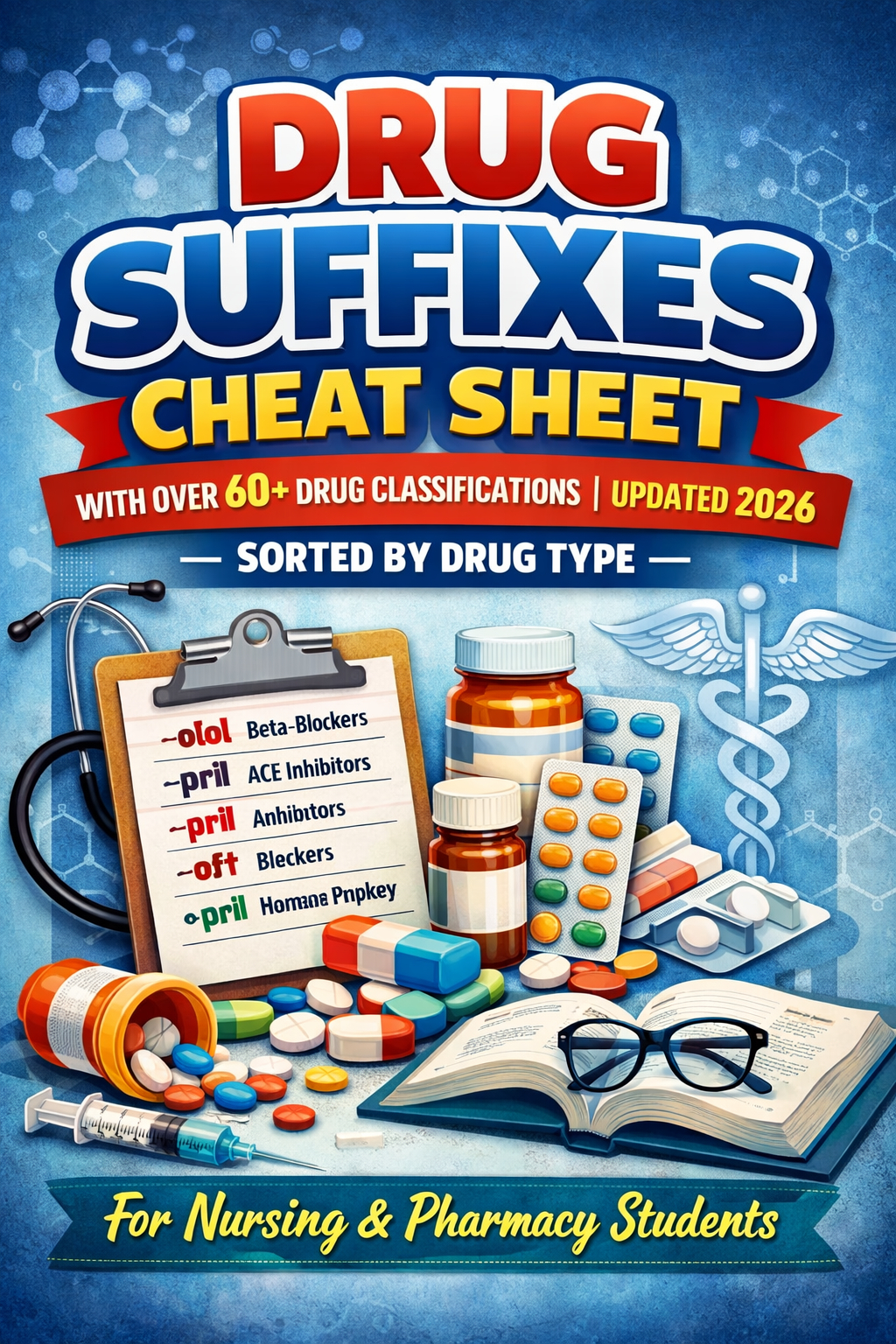
Master Meds with the Ultimate 2026 Suffix Guide
Pharmacology is often the biggest hurdle in nursing and medical school. With thousands of different medications, memorizing them one by one is almost impossible. The secret used by top students is suffix recognition. Most drugs in the same class share the same “ending.” Once you know the suffix, you know exactly what the drug does, how it works, and what patterns to look for.
This 2026 Drug Suffixes Cheat Sheet is your shortcut to mastering over 60 different drug classifications. Updated with the latest medications released this year, this guide turns a mountain of memorization into a simple system of patterns.
Why Suffixes are Your Secret Weapon
Instead of memorizing 20 different blood pressure medications, you only need to learn one suffix: “-pril.” If a drug ends in “-pril,” you immediately know it is an ACE Inhibitor. This cheat sheet gives you that power for every major drug category.
-
Instant Identification: Spot the drug class just by looking at the name.
-
Safety First: Knowing the class helps you quickly recall the mechanism of action, such as how a drug affects blood pressure, heart rate, or vascular tone.
-
NCLEX & HESI Ready: These exams love to test your ability to recognize drug patterns under pressure.
What is Included in the 2026 Update?
This is a comprehensive guide organized into clean tables for the current clinical year:
-
60+ Drug Classifications: Covers everything from Cardiovascular and Respiratory to Psychiatric and Infectious Disease meds.
-
Prefixes and Suffixes: While most classes use suffixes, we also include vital prefixes like “cef-” or “ceph-” for Cephalosporins and “sulfa-” for Sulfonamides.
-
Mechanism of Action: A brief, clear note on what each class actually does in the body, such as inhibiting cell wall synthesis or blocking specific receptors.
-
Common Examples: Each suffix comes with a list of the most frequently prescribed drugs in that category, such as lisinopril, atorvastatin, and ondansetron.
Features for Fast Learning
We designed this cheat sheet to be used in the classroom, at home, or during clinical rotations:
-
Categorized by Body System: Medications are grouped by system (e.g., Cardiovascular, Respiratory, Gastrointestinal) so you can find what you need in seconds.
-
Portable and Clear: Organized into clean tables that are easy to read on a phone, tablet, or printed out for your clipboard.
-
Broad Coverage: Includes specialized categories like Monoclonal Antibodies (“-mab”), Tyrosine Kinase Inhibitors (“-nib”), and Bisphosphonates (“-dronate”).
Stop guessing and start knowing. By learning the 60+ suffixes in this guide, you are building a foundation that will last throughout your entire career. When you see a new drug name, you won’t feel panicked—you’ll feel prepared.


Winnie583 –
very very helpful
Marcus –
I wish I found this earlier
Henry Wilcox –
Total game changer. thanks