

The strongest clinical nurses in the world have one thing in common.
They never outgrew their fundamentals.
The nurse who catches a subtle deterioration before it becomes a code. The nurse whose hand hygiene technique is flawless after twenty years at the bedside. The nurse whose patient education changes a diabetic patient’s self-management forever. The nurse whose documentation protects a patient, a family, and an entire care team when something goes wrong. These are nurses who built their foundation right — and never stopped standing on it.
That foundation begins here.
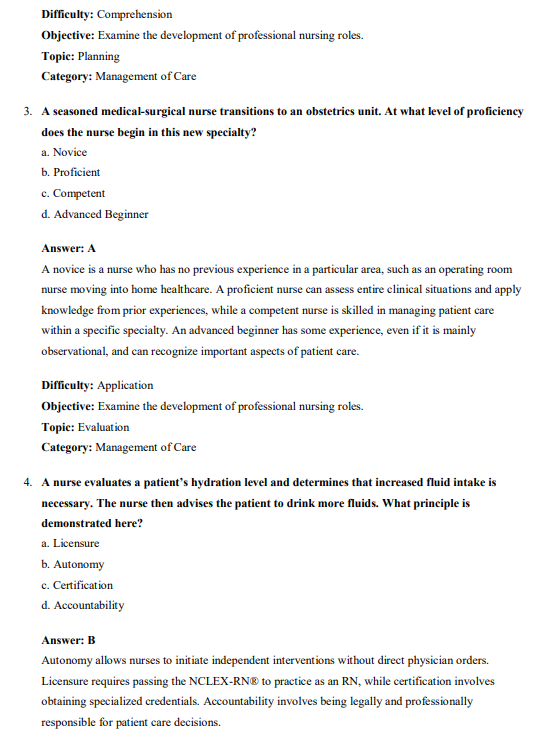
This comprehensive test bank is built for the 12th Edition of Fundamentals of Nursing by Potter, Perry, Stockert, and Hall. It is the most widely used, most comprehensively respected, and most thoroughly revised fundamentals of nursing textbook in the world — and the 12th Edition represents the most current, evidence-based, and Next Generation NCLEX-aligned iteration in this textbook’s distinguished history.
This test bank helps you master every chapter with the focused, clinically applied, nursing-process-centered practice that Potter and Perry have always demanded — and that nursing practice rewards every day of a nursing career.
Whether you are beginning your nursing education, preparing for a fundamentals course exam, building toward the NCLEX-RN, or establishing the clinical judgment foundation that every subsequent nursing course will develop further, this resource delivers the depth, breadth, and clinical reasoning precision that the world’s most trusted fundamentals textbook demands.
What’s Inside?
- Hundreds of practice questions covering every chapter
- Multiple-choice, select-all-that-apply, priority, delegation, and Next Generation NCLEX-style clinical scenario questions
- Complete answer keys with thorough, clinically grounded rationales
- Questions aligned with current NCLEX-RN, NCLEX-PN, and Next Generation NCLEX examination standards
- Coverage of all foundational nursing concepts, clinical skills, and patient care applications — fully aligned with the 12th Edition content updates
Who Is This Test Bank For?
This resource is perfect for:
- First and second-year undergraduate RN nursing students in fundamentals of nursing courses
- LPN and LVN students building foundational nursing knowledge and clinical skills
- RN-to-BSN students reviewing and reinforcing core nursing concepts and evidence-based practice foundations
- NCLEX-RN and NCLEX-PN candidates refreshing foundational nursing content
- Nursing faculty developing fundamentals course exams and clinical skills assessments
- Nursing students in accelerated BSN or second-degree programs covering nursing fundamentals
- Students whose programs use the 12th Edition of Potter, Perry, Stockert, and Hall as their course text
Topics Covered Include:
- Nursing today — the profession, standards, and contemporary practice landscape
- The healthcare delivery system — settings, roles, and interprofessional care
- Community and population health nursing foundations
- Theoretical foundations of nursing practice
- Evidence-based practice in nursing — principles, hierarchy, and application
- Healthcare informatics — electronic health records and technology in nursing
- Critical thinking and clinical judgment in nursing practice
- Nursing assessment — health history and physical examination
- Nursing diagnosis — clinical judgment and NANDA-I framework
- Planning nursing care — goals, outcomes, and individualized care plans
- Implementing nursing care — nursing interventions and clinical decision-making
- Evaluating nursing care outcomes
- Communication — therapeutic techniques, interprofessional communication, and SBAR
- Patient education — principles, learning theory, and teaching strategies
- Documentation and informatics — legal, ethical, and clinical aspects
- Cultural competence and spiritual care in nursing practice
- Legal and ethical dimensions of nursing practice
- Safety — fall prevention, restraints, and environmental safety management
- Infection prevention and control — medical and surgical asepsis
- Vital signs — assessment, interpretation, and clinical significance
- Health assessment and physical examination
- Oxygenation and respiratory care
- Fluid, electrolyte, and acid-base balance
- Sleep and rest — assessment and nursing care
- Pain assessment and management — acute and chronic
- Nutrition — assessment, therapeutic diets, and enteral nutrition
- Urinary elimination — assessment, catheterization, and continence care
- Bowel elimination — assessment, ostomy care, and constipation management
- Mobility and immobility — positioning, transfers, and exercise
- Skin integrity and wound care — assessment, dressings, and pressure injury prevention
- Sensory alterations and nursing care
- Medication administration — all routes, calculation, and safety
- Perioperative nursing care
- Palliative care, loss, grief, and end-of-life nursing
Why This Test Bank Delivers Results
Potter and Perry’s Fundamentals of Nursing is not just the most widely used fundamentals textbook in nursing education. It is the most influential. For generations of nursing students, it has been the book that first made nursing make sense — the book that first connected anatomy and physiology to patient care, connected ethical principles to clinical decisions, connected the nursing process to real-world nursing practice.
The 12th Edition by Potter, Perry, Stockert, and Hall carries that legacy forward — with the most comprehensive updates in the textbook’s history. Expanded Next Generation NCLEX clinical judgment content is integrated throughout. Evidence-based practice is embedded more deeply than ever. Social determinants of health, health equity, and culturally responsive nursing care receive expanded treatment. The pharmacology, wound care, infection prevention, and assessment content reflects the most current clinical guidelines and evidence.
This test bank is built to match every one of those updates.
Every question reflects the nursing process framework, evidence-based clinical reasoning, and patient-centered care philosophy that Potter, Perry, Stockert, and Hall establish throughout the 12th Edition. You will not simply recite the five steps of the nursing process — you will apply each step to a real patient scenario and demonstrate that you understand what assessment data means, what nursing diagnoses it generates, what outcomes to set, which interventions to implement, and how to evaluate whether care has achieved its goal.
The 12th Edition’s NGN integration means this test bank includes questions built around the NCLEX Clinical Judgment Measurement Model — recognize cues, analyze cues, prioritize hypotheses, generate solutions, take actions, and evaluate outcomes. These are the most challenging question types on the NCLEX — and the most directly representative of what clinical nursing actually requires. This test bank builds that capability from the very first course of nursing school.
Detailed rationales explain the nursing principles, clinical reasoning, evidence-based practice standards, and patient safety guidelines behind every correct answer. The 12th Edition content is fully reflected — including updated asepsis guidelines, current CDC infection prevention standards, revised wound care evidence, and the latest NANDA-I nursing diagnosis framework.
Questions are organized chapter by chapter for structured, systematic study. Build the foundational clinical judgment that Potter and Perry have always been designed to develop — and that the best nurses carry with them for an entire career.
Sample Questions
Question 1
A nurse is preparing to administer 0.8 mg of a medication. The medication is available as 0.5 mg per tablet. How many tablets should the nurse administer?
- A) 1 tablet
- B) 1.5 tablets
- C) 1.6 tablets
- D) 2 tablets
Correct Answer: C
Rationale: Safe medication dosage calculation uses the formula: Desired dose ÷ Available dose × Quantity = Amount to administer. Substituting the values: 0.8 mg ÷ 0.5 mg × 1 tablet = 1.6 tablets. While administering a partial tablet requires scoring and may not always be clinically feasible depending on the tablet formulation, the mathematically correct calculated dose is 1.6 tablets. Before administering a calculated dose that results in a fraction, the nurse must verify whether the tablet is scored and safe to divide, confirm the calculation with a second nurse per facility policy, and notify the provider if the available formulation cannot deliver the prescribed dose accurately. Medication calculation accuracy is a fundamental patient safety competency — calculation errors represent one of the most common and preventable causes of medication harm in nursing practice. The nurse must never round a medication dose without a provider order authorizing the adjustment.
Question 2
A nurse is performing a focused assessment on a patient who has been on bed rest for five days following a hip fracture repair. The patient reports sudden onset of chest pain that worsens with deep breathing, shortness of breath, and anxiety. The nurse notes the respiratory rate is 28 breaths per minute, heart rate is 116 bpm, and oxygen saturation has dropped from 96% to 88%. Which nursing action is the priority?
- A) Administer the prescribed PRN oral analgesic for chest pain and reassess in 30 minutes
- B) Position the patient in high Fowler’s, apply supplemental oxygen, activate the rapid response team, and notify the provider immediately
- C) Obtain a 12-lead ECG and wait for results before notifying the provider
- D) Reassure the patient that anxiety after surgery is common and encourage slow, deep breathing
Correct Answer: B
Rationale: This clinical presentation — sudden onset pleuritic chest pain, dyspnea, anxiety, tachycardia, tachypnea, and acute oxygen desaturation in a patient with prolonged immobility following orthopedic surgery — is the classic presentation of pulmonary embolism. Prolonged immobility is a major risk factor for deep vein thrombosis and subsequent pulmonary embolism — one of the most feared and potentially fatal postoperative complications. This is a life-threatening emergency requiring immediate action. The priority nursing interventions are positioning in high Fowler’s to optimize respiratory mechanics, applying supplemental oxygen to correct hypoxemia, activating the rapid response team for immediate multi-disciplinary emergency assessment, and notifying the provider simultaneously. Waiting for ECG results before notifying the provider wastes critical minutes in a potentially fatal emergency — the ECG can be obtained while emergency assessment and intervention proceed simultaneously. Administering oral analgesics and reassuring the patient about anxiety are wholly inappropriate responses to acute hemodynamic and respiratory deterioration. This question reflects the fundamental nursing competency of recognizing acute clinical deterioration and responding with appropriate urgency.
Question 3
A nursing student is performing hand hygiene using soap and water before caring for a patient with Clostridioides difficile infection. Which technique reflects the correct evidence-based hand hygiene practice for this specific clinical situation?
- A) Apply alcohol-based hand rub for 20 seconds covering all hand surfaces as the preferred method
- B) Wash hands with soap and water for at least 20 seconds using vigorous friction on all surfaces including under nails and between fingers
- C) Apply alcohol-based hand rub first followed by soap and water washing for maximum effectiveness
- D) Wash hands for five seconds with soap and water since C. difficile is susceptible to alcohol-based products
Correct Answer: B
Rationale: Clostridioides difficile produces highly resistant endospores that are not killed by alcohol-based hand sanitizers — a critical distinction that makes soap and water the mandatory hand hygiene method for C. difficile contact precautions. Alcohol-based hand rubs are the preferred method for most clinical situations — including before and after patient contact, before aseptic procedures, and after body fluid exposure risk — but they are specifically ineffective against C. difficile spores. Soap and water washing uses mechanical friction to physically remove spores from the skin surface rather than killing them chemically. Current CDC and WHO hand hygiene guidelines specifically recommend soap and water hand washing — for at least 20 seconds with vigorous friction on all hand surfaces — when caring for patients with confirmed or suspected C. difficile infection. Using alcohol-based hand rub alone for C. difficile precautions is a serious infection control error that can contribute to healthcare-associated C. difficile transmission. Combining both products does not improve efficacy and is not recommended. Five seconds of washing is wholly inadequate for mechanical spore removal.
Question 4
A nurse is preparing to insert an indwelling urinary catheter for a female patient. The nurse opens the sterile catheterization kit and arranges the sterile field on the overbed table. While reaching for the sterile drape, the nurse’s non-sterile sleeve brushes against the sterile field. Which action is most appropriate?
- A) Continue with the procedure since the contamination was minimal and only involved the edge of the field
- B) Wipe the contaminated area with a sterile gauze and proceed with the insertion
- C) Stop the procedure, discard the contaminated kit, obtain a new sterile kit, and establish a new sterile field
- D) Proceed with the insertion while mentally noting the area of potential contamination
Correct Answer: C
Rationale: In surgical asepsis — which governs all invasive procedures including urinary catheterization — any contact between a sterile field and a non-sterile object renders the entire field contaminated. This is an absolute principle of sterile technique — there are no degrees of contamination and no acceptable level of contamination in a sterile field. A sleeve touching the sterile drape has introduced microorganisms that are invisible to the eye but capable of causing serious healthcare-associated infections, including catheter-associated urinary tract infection. The nurse must stop the procedure immediately, discard the contaminated kit, obtain a new sterile catheterization kit, and re-establish a completely sterile field before proceeding. The fact that contamination was “minimal” or involved only the “edge” of the field does not change this principle — the sterile field is binary: sterile or contaminated. Wiping the area with sterile gauze does not restore sterility to a contaminated surface. Proceeding while mentally noting the contamination is a patient safety violation. This question reflects one of the most fundamental sterile technique principles in all of nursing practice.
Question 5
A nurse is caring for four patients at the beginning of a shift. Which patient should the nurse assess first?
- A) A 45-year-old patient with stable type 2 diabetes whose morning blood glucose is 186 mg/dL
- B) A 72-year-old patient with a hip replacement on postoperative day two reporting pain rated 4 out of 10
- C) A 58-year-old patient with community-acquired pneumonia on IV antibiotics whose temperature has risen from 38.1°C to 39.6°C over the past two hours and is now reporting chills and confusion
- D) A 67-year-old patient with chronic heart failure who is awaiting discharge teaching this morning
Correct Answer: C
Rationale: Clinical prioritization requires identifying the patient with the most acute, potentially life-threatening change in condition. The patient with pneumonia represents the highest clinical priority — a temperature rise from 38.1°C to 39.6°C over two hours combined with new-onset confusion represents a significant acute physiological deterioration. New confusion in a hospitalized patient — particularly an older adult with active infection — is a critical clinical finding that may indicate sepsis, worsening hypoxia, electrolyte imbalance, or neurological compromise. The combination of a rapidly rising fever and new-onset altered mental status in an actively infected patient meets screening criteria for sepsis — a life-threatening medical emergency with a mortality rate that increases with every hour of delayed treatment. Early recognition and intervention for sepsis is the single most impactful nursing action in reducing sepsis mortality. A blood glucose of 186 mg/dL in a stable diabetic patient is elevated but not emergent. Postoperative pain of 4 out of 10 on day two is expected and manageable. Discharge teaching is a low-acuity activity that can be appropriately deferred while an acute deterioration is addressed.
Frequently Asked Questions (FAQs)
What edition does this test bank cover?
This test bank is written specifically for the 12th Edition of Fundamentals of Nursing by Potter, Perry, Stockert, and Hall. All questions are fully aligned with the current edition’s chapter organization, updated clinical content, evidence-based practice standards, NGN clinical judgment integration, and current NCLEX examination frameworks.
How are the questions organized?
Questions are arranged chapter by chapter, allowing you to study systematically from the very first week of nursing school through the final fundamentals exam — or focus on specific content areas such as medication administration, infection control, wound care, or the nursing process based on your upcoming assessment schedule or identified knowledge gaps.
Is this test bank aligned with the NCLEX-RN and Next Generation NCLEX?
Yes. Questions are written to reflect current NCLEX-RN and NCLEX-PN examination standards and incorporate the Next Generation NCLEX Clinical Judgment Measurement Model framework. The 12th Edition’s expanded NGN content is fully represented — with clinical scenario questions built around all six NGN cognitive skills in fundamental nursing care contexts. Fundamentals content is tested across all NCLEX client needs categories and this test bank covers every one of them.
How does this test bank differ from earlier Potter and Perry edition test banks?
This test bank is written specifically for the 12th Edition of Potter, Perry, Stockert, and Hall’s Fundamentals of Nursing. The 12th Edition includes expanded NGN clinical judgment integration, updated infection prevention guidelines, revised wound care evidence, enhanced health equity content, and the most current NANDA-I nursing diagnosis framework. Students using the 12th Edition should use this test bank for fully current, edition-specific exam preparation.
Is this test bank appropriate for LPN and LVN students?
Absolutely. Fundamentals of Nursing by Potter and Perry is widely used in LPN, LVN, and PN programs. This test bank is equally relevant for PN-level students — covering foundational nursing concepts, clinical skill applications, and patient safety principles that the NCLEX-PN tests across all client needs categories.
How quickly can I access the test bank after purchase?
Immediately. As soon as your purchase is complete, you receive instant digital access with no waiting period. Study on your own schedule, at your own pace, from any device.
Are the rationales detailed enough to support genuine foundational clinical learning?
Yes. Every rationale explains the nursing principles, clinical reasoning, evidence-based practice standards, and patient safety guidelines behind the correct answer — not just identifies it. This approach builds the deep foundational understanding that Potter, Perry, Stockert, and Hall have always emphasized — the kind that carries nursing students through fundamentals, through every subsequent nursing course, through the NCLEX, and into a clinical practice they can be proud of.
Can nursing faculty use this test bank for course assessments?
Absolutely. The chapter-by-chapter organization, NGN-aligned question formats, clinical skills emphasis, and evidence-based rationale construction make this an outstanding resource for faculty building unit exams, clinical skills laboratory assessments, and comprehensive course finals for undergraduate fundamentals of nursing courses at both the RN and PN level.

Anne M. –
A very helpful test bank. I recommend it to every nursing student
Ivy Amara –
Perfect!
Caytlene J. –
Well organized, clear, and concise.
Peterson S. –
This study resource is pure gold.
Warren Brent –
Exactly what I needed
Winnie M. –
This test bank is so valuable. It helped me pass my finals.
Gerald N –
An excellent resource for nursing fundamentals exam preps
Grace W. –
Very good
Norah Helen –
Ecellent!
Betty N. –
A very helpful resource
Nelly –
A solid study guide
Caleb Martins –
What a gem!
Janny Cummings –
I recommend it
Bruno Molino –
The best test banks for nursing fundamentals exam preps
Leo Fernandez –
Perfectly organized study guide
Lisa Horton –
Very helpful and easy to use.
Theresa M. –
Lots of useful practice questions in here
Even Njeri –
Definitely made studying feel less stressful
Kamara Reid –
Very useful as I prepare for my exams
Jarrod Bent –
Plenty of relevant questions of all levels of difficulties followed by correct answers and detailed rationales
Chris martin –
Helpful practice for nursing exams and quizzes
Liam Mbogo –
Great resource for reviewing key nursing concepts.
Catherine Maribel –
Great questions that made nursing concepts easier to understand.
Colletor Kane –
Helpful test bank with clear, relevant nursing questions.
Tess Mwaure –
Excellent resource for reviewing important nursing topics.
Perpetual Gates –
Questions were challenging and helped strengthen my knowledge
Carol Kay –
Very helpful throughout nursing school
Aurora Hezel –
Questions encourage regular engagement with course material.
Benjamin Campbell –
Good practice resource for strengthening familiarity with concepts.
Patty Townsend –
Convenient tool for adding practice to daily studying.
David Miller –
Helpful questions for reinforcing information through repetition.
Zipporah Shaw –
Good material for reviewing foundational topics systematically.
Sarah Brown –
Useful practice questions for supporting ongoing exam preparation.
Andrew Pep –
Useful questions for checking knowledge retention.
Beryl A. –
Helps maintain a steady exam preparation routine.
Jonny Frimpong –
Practical resource for reviewing important learning objectives.